
WNBA public betting data shows which side of a game the crowd is backing, broken into two numbers: the share of bets and the share of money. The gap between them is where the useful signal can be found. When most tickets sit on one team but most of the money sits on the other, larger and often sharper bettors are taking a side the public is not.
Reading that gap matters more in the WNBA than in bigger markets, because the league draws less betting volume and its lines move on smaller pushes. A single large wager swings a thin WNBA number harder than it would an NFL spread. Smart Bet Insider covers the mechanics behind these markets, including how to separate crowd noise from real signal.
Bets Versus Money: The Two Numbers That Matter
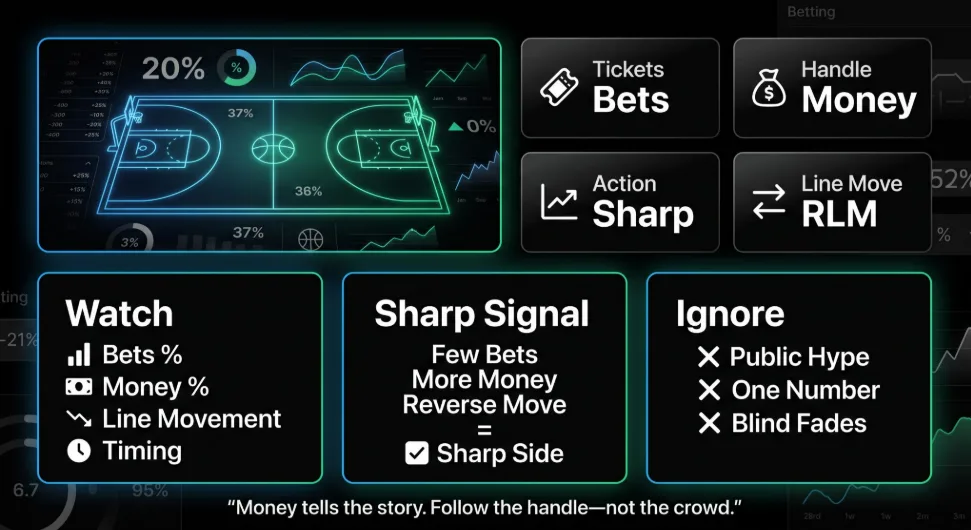
Public betting splits report two separate figures, and confusing them is the most common mistake. The percentage of bets, sometimes called tickets, counts how many individual wagers landed on each side. The percentage of money, or handle, measures how many actual dollars went each way.
The Action Network, which tracks these splits, defines them with a simple example: if 13,000 of 20,000 bets land on one team, that side has 65% of tickets. Money works differently, since a single $5,000 wager outweighs fifty $20 bets. One big bettor can hold a minority of the tickets and still control most of the handle.
Most of the time the two numbers track each other. If 70% of bettors back a team, roughly 70% of the money usually follows. The interesting games are the ones where the figures split apart, because that gap is the fingerprint of money behaving differently from the crowd.
What the Gap Between Them Reveals
A wide gap between tickets and money points to where the larger wagers are. Picture a WNBA game where the Aces draw 75% of the bets but only 45% of the money. That means a small number of bettors put serious dollars on the other side, and those bettors are usually the sharper ones the books watch.
The logic runs through bet size. Casual bettors spread thousands of small wagers across popular favorites, which inflates the ticket count without moving much money. A book reads a side with 80% of bets but 35% of the handle as a very public play, since the dollars are landing elsewhere. Professionals fire fewer but far larger bets, so their side shows up in the handle long before it shows up in the ticket percentage.
When you see a team with 20% of the bets but 50% of the money, the read is straightforward. The big money is fading the public, and the books are content to let the crowd pile onto the other side. Following the handle, not the ticket count, usually means standing with the sharper money.
Reverse Line Movement: The Strongest Signal
The clearest sign of sharp action is a line that moves against the crowd. If a team draws 70% of the tickets, the spread should normally climb in its favor. When the number moves the other way instead, money is overriding the public, and that pattern is called reverse line movement.
Picture a WNBA favorite opening at -3.5 with most tickets on it, then drifting to -1.5 as game time nears. The crowd kept betting the favorite, yet the price dropped, which means heavy money hit the underdog and pushed the line back. The books moved to balance their exposure against the larger wagers.
Reverse line movement only counts when nothing else explains it. A key injury, a rest day, or a lineup change can move a number for honest reasons, so rule those out first. Once you have, a line moving against the public is the market telling you where the confident money sits.
Why WNBA Lines Move Differently
WNBA betting handle runs far below the NBA, NFL, or college markets, and that thinner volume changes how lines behave. Books set lower betting limits on lower-volume games, so it takes less money to move a WNBA number than an NBA one. A wager that barely nudges an NFL spread can shift a WNBA line a full point.
That sensitivity cuts both ways for a bettor. A sharp move stands out more clearly in a thin market, since there is less public noise to bury it, so reverse line movement reads cleaner in the WNBA than in heavily bet leagues. The flip side is that a single recreational whale can also distort a number without any real information behind it.
Timing sharpens the read. Early line moves tend to come from professionals betting into soft opening numbers, while the hours right before tipoff fill with public money. Smart Bet Insider tracks WNBA line movement and the splits behind it so the signal stays separated from the noise. Check when a move happened, not just that it happened, before you read it as sharp.
How to Put It Together
Reading WNBA public betting is a sequence, not a single number. Start with the ticket percentage to see where the crowd leans, then check the money percentage for a gap that points to larger wagers. A team with far more money than tickets is the side worth a closer look.
Then watch the line itself. Confirm whether the number moved with the heavy money or against the heavy tickets, and pin down when the move happened. A line drifting toward the minority-ticket side in the hours after open is the strongest combination of signals you can find.
None of this replaces handicapping the game on its merits. Public betting data tells you what the market is doing, not which team will win, so treat it as one input among injuries, matchups, and rest. Compare the splits against your own read of the game, and keep stakes to a small share of your bankroll.
Frequently Asked Questions
What is WNBA public betting data?
WNBA public betting data shows how bettors are splitting their action on a game, reported as a percentage of bets and a percentage of money. The percentage of bets counts how many wagers land on each side, while the percentage of money tracks the actual dollars. Comparing the two reveals whether large bettors are taking a different side than the crowd.
What is the difference between bets and money percentages?
The bets percentage counts individual wagers, while the money percentage measures total dollars wagered, or handle. They usually move together, but a big gap signals that a few large bets are pulling the money one way while the ticket count sits elsewhere. That gap often points to sharper money.
What is reverse line movement in WNBA betting?
Reverse line movement happens when a betting line moves against the side getting most of the tickets. If a favorite draws 70% of bets but the spread drops anyway, heavy money hit the other side and pushed the number. It is one of the clearest signs that sharp money is opposing the public, once injuries and lineup news are ruled out.
Why do WNBA betting lines move so easily?
WNBA lines move easily because the league draws less betting handle than the NBA or NFL, and books set lower limits on lower-volume games. With less money in the market, a single large wager can shift a WNBA spread a full point. That makes sharp action easier to spot but also lets one big recreational bet distort a number.
Should I bet with or against the public in the WNBA?
Neither approach wins on its own, since the public is sometimes right and sometimes wrong. The more useful move is to follow the money percentage and line movement rather than the raw ticket count, because those track the larger, often sharper wagers. Public betting data is one input, not a substitute for handicapping the matchup yourself.