
The Biggest Prop Betting Day of the Year
The Super Bowl is the single largest sports betting event on the American calendar, and prop bets are where the majority of casual and sharp bettors alike find their action. In 2027, Super Bowl prop markets will span hundreds of individual wagers — from who scores the first touchdown to how long the national anthem runs. Most bettors treat them as entertainment. The ones profiting treat them as a market full of exploitable pricing mistakes.
Smart Bet Insider was built for bettors who want to do more than guess. With structured prop analysis, line movement tracking, and value-rated picks across player, game, and novelty markets, Smart Bet Insider gives you the framework to approach Super Bowl props the way sharp bettors do — with data, context, and a clear edge. Whether you’ve never placed a prop bet or you’re looking to sharpen your process, this guide covers everything you need for 2027.
What Are Super Bowl Prop Bets?
Prop bets — short for proposition bets — are wagers on specific events within a game rather than the overall outcome. Instead of betting on which team wins, you’re betting on whether a quarterback throws for over or under 275 yards, whether a specific receiver scores a touchdown, or which team scores first. Super Bowl props are available in greater volume and variety than any other single sporting event, with major sportsbooks releasing hundreds of individual markets in the week leading up to kickoff.
Props fall into two broad categories: player props and game props. Player props focus on individual performance — passing yards, rushing attempts, reception totals, and touchdown scores. Game props cover broader match events — first scoring play, total combined points, margin of victory, and coin toss outcomes. Understanding which category a bet belongs to is the first step, because each type requires a completely different research approach and carries very different variance profiles.
How Super Bowl Prop Odds Are Set
Sportsbooks set Super Bowl prop lines using a combination of season-long performance data, recent form, matchup analysis, and — critically — public betting tendencies. The Super Bowl attracts enormous recreational betting volume, which means books shade many prop lines to account for the predictable behavior of casual bettors who favor big names, skill position players, and high-scoring outcomes. This deliberate shading is where value gets created for bettors willing to look past the obvious picks.
Pinnacle, widely regarded as the sharpest sportsbook in the world, publishes Super Bowl prop lines that serve as a useful benchmark. When a prop line at a recreational book like DraftKings or FanDuel differs significantly from Pinnacle’s equivalent, it almost always reflects public money inflating one side — and that gap is frequently where the value sits. Smart Bet Insider tracks these cross-platform discrepancies as lines are released, flagging the props where the market has been moved by volume rather than information.
Super Bowl Props Are a Temporary Low-Efficiency Market Shock
Super Bowl Props as a Temporary Efficiency Breakdown
Super Bowl prop markets are often treated as an extension of normal NFL betting, but structurally they behave more like a temporary efficiency breakdown than a standard pricing environment. Research on sports betting market efficiency shows that inefficiencies emerge when pricing inputs become noisier, thinner, or heavily driven by bettor behavior rather than stable modeling — and the Super Bowl combines all three conditions at once.
Why Super Bowl Pricing Becomes Less Efficient
The Super Bowl creates a unique market condition: a massive expansion of micro-props around a single game. Sportsbooks release hundreds of correlated markets at once — player stats, scoring events, and novelty outcomes — forcing pricing models to operate across far more variables than usual, often with less precise calibration per prop.
The One-Game Variance Problem
Unlike regular-season markets, Super Bowl props are built on a single-game sample. This means there is limited direct historical repetition, so pricing relies more on matchup context and estimation than on stable frequency data. That increases variance and reduces model reliability.
Public Money Distortion
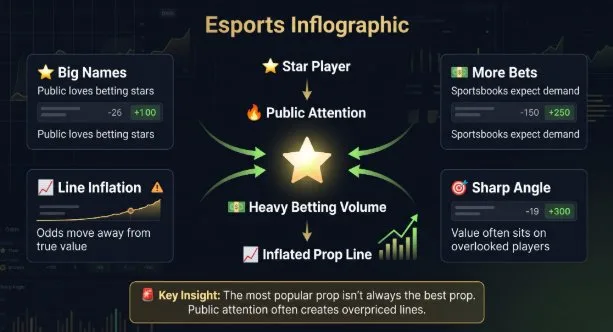
The Super Bowl also attracts extreme recreational betting volume. As a result, sportsbooks shade lines more aggressively on high-visibility players and popular outcomes, while less popular props remain closer to baseline probability.
Key Insight
Together, these factors create a short-lived “low-efficiency shock state” where prop pricing becomes less precise not due to permanent flaws, but due to scale, attention, and variance overwhelming standard modeling assumptions.
The Public Money Trap: Why Popular Props Are Usually Bad Value
Every Super Bowl, the same pattern repeats itself: the most-discussed skill players see their prop lines shaded significantly against bettors who back them. A star wide receiver who has dominated headlines all season will have his reception total set half a catch higher than the data supports, simply because sportsbooks know the public will bet him regardless. This is what sharp bettors call the “Superstar Tax” — the hidden cost built into popular player props that quietly erodes expected value before you’ve placed a single bet.
The antidote is straightforward: prioritize props on players the public isn’t watching closely. Second receivers, tight ends in run-heavy offenses, defensive player props, and team-level rushing totals are consistently underpriced relative to their actual probability because recreational bettors don’t gravitate toward them. As the low-efficiency shock framework above makes clear, the props least touched by public money are precisely the ones where sportsbook models are operating closest to their actual probability estimates — and where value is most reliably found.
How to Research Super Bowl Props Like a Sharp Bettor
The foundation of solid prop research is understanding the specific matchup context driving each number. A quarterback’s passing yard total isn’t just a function of his season average — it’s a function of the opposing defense’s coverage scheme, the game script likely to unfold based on the spread, and the weather conditions at the venue. A game with a low total in cold conditions should immediately make you skeptical of high passing yard props for both quarterbacks, regardless of what their regular season numbers look like.
For player props specifically, Pro Football Reference and Next Gen Stats provide the underlying performance data needed to evaluate whether a line is set fairly. Cross-reference target shares, snap counts, and red zone usage to assess whether a receiver’s touchdown prop is priced correctly given how often they’re actually involved in scoring situations. Smart Bet Insider’s Super Bowl prop breakdowns do this work systematically across every major player market, delivering value-rated picks with the research already baked in.
Smart Bet Insider: Your Edge Across Every Super Bowl Market
The volume of Super Bowl prop markets is both an opportunity and a trap. With hundreds of lines available, undisciplined bettors scatter their bankroll across too many bets at poor value — treating props as lottery tickets rather than investments. Smart Bet Insider’s approach is the opposite: a focused, research-driven selection of the highest-value props across player, game, and novelty markets, each rated by confidence tier so you know exactly where to put your money.
Members receive a full Super Bowl prop guide in the week before kickoff, covering line movement analysis, public money flags, sharp-side indicators, and specific value picks with clear reasoning. From first touchdown scorer to game script props and team totals, every recommendation is backed by the same structured analysis Smart Bet Insider applies year-round. Follow Smart Bet Insider today and make sure your 2027 Super Bowl card is built on intelligence, not instinct.
Stop Guessing, Start Researching
Super Bowl props in 2027 will offer more betting opportunities than any previous year — and more traps for bettors who approach them without a framework. The Superstar Tax, public money shading, novelty market margins, and line movement all work against the unprepared bettor. But for those who know where to look, what data to use, and how to read the market, Super Bowl prop week is one of the most exploitable betting environments of the entire year.
Smart Bet Insider exists to hand you that framework, backed by the same structured analysis that drives value picks across esports, NFL, and international markets year-round. Follow Smart Bet Insider now and go into Super Bowl 2027 with the sharpest prop card you’ve ever built.
FAQs
1. What is the difference between a prop bet and a regular bet?
A regular bet — also called a moneyline or spread bet — is wagered on the overall game outcome. A prop bet is wagered on a specific event within the game, such as a player’s statistical performance, which team scores first, or novelty outcomes like the coin toss result. Super Bowl prop markets are the largest and most varied of any single game in sports.
2. When do Super Bowl prop lines come out?
Most major sportsbooks release initial Super Bowl prop lines in the days immediately following the conference championship games. Lines are updated continuously in the week leading up to the game as injury news, public betting volume, and sharp money shape the market. Early lines often represent the best value before public money moves them.
3. Which sportsbooks have the best Super Bowl prop markets?
DraftKings, FanDuel, and BetMGM offer the widest variety of prop markets for casual bettors. Pinnacle offers the sharpest lines and is the best benchmark for identifying value at recreational books. Use an aggregator like Oddschecker to compare props across platforms before placing.
4. What are novelty props and are they worth betting?
Novelty props cover non-game events such as the coin toss, national anthem duration, halftime show outcomes, and Gatorade bath color. These markets are set with wide margins and limited data, making them difficult to beat consistently. They’re best treated as low-stake entertainment rather than serious value opportunities — save your bankroll for player and game props where research creates a genuine edge.
5. How do I spot a mispriced Super Bowl prop?
Compare lines across multiple books using Oddschecker and benchmark against Pinnacle. A prop that differs significantly from the sharpest book’s line, without a clear injury or news-driven reason, is often mispriced due to public money. Props on less prominent players — second receivers, fullbacks, defensive contributors — are the most consistently mispriced category every year.
6. How much should I bet on Super Bowl props?
Even with strong research, prop bets carry significant variance due to the sample size of a single game. A conservative approach of 1–2% of total bankroll per prop is recommended, with a hard limit on the total number of bets placed. Placing twenty small, well-researched bets is far more disciplined — and more profitable long-term — than placing five large bets on high-profile players.
7. Can I parlay Super Bowl prop bets?
Yes, and many sportsbooks actively promote prop parlays for the Super Bowl. However, parlaying props dramatically increases variance and hands the book a compounding edge on each leg. Sharp bettors treat props as individual bets evaluated on their own merits. If you do parlay, limit it to two or three legs maximum and ensure each leg represents genuine independent value rather than entertainment picks bundled together.