

Introduction: The Most Beatable Market in American Sports Betting
College football is the most structurally exploitable major betting market in the United States — and most bettors treat it exactly like the NFL, which is precisely why they keep losing. The sheer volume of games, the wide talent gaps between programs, and the heavy reliance on brand recognition over data make NCAAF lines softer and more exploitable than anything the NFL offers on a weekly basis. The bettors profiting from college football aren’t luckier than everyone else — they’re using a different framework entirely.
Smart Bet Insider was built for bettors who want that framework. With team-level efficiency analysis, line movement tracking, situational betting models, and weekly value picks across the full college football slate, Smart Bet Insider gives you the structured approach needed to profit from a market that rewards preparation and punishes the public. Whether you’re placing your first college football bet or tightening a strategy that’s already in motion, this guide covers the fundamentals and the advanced angles that hold up across a full season.
How College Football Betting Lines Are Set
Sportsbooks set college football lines using power ratings, recent performance, and expected public betting behavior. As noted in the micro-market framework, this shading is uneven: it is stronger on brand-name programs and weaker in lower-visibility G5 games with less sharp action. Blue-chip teams often see spreads inflated by one to two points due to public bias, even when matchup data suggests otherwise.
This systematic shading is the foundation of college football betting value. Pinnacle, the sharpest book in the world, consistently publishes college football lines that diverge meaningfully from recreational books like DraftKings and FanDuel on high-profile matchups — and those gaps almost always reflect public money inflating the popular side. Using Oddschecker to monitor these cross-platform discrepancies is one of the highest-leverage habits any college football bettor can develop, because the gaps are wider and more frequent than in any other major sport.
Public Bias vs True Market Efficiency: CFB Is Systematically Skewed
The Myth of “The Public”
One of the most misunderstood aspects of college football betting is the idea that “the public” is a uniform force that simply moves lines off true numbers. In reality, pricing is shaped by program-based perception before markets even open. Blue-chip and historic programs are often baked into power ratings, creating pre-shaded spreads independent of early action. Public bias in college football is program-driven, and recognizing that distinction is key to long-term betting strategy.
Conference Bias and Built-In Inflation
Teams from high-profile conferences — SEC, Big Ten, and Big 12 — consistently attract inflated spreads because sportsbooks anticipate disproportionate recreational betting interest, while Group of Five programs are frequently underweighted unless they appear in ranked matchups. Academic research on sports betting market efficiency supports the idea that informational efficiency breaks down more frequently in lower-visibility or high-emotion environments, where participant heterogeneity is higher and pricing signals are noisier — and in college football, that heterogeneity is extreme.
Market Sharpness Varies by Game Type
Market sharpness also shifts dramatically by game type: top-25 matchups tend to attract more professional attention and tighter lines, while G5 vs P5 games regularly exhibit softer pricing due to reduced sharp participation, and rivalry games carry a third distortion layer where emotional narrative inflation routinely skews both spreads and totals beyond what the underlying matchup data supports.
College Football as a Layered Market System
College football is not a single efficient market — it is a stack of overlapping micro-markets, each with different levels of sharpness, bias, and liquidity, and understanding which layer you are betting into is often more important than the pick itself.
Fundamentals: What Every College Football Bettor Needs to Know
The spread, the moneyline, and the total are the three core bet types in college football, and understanding how each behaves in this specific market is the starting point for any profitable strategy. Spread betting — wagering on whether a team wins by more or fewer points than the listed margin — is where the majority of sharp college football action concentrates, because it is the market where sportsbook models are most stretched across the sport’s enormous game volume. With hundreds of games per week, books cannot calibrate every line with the same precision they apply to a twelve-game NFL slate.
Totals — over/under bets on combined scoring — are a key college football market. Unlike the NFL’s more stable scoring, college football has wide variation in pace and style by program. An Air Raid offense against a triple-option defense creates a very different scoring environment than two pro-style teams in a defensive rivalry game. Using ESPN’s college football team stats alongside efficiency metrics from SP+ rankings at Football Outsiders gives you the baseline context needed to evaluate whether a total is set in line with what the specific matchup actually projects.
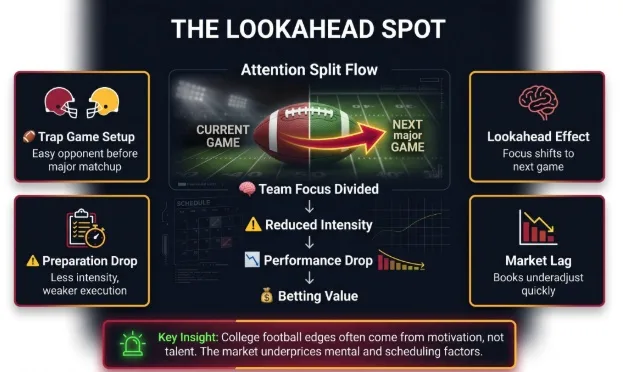
The Lookahead Spot: College Football’s Most Reliable Edge
A trap game — specifically a “lookahead spot” — occurs when a team faces a manageable opponent ahead of a major rivalry game, championship, or playoff matchup. In these situations, focus and preparation can be split, but sportsbooks often fail to fully adjust for that reduced intensity in their lines.
The Lookahead Spot is most reliable when three conditions align: the upcoming game is objectively more important than the current one, the current opponent is a mid-tier team that won’t generate media pressure for a close game, and the favored team is coming off a high-effort physical performance the previous week.
Research on psychological momentum and competitive focus in sports supports the idea that motivational variance is a genuine performance factor — and in college football, where player maturity and coaching bandwidth are far more limited than in professional sports, that effect is amplified significantly. Smart Bet Insider flags Lookahead Spots across the full weekly slate every Friday, giving members a clear situational edge before lines tighten into the weekend.
Advanced Strategy: Line Shopping, Key Numbers, and Market Timing
Line shopping — comparing odds across sportsbooks before placing a bet — is one of the highest-return habits in college football betting. Unlike the NFL, where sharp action quickly standardizes lines, college football’s volume of games and weaker modeling on lower-profile matchups allows discrepancies to persist longer before being corrected. Holding accounts at three to five books and checking Oddschecker before every bet adds measurable value over a full season without requiring any additional analysis.
Key numbers matter more in college football than in the NFL due to the sport’s wider scoring distributions and more frequent blowouts. The numbers three, seven, ten, fourteen, and seventeen are the most common final margins, making half-point purchases around these figures — moving from -3 to -2.5, or from +7 to +7.5 — genuinely valuable in close matchups. OddsPortal’s college football historical data allows you to review how often specific spreads have covered historically, which gives empirical grounding to key number decisions rather than relying on intuition. Smart Bet Insider’s weekly picks identify the specific games where key number positioning and market timing intersect to create the clearest value on the board.
Strategy Beats Volume Every Time
College football betting rewards the disciplined and punishes the impulsive — not because it’s harder than other markets, but because the sheer volume of games makes undisciplined bettors overextend while prepared bettors pick their spots carefully. The Lookahead Spot, line shopping, key number awareness, and efficiency-based handicapping are not complicated concepts. They are simply frameworks that hold up across a full season because they are grounded in how the market actually prices college football, not how fans want to bet it.
Smart Bet Insider delivers those frameworks every week of the season — with the picks, alerts, and analysis needed to act on them before the market corrects. Follow Smart Bet Insider now and build a college football betting strategy that doesn’t just work in week one — it holds up through January.
FAQs
1. Why is college football considered easier to beat than the NFL?
College football lines are set across a far larger game volume than the NFL, meaning sportsbook models are less precisely calibrated per game. Public betting behavior is also more predictable — fans back popular programs regardless of the spread — creating systematic line shading that sharp bettors can exploit. The talent gap between programs is also wider than in the NFL, creating more situations where efficiency metrics diverge significantly from reputation-based pricing.
2. What is the most important stat to look at for college football betting?
SP+ ratings, available at Football Outsiders, are the most predictive single efficiency metric for college football outcomes. SP+ accounts for opponent strength, pace, and garbage-time scoring in a way that raw points-per-game figures do not. Cross-referencing SP+ with recent form and situational context gives you a more reliable foundation for spread and total evaluation than any single conventional statistic.
3. How do I identify a trap game in college football?
Look for a favored team facing a moderate opponent sandwiched between two high-stakes games — a rivalry, a conference title race, or a playoff qualifier. Add recency of a physically demanding previous game and a current opponent unlikely to generate significant media attention for an upset, and the Lookahead Spot framework applies. Smart Bet Insider flags these situations every week before lines fully adjust.
4. Which sportsbooks are best for college football betting?
DraftKings and FanDuel offer the widest market variety and frequent line boosts on popular games. Pinnacle is the sharpest benchmark for evaluating whether a line represents genuine value. BetMGM is worth including for line shopping on lower-profile conference games where discrepancies persist longest.
5. What are key numbers in college football and why do they matter?
Key numbers are the most common final point margins in college football — primarily three, seven, ten, fourteen, and seventeen. When a spread sits on or near a key number, the half-point on either side of it carries meaningful value because it determines whether a push becomes a win or a loss at the most frequent margins. Paying the extra juice to buy off a key number is often mathematically justified in close, evenly matched games.
6. Is it worth betting college football totals?
Yes — college football totals are among the softest markets on the board for bettors who understand pace and style matchups. Books set totals primarily on scoring averages without fully adjusting for the specific offensive and defensive system interaction in a given game. Air Raid versus Air Raid matchups, triple-option teams, and defensive-minded programs all create structural total environments that diverge from average-based pricing.
7. How should I manage my bankroll across a college football season?
A flat-stake model of 1–2% of total bankroll per bet is recommended across a full season. The college football schedule is long enough that variance evens out over time, but individual weeks can produce multi-game losing streaks even with sound process. Never increase stake size to chase losses after a bad week — the volume of games means the next value opportunity is always close, and preserving bankroll to act on it is more important than recovering quickly.