
A System So Elegant the House Cannot Lose
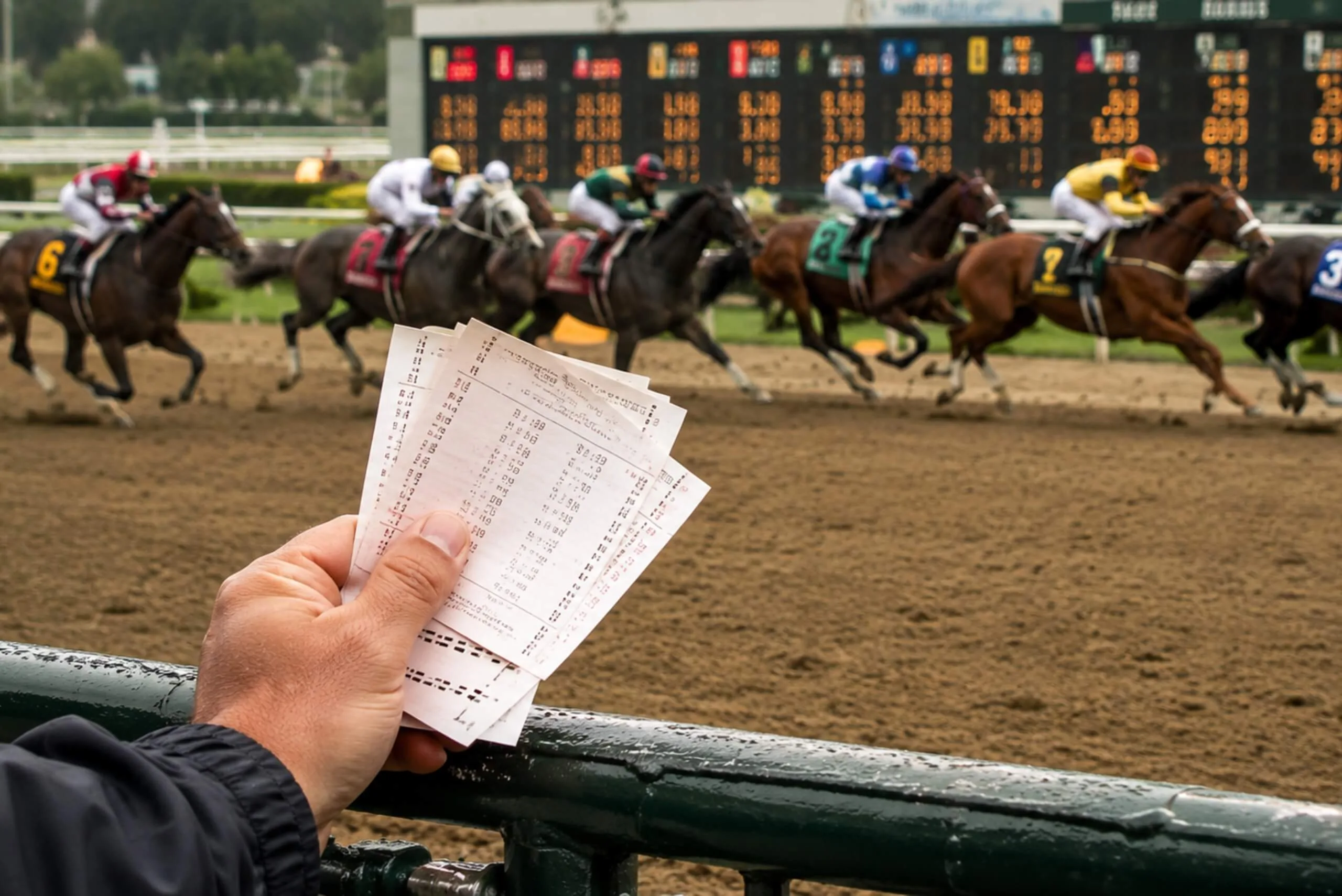
Most gambling systems require the house to take a position on an outcome. A casino pays out on roulette whether the ball lands on red or black. A sportsbook wins or loses depending on which team covers. Pari-mutuel betting, the system that governs virtually all horse racing wagering in North America, works differently. In theory, the house cannot lose with a pari-mutuel system. Because the returns can never, by definition, be greater than the total stakes, the risk is entirely removed and the house, barring gross mismanagement, cannot lose.
Understanding why requires understanding the arithmetic underneath every race — an arithmetic that has been quietly extracting value from bettors since a French impresario invented the system in the 1860s, and that remains the financial engine of the sport of kings to this day.
The Origin: A Frenchman Solves a Bookie Problem
Why Fixed Odds Failed at the Track
Before pari-mutuel betting arrived, horse racing was governed by fixed-odds bookmakers — individuals who set prices on each horse and personally guaranteed those prices to every bettor. The system had a fundamental flaw: when a long shot won at 50-to-1 and many people had backed it, the bookmaker could face catastrophic losses.
French businessman Joseph Oller introduced pari-mutuel betting in the 1860s as a way to provide a fair and transparent betting system for horse racing, replacing the traditional method of bookmaking where bookmakers set fixed odds for each horse. This new system allowed bettors to wager against each other, with the odds dynamically determined by the total amount of money wagered on each horse.
The Moulin Rouge Connection
The pari-mutuel system was invented by Joseph Oller — founder of the famous Moulin Rouge — in 1867, and it was eventually adopted by French racetracks in 1891. The same man who built Paris’s most famous cabaret also built the financial architecture that would power horse racing globally for the next century and a half. An important innovation in pari-mutuel betting came in the 1920s with the development of the totalizator, a mechanical device for issuing and recording betting tickets. Modern totalizators, usually computers, calculate betting pools and current odds on each horse and flash these figures to the public at regular intervals.
How the Pool Actually Works
Bettors Against Bettors, Not Against the House
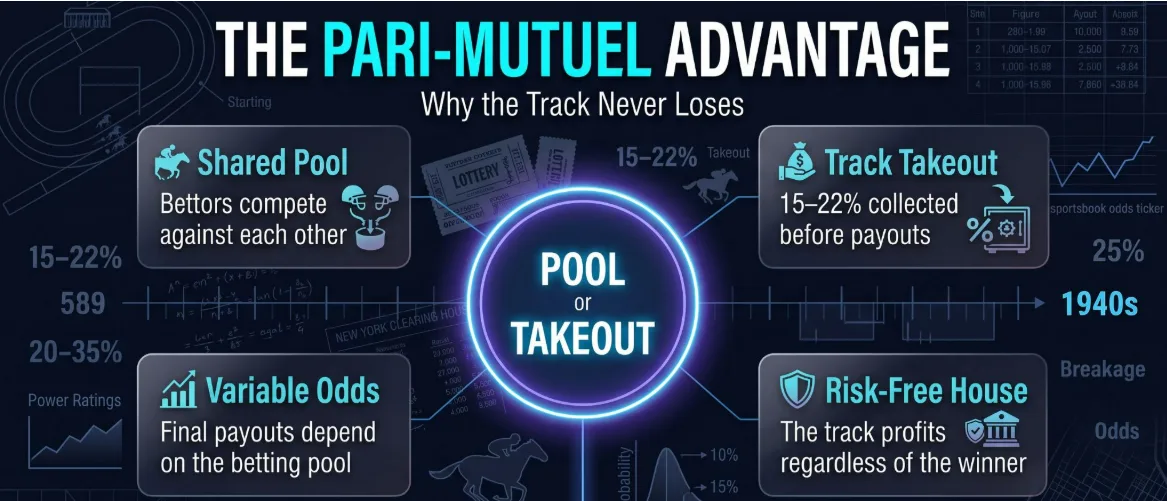
Pari-mutuel wagering means, literally, a mutual wager or “betting among ourselves.” It is similar to a stock transaction. When you buy a $2.00 ticket on a horse you are, in effect, buying one share in the horse’s performance in the race. The race track merely acts as the broker for the transaction and deducts a commission fixed by the state and shared by the state, track, and horsemen. The track’s takeout remains the same, regardless of whether a favorite or a longshot wins.
The Math Behind a Single Race
The process is straightforward once you see it in sequence. All bets on a race of a given type — win, place, or show — go into a single pool. A house commission to cover taxes, expenses, and profits is deducted from the pool. This is called takeout and usually amounts to 15 to 22 percent of the pool, depending on the track and the type of bet. Payoffs are calculated by sharing the remaining pool among all the people who placed bets on the winning horse. The key insight is that the track’s revenue is fixed before the race starts. It does not matter which horse wins. The commission was already collected.
The Takeout: Where the Track’s Profit Lives
Two Layers of Extraction
The takeout is the most visible form of track revenue, but it is not the only one. The return to bettors varies from 70% to 85% of each dollar wagered and is always legislated. The takeout for straight wagering is usually 17-20% and is always legislated. Exotic wagering is often more, with a 20-35% range depending on the type of wager, the track, and the state racing bill.
Breakage: The Hidden Tax on Every Winning Ticket
Underneath the takeout sits a second, less visible mechanism. North American horse racing does not break to the penny, but in most cases to the nearest dime on every dollar. Serving as an additional rake on winning bets, breakage increases the effective takeout to near 20% or higher in some jurisdictions, reducing the return to bettors and thus reducing the amount of money that could be churned back into the pools. In the case of the Preakness, Pimlico has an 18 percent win takeout. But when you factor in the amount of money withheld for breakage, the effective takeout becomes about 20.69 percent for that particular race.
Why Horse Racing Still Uses Pari-Mutuel Betting
A System Built for Stability
Given the popularity of fixed-odds sports betting, it is natural to wonder why horse racing never fully abandoned the pari-mutuel system. The answer lies in both economics and regulation. Unlike sportsbooks, which accept financial liability on every wager, pari-mutuel racetracks never bet against their customers. Because payouts depend entirely on the size of the pool, the operator cannot suffer catastrophic losses if an overlooked long shot wins.
That stability made pari-mutuel wagering attractive to regulators, who viewed it as a transparent system that reduced insolvency risk while simplifying oversight, auditing, and tax collection. Rather than guaranteeing odds, the track simply administers the pool and collects its commission before the race begins. This framework became the standard model for horse racing throughout North America and remains required in many jurisdictions today. (Legal Information Institute)
Why Fixed Odds Are Slowly Gaining Ground
Horse racing also presents challenges that traditional sportsbooks rarely face. Field sizes vary from race to race, horses can be scratched minutes before post time, and a significant percentage of wagering arrives just before betting closes. With pari-mutuel wagering, the odds change as money enters the pool. Computer-assisted wagering can push bets through to pari-mutuel pools at up to six bets per second in the final minute before pools close, causing a horse’s odds to fall dramatically — from 8-1 as they are loading into the gate to 3-1 as the race unfolds.
Fixed-odds betting eliminates that frustration by locking in a price at the time the wager is placed. Four states have authorized fixed-odds horse racing betting to date: Colorado, Kentucky, New Jersey, and West Virginia, and rather than replacing the pari-mutuel pools, these systems coexist alongside them, allowing bettors to choose between locking in a guaranteed price or accepting the variable payout determined by the market.
The Takeout Debate: Does the Track Charge Too Much?
A Hidden Cost Compared to Other Gambling
Slot machines often charge between five and nine percent. Sports betting takeout hovers around five or six percent in mature markets. Given the state of play in racing today, it might finally be time to reconsider how we charge customers. The typical horse racing takeout of 17-20% on straight bets sits three to four times higher than the margin built into most regulated sports betting markets, making long-term profitability substantially harder for the regular horseplayer.
The Economic Logic of Lowering the Take
McKinsey & Company found that pari-mutuel revenues are very responsive to changes in the effective takeout rate. In economic terms, the demand for wagering is found to be highly elastic with respect to the “price” of a typical wager. This result indicates that pari-mutuel revenues can be enhanced by reducing the current effective takeout rate. The irony of the takeout debate is that lowering it — returning more to bettors — would likely generate more total revenue for the track, as bettors with more money to re-wager produce higher overall handle.
The Purest House Edge in Gambling
Pari-mutuel betting is not a bet against the track. It is a bet against every other person at the window, net of a commission that the track collects regardless of what happens in the race. The track retains a flat percentage from each wagering pool, known as the takeout. After winning bets are set aside and returned to their investors and takeout is removed from each wagering pool, the remainder of the pool is paid out on all winning bets. The genius of the system is structural: the track’s profit is locked in the moment a bet is placed, not the moment a race is run. No favorite is too dominant to threaten it. No long shot is too explosive to exceed it. The house edge in pari-mutuel betting is not a statistical approximation — it is a mathematical certainty, built into every ticket sold.
FAQs
What does pari-mutuel mean?
The term “pari-mutuel” comes from “parier mutuel,” a French phrase meaning “mutual betting.” French bookmaker Joseph Oller invented the system in the 19th century. In pari-mutuel betting, every bettor contributes to a shared pot, and the racetrack deducts a small percentage called the takeout before paying winners.
How does the track make money in pari-mutuel betting?
The race track merely acts as the broker for the transaction and deducts a commission fixed by the state and shared by the state, track, and horsemen. The track’s takeout remains the same, regardless of whether a favorite or a longshot wins. This is what makes the system structurally risk-free for the track — revenue is generated before the race begins, not after.
What is the takeout rate in horse racing?
Takeout usually amounts to 15 to 22 percent of the pool, depending on the track and the type of bet. Exotic wagering is often more, with a 20-35% range depending on the type of wager, the track, and the state racing bill. This is substantially higher than most other legal forms of gambling.
What is breakage in pari-mutuel betting?
Breakage is the difference between what horseplayers should receive on a winning bet and what they actually receive — a rounding down of a winning dividend to present a tidy payout. North American horse racing does not break to the penny, but in most cases to the nearest dime on every dollar, serving as an additional rake on winning bets and increasing the effective takeout to near 20% or higher in some jurisdictions.
Why do pari-mutuel odds change before a race?
Pari-mutuel wagering involves frequent odds changes as the action flows toward or away from individual horses. A horse priced at 6-1 the morning of a race can easily shift to 2-1 by post time if a lot of action comes in. Track oddsmakers post the morning-line odds ahead of the race, but that’s just a projection — ultimately, the betting public determines the final price of every horse.
Is fixed-odds horse racing betting available in the US?
Yes, and it is growing. Colorado, Kentucky, New Jersey, and West Virginia have authorized fixed-odds horse racing betting, with licensed online sportsbooks permitted to offer it alongside traditional pari-mutuel pools. Rather than replacing the tote system entirely, these fixed-odds markets coexist with pari-mutuel wagering, giving bettors a choice between locked-in prices and the variable pool-based payouts the sport has used for over a century.
Why is long-term profitability so difficult in pari-mutuel betting?
Sports betting takeout hovers around five or six percent in mature markets, while slot machines often charge between five and nine percent. In racing, the cost of betting — takeout — has increased rather than decreased to meet competition. With a typical takeout of 17-20% before breakage, a horseplayer must overcome a significantly larger structural disadvantage than bettors in virtually any other legal gambling market.