
Point shaving is when a player on a favored team deliberately holds the winning margin below the betting spread, letting his team win while a bettor cashes against the number. Economists have argued for two decades over how often it happens, and they still disagree. That argument is the real story, because a scheme designed to hide inside a victory leaves almost nothing for investigators to find.
The mechanic is simple, but proving it after the fact rarely is. A player can miss a free throw or ease off on defense in ways that look like an ordinary bad night. Smart Bet Insider covers the integrity side of sports betting, including the schemes that distort outcomes. The sections below explain how point shaving works, the cases that exposed it, and why most of it likely never surfaces.
How the Scheme Works
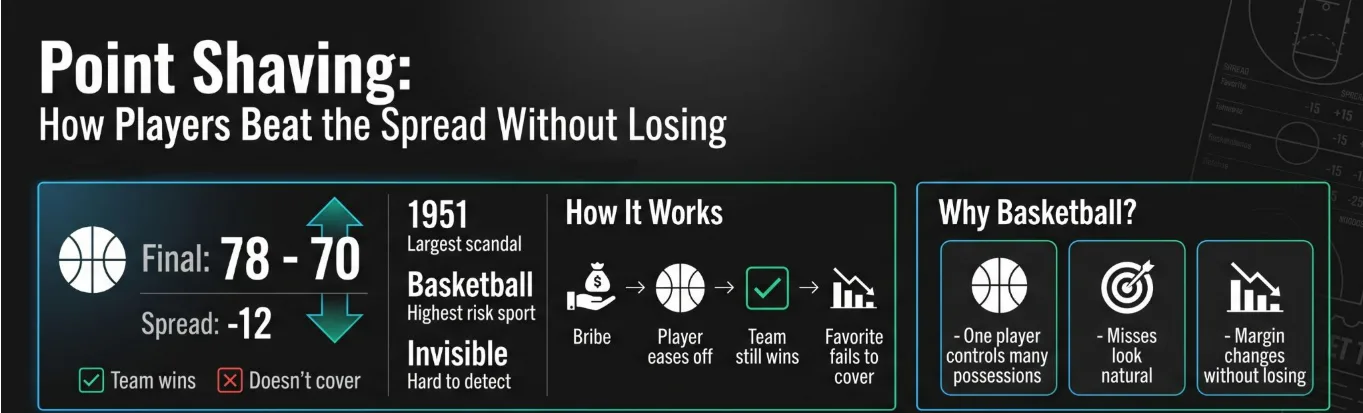
Point shaving runs on the spread, not the result. A sportsbook posts a favorite to win by a set number, and a bettor who wagers against that margin needs the favorite to win by less. A player paid to keep the score down delivers exactly that, and his team still walks off with the win.
A corrupt gambler supplies the bribe and places the bets. The player does not have to lose, only to control the gap, which is why the pitch has worked on athletes for decades. He can tell himself the team still won, and the scoreboard backs him up.
The scheme needs a wide spread to function. A favorite laying 12 points gives a shaver room to trim the margin without losing outright. A tight line offers almost no cushion, so fixers hunt for lopsided games where a few plays decide whether the favorite covers.
Why Basketball Is the Natural Home for It
Basketball suits point shaving better than any other sport. A game runs dozens of possessions, and a single player handles the ball constantly, scores often, and defends on every trip down the floor. One man can swing a margin without a teammate noticing.
The control hides in plain sight. A missed jumper, a lazy closeout, a turnover in transition all read as a rough night rather than a fix. Arizona State guard Stevin Smith later admitted he shaved by easing off on defense, the part of the game nobody studies on film.
Football and baseball spread that control across a roster, which is why hoops dominate the case history. A basketball star can bend a final margin alone, on his own shots and his own defense, while staying inside the range of an off night.
The Cases That Defined It
The 1951 scandal set the scale. Investigators found that 32 players across seven schools, including national power City College of New York, had fixed games between 1947 and 1951. CCNY had just won both the NCAA and NIT titles in 1950, and the fallout drove the program down to Division III.
Boston College brought in the mob. During the 1978-79 season, gangster Henry Hill, later the central figure in Goodfellas, ran a scheme with player Rick Kuhn across nine games. Kuhn drew a 10-year sentence, the heaviest in point-shaving history, later cut to 28 months.
Arizona State showed the money. Star guard Stevin Smith and teammate Isaac Burton took thousands to fix four games in 1994, with Smith collecting $20,000 on a single game against Oregon. A problem gambler, Smith jumped in to clear his own debts and drew a year in jail.
Why It’s So Hard to Catch
The detection problem is real enough that economists cannot settle it. Justin Wolfers analyzed NCAA basketball betting data from 1987 to 2003 and found favorites failed to cover the spread just often enough to suggest point shaving touched around 6% of favored teams, arguing that strong teams missed the spread a bit too often for it to be mere chance. His paper landed like an accusation against the whole sport.
The rebuttal hit just as hard. Dan Bernhardt and Steven Heston reanalyzed the same patterns and argued the skew came from coaching strategy in blowouts, not corruption, since teams pull starters and ease off once a game is decided. After millions of calculations, neither side could prove what actually happened in any specific game.
The gap between estimates and arrests tells the story plainly. One academic study put the likely range at 10 to 30 compromised games a season, while the NCAA has detected point shaving in roughly one team-season per decade. A scheme built to look like a bad night mostly succeeds at looking like one.
How Detection Works Now
Modern detection leans on the betting market itself. Sportsbooks and integrity firms watch for line movement that public wagering cannot explain, and a sharp wave of money against a favorite’s margin flags a game for review. The same market that pays the fixer records his footprint.
Federal enforcement still lands. In January 2026, the Justice Department charged 26 people in a bribery and point-shaving scheme across NCAA and Chinese Basketball Association games, proof the scheme survived into the legal-betting era. The bribery charge carries up to five years, and the wire-fraud counts reach twenty apiece.
Legal sports betting widened the opening and funded the systems that watch for it. Smart Bet Insider tracks integrity monitoring, betting-line anomalies, and the cases that shape how leagues respond. Read the analysis before you trust a line that moves against the obvious.
Frequently Asked Questions
What is point shaving?
Point shaving is when a player on a favored team intentionally keeps the winning margin below the betting spread while still winning the game. A corrupt gambler bets against the favorite covering and bribes the player to hold the score down. It differs from game-fixing, where a player tries to lose outright.
How common is point shaving?
No one knows for certain, which is the core of the problem. Economist Justin Wolfers estimated that roughly 1% of college basketball games showed signs of point shaving, while other researchers dispute that the patterns prove anything. Detection runs far below the estimates, at about one team-season per decade in the NCAA.
Why is point shaving so hard to detect?
Point shaving hides inside a win, so a shaved game looks like a favorite playing down to a weaker opponent. A missed shot or soft defensive possession reads as a normal off night rather than a fix. Proving intent usually requires wiretaps, bank records, or a player’s confession rather than the box score.
Which sport sees the most point shaving?
College basketball accounts for nearly every major point-shaving case in U.S. history. A single player controls the ball, scores, and defends on most possessions, so he can shift a margin without help. The biggest cases include City College of New York in 1951, Boston College in 1978-79, and Arizona State in 1994.
Is point shaving illegal?
Yes. Point shaving is prosecuted as sports bribery and wire fraud under federal law, not as a minor gambling violation. A bribery-in-sporting-contests charge carries up to five years in prison, while accompanying wire-fraud counts can reach twenty years each. The organizing gamblers typically draw heavier sentences than the players.