
A Daily Bet That Built an Empire in Plain Sight
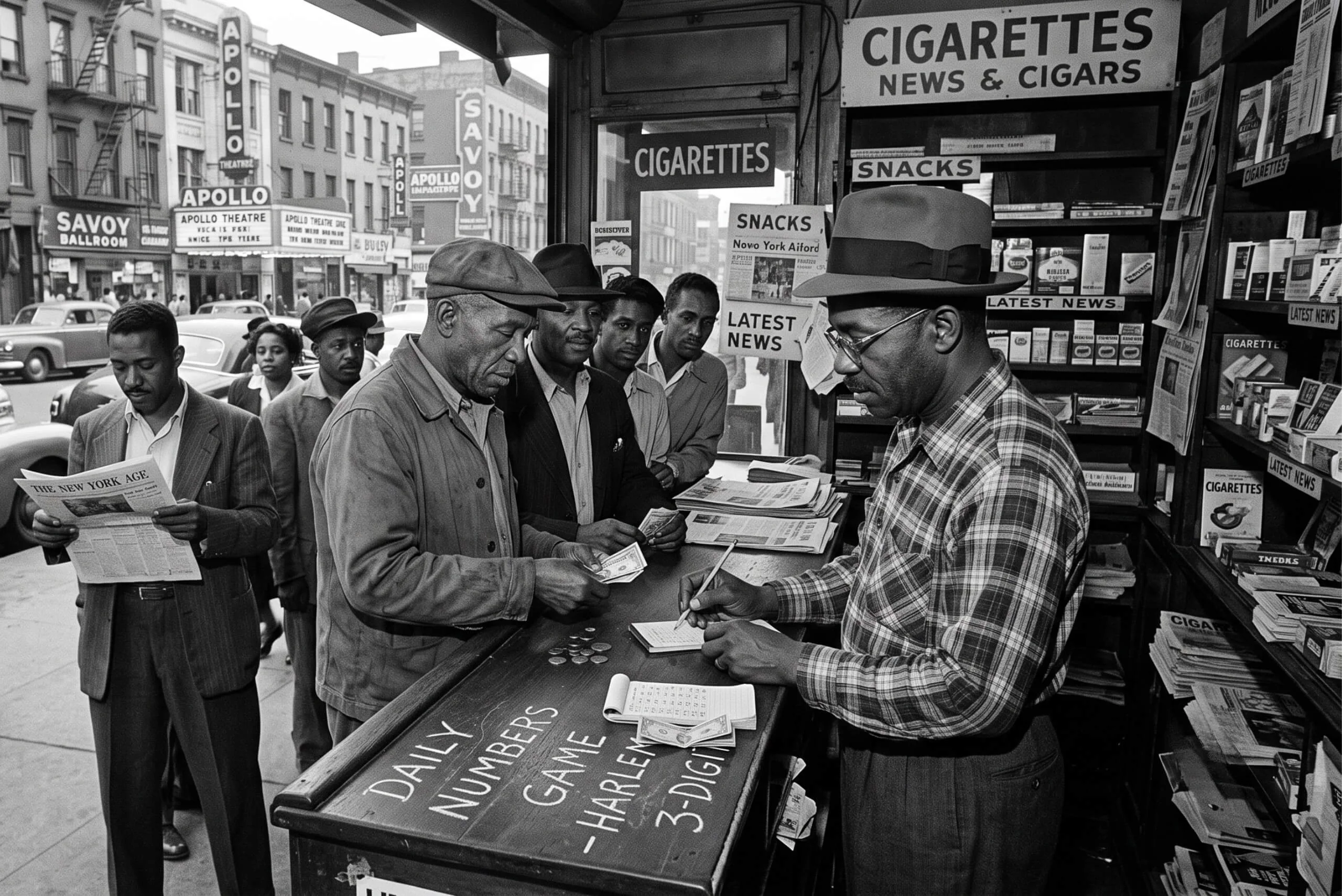
The Numbers game has always been illegal. It was invented in Harlem, New York City, about a century ago, 40 years before legal state lotteries. Bets were taken in person then, and players gambled on digits drawn from unpredictable clearinghouse totals, the records of exchanges of money between banks. For most of the twentieth century, the Numbers was the most widely played illegal gambling operation in America — not a shadowy underworld enterprise but a daily ritual woven into the fabric of city life, played in barbershops, candy stores, and factory floors from Harlem to Detroit.
Until that time, the local numbers runner was a familiar figure in black neighborhoods throughout the United States, especially in Harlem, and daily street life was often organized around placing bets and collecting winnings. Understanding how the game worked mathematically reveals why it survived for decades, why the house never lost, and why the communities that built it were ultimately displaced by the very state governments that had once declared it criminal.
How the Game Worked
Picking Your Number
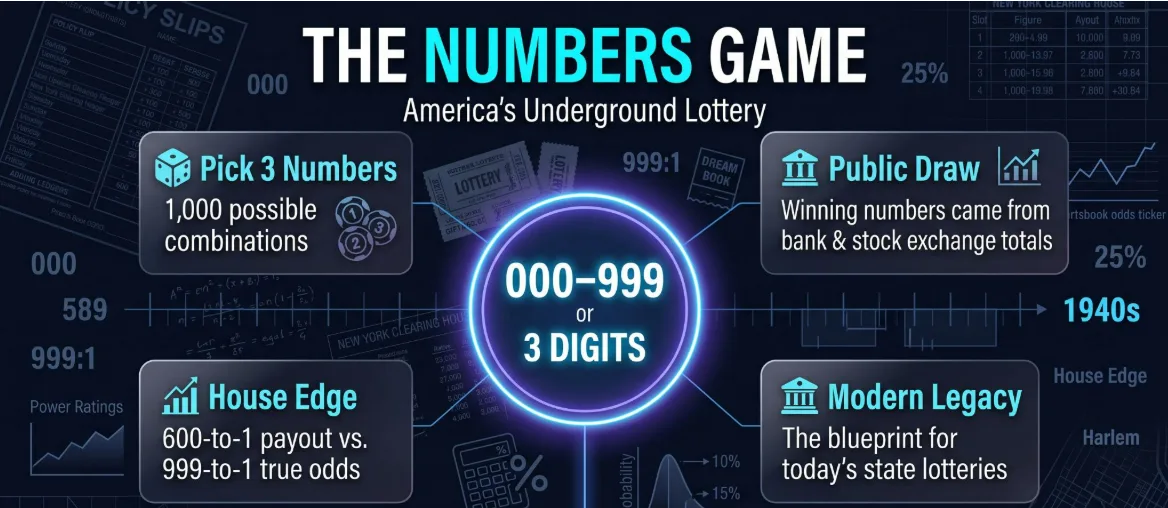
The mechanics were elegantly simple. The policy game involved bettors selecting a three-digit number between 000 and 999 and wagering small sums, often a nickel or dime, recorded on slips known as policy slips. Bets were placed at informal neighborhood outlets such as barbershops, groceries, or social clubs, then collected daily by runners who delivered them to a central banker for tabulation and payout funding.
Where the Winning Number Came From
The key innovation that made the Numbers trustworthy in the eyes of its players was its transparency. The winning number was derived from publicly available financial data to ensure verifiability and prevent manipulation, typically the last three digits of the New York Clearing House daily clearings — such as $589,000,000 yielding 589 — or a combination incorporating the Federal Reserve Bank balance. Later, racetrack handle totals and stock exchange figures served the same purpose. By the 1920s, rather than using lotteries, the results of which could be easily manipulated, bankers drew the winning result from the last three digits of the total volume of the daily New York Stock Exchange trades.
The Arithmetic Behind the House Edge
Why the Odds Were Always Against the Bettor
There are exactly 1,000 possible three-digit combinations from 000 to 999. A fair payout for picking the correct one would be 999-to-1. Different policy banks would offer different rates, although a payoff of 600-to-1 was typical. Since the odds of winning were 999-to-1 against the bettors, the expected profit for racketeers was enormous. The gap between true odds and the payout offered — roughly 400 points on a 1,000-point scale — was the banker’s built-in edge, operating the same way a casino’s house advantage does, except it was collected on millions of penny, nickel, and dime bets every single day.
How the Money Was Split
Bets of up to $2 would be placed with hundreds of numbers writers around the city, who would keep 25% of the money bet as their fee. In the mid-afternoon a runner rendezvoused with the writers to collect the policy slips and cash, which were taken to a central location and totaled on adding machines before determining the winners.
The runners kept 10% of the money bet as their fee. 65 cents on every dollar bet would be delivered to the clearinghouse parlors, which calculated the winners and paid off at 500-to-1 odds, keeping 15 cents on the dollar on an average day. The structure was a layered commission system — writer, runner, banker — each extracting a percentage before a single winner was paid.
The Hierarchy: Writers, Runners, and Bankers
The Street-Level Operation
For approximately every one hundred runners there was one collector, who organized the day-to-day workings of the operation and who, together with the runner, took up to twenty-five percent of total bets as a salary. The collector was also responsible for bribing police and vice squads. The runner was not merely a courier — the most famous runner in the heyday of Harlem’s 1920s numbers racket was “Walking Jack” — the nickname of Alec Jackson — who was capable of retaining hundreds of numerical combinations in his memory daily.
The Banker: The Engine of the Enterprise
While the policy racket depended on a significant labor force of individuals to collect slips and pay winners, the most important person was the banker, who financed the whole operation. The banker absorbed the risk on any given day when a heavily-played number hit, paying out from their own reserves while keeping the long-run mathematical edge working in their favor over weeks and months. By some estimates, in the 1960s and ’70s, around 20,000 New Yorkers worked in the numbers business.
Dream Books, Lucky Numbers, and the Folklore of the Numbers Game
How Players Actually Chose Their Numbers
For many players, choosing a number was about far more than random chance. The Numbers game developed its own folklore in which dreams, everyday experiences, and personal milestones were believed to contain hidden numerical messages. Published dream books became indispensable companions for millions of bettors. One of the earliest, a pamphlet entitled Old Aunt Dinah’s Policy Dream Book, enjoyed great popularity in the 1830s. Only thirty-two pages in length, it contained brief advisories on the luck of certain dreams relative to policy betting — entries such as “to dream that your sweetheart is very anxious to see you is good for the day of the month, her age and yours in a gig.”
A Publishing Industry Built on the Dream
Dream books became enormously popular after the 1862 publication of The Golden Wheel Fortune Teller and Dream Book, which assigned lucky numbers to hundreds of dream symbols alongside their traditional interpretations. Later titles, such as Aunt Sally’s Policy Players Dream Book (1889), expanded the concept with extensive alphabetical lists linking dreams to betting numbers. By the 1930s, some players even burned “lucky dream” incense before bed in the hope of dreaming numbers they could interpret and wager on the following day.
Everyday Life as Betting Strategy
Not every wager came from a dream. Players also chose numbers based on birthdays, anniversaries, street addresses, license plates, Bible verses, and other meaningful figures. Upon waking, many reached for a Lucky Number Dream Book, matching dream symbols—a cat, a witch, or a wolf—to corresponding betting numbers. Fortune tellers and neighborhood mystics offered their own interpretations, turning everyday experiences into lottery picks. The odds never changed—every three-digit combination still had a one-in-one-thousand chance of winning—but these rituals made the Numbers game feel personal, communal, and full of possibility.
The End: When the State Took Over the Game
Legal Lotteries Made the Numbers Obsolete
Starting in the 1960s, politicians established lotteries that they hoped would replace these games. When the lottery was actually established in 1967, it initially disappointed supporters. Many gamblers preferred to stick with the street games they knew, which not only offered better payouts but also allowed people to place wagers on numbers of their own choosing rather than just buying a ticket.
The State Learned From the Street
Eventually, states caught on to what made numbers so attractive. As they did so, players gradually shifted to the safety of state-run games. This damaged Black communities by putting thousands of numbers runners — primarily young Black men — out of work, especially because their extensive arrest records prevented entry into the legal workforce. The state did not merely replace the Numbers — it absorbed its mechanics, adopted its daily draw format, and collected the house edge for government revenue rather than neighborhood bankers.
The Mathematics Never Changed
The Numbers game was, at its core, a daily exercise in applied probability — one that millions of Americans understood intuitively without ever having studied the math. A three-digit bet at 600-to-1 payout on 999-to-1 odds is a negative-expected-value proposition for the bettor and a guaranteed long-run profit for the house, regardless of who runs the house.
Whether a player chose their number from a dream book, a birthday, or a license plate, the arithmetic underneath was immovable. As legal lotteries expanded, the Numbers receded. But the structure it pioneered — pick a number, pay below fair odds, keep the difference — is the same structure that powers every state lottery ticket sold in America today.
FAQs
What was the Numbers game?
The numbers game, also known as the numbers racket, the Italian lottery, or the daily number, is a form of illegal gambling or illegal lottery played mostly in poor and working-class neighborhoods in the United States, wherein a bettor attempts to pick three digits to match those that will be randomly drawn the next day. Players could wager as little as a penny, making it accessible to even the poorest bettors.
How was the winning number determined?
The winning number was derived from publicly available financial data to ensure verifiability and prevent manipulation, typically the last three digits of the New York Clearing House daily clearings, or a combination incorporating the Federal Reserve Bank balance. Later variations used racetrack handle totals and stock exchange figures for the same purpose.
What were dream books and how were they used?
Dream books contained hundreds of alphabetized entries linking dreamed-of objects or situations to specific lucky numbers. Dedicated publishers regularly issued updated editions for eager players, and the practice extended beyond dreams — players also drew numbers from birthdays, Bible verses, and street addresses. “Aunt Sally’s Policy Players Dream Book,” first published in 1889, was among the most popular and widely circulated, containing nine alphabetical lists of objects and situations found in dreams alongside their corresponding lucky numbers.
What was the house edge in the Numbers game?
There are 1,000 possible three-digit combinations from 000 to 999. Different policy banks would offer different rates, although a payoff of 600-to-1 was typical. Since the odds of winning were 999-to-1 against the bettors, the expected profit for racketeers was enormous. The gap between the true odds and the payout was the banker’s guaranteed long-run margin.
Who was Stephanie St. Clair?
Madame Stephanie St. Clair was one of Harlem’s most powerful numbers bankers of the 1920s and early 1930s. She made her fortune in the underground economy of the numbers racket, fearlessly facing down corrupt cops and violent mobsters alike, while channeling her money into legitimate ventures and working to lift up others of her race.
How was the Numbers game organized?
Bankers ran illegal lotteries, staffing numbers bank headquarters with a group of controllers, clerks, messengers, and numbers runners. Every morning, runners collected bets on policy slips that were then passed on to headquarters. When the day’s winning number came in, lucky gamblers received their due. Each layer of the operation — writer, runner, banker — retained a percentage of the money collected.
Why did the Numbers game decline?
Starting in the 1960s, politicians established lotteries that they hoped would replace these games. Many gamblers preferred to stick with the street games they knew, which not only offered better payouts but also allowed people to place wagers on numbers of their own choosing. Within four years, the lottery’s sales rose 300 percent, finally making it the successful revenue source for which supporters had always hoped.