
The Most Influential Man in American Sports You’ve Never Heard Of
Every weekend during football season, hundreds of millions of dollars change hands on the basis of a single number: the point spread. It determines whether you win or lose, whether your team “covered,” and whether an otherwise forgettable blowout keeps you watching until the final whistle.
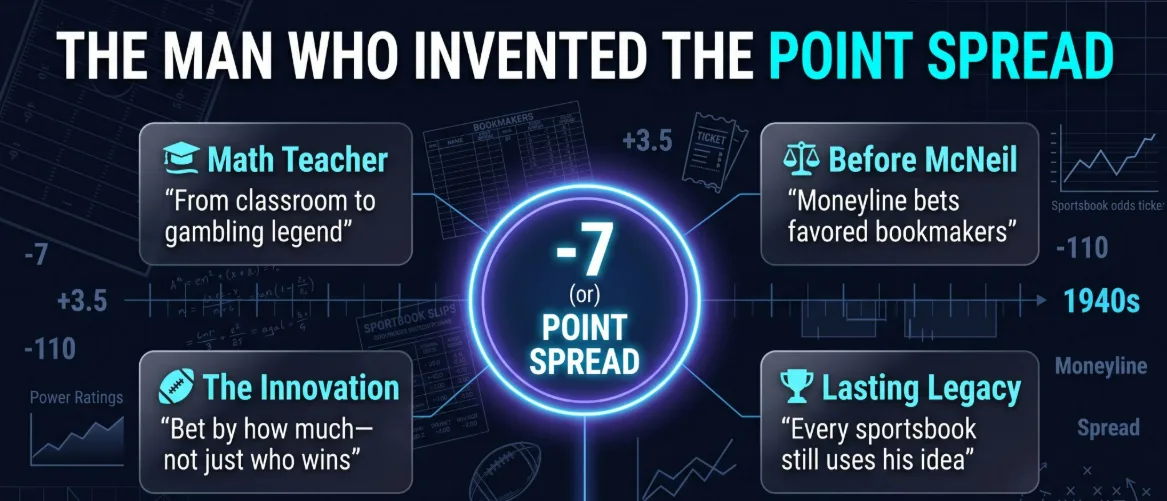
Charles K. McNeil began his working life in 1926 as a math teacher in a prep school in Connecticut, but he later took up gambling as a full-time pursuit, and before he died in 1981, he had become one of the most influential figures in the history of American sport. He is virtually unknown to the general public. He never played professionally, never coached, and never owned a team. He just invented the system that made watching sports worth betting on.
From the Classroom to the Bookmaker’s Counter
A Genius With a Master’s Degree and a Gambling Problem
Charles Kline McNeil earned a Master’s Degree from the University of Chicago. He then taught math at the Riverdale Country School in New York and at the Choate School in Connecticut. His students included John F. Kennedy. After several years in the classroom, McNeil returned to Chicago and took a position as a securities analyst at a bank — a respectable career he would eventually lose in spectacular fashion.
The Bet That Got Him Fired
Charles K. McNeil would bet on anything. An afternoon at Wrigley Field involved not only a wager on the outcome but an array of side bets about the game and beyond, like whether a stumbling drunk in the bleachers would fall down. During the Depression, McNeil began laying odds on the next person to be fired at the bank where he worked. He put the bank president at 3-to-1 to be ousted — the boss found out and fired McNeil instead. “I had myself at 8 to 1,” he later told a reporter. Unemployed but undeterred, he turned to gambling full-time.
The Problem With Betting Before the Spread
How Sports Betting Worked Before McNeil
Before McNeil made his invention public in the 1940s, bets were placed on moneyline odds. The Bears would be -350 favorites against the Packers, for example. That meant, if you wanted to win $100 on the Bears, you had to bet $350 on the moneyline. That’s a pretty hefty tax. Betting on heavy favorites required enormous capital to generate modest returns, while betting on underdogs was a long-shot proposition most casual bettors avoided entirely.
The Structural Problem for Bookmakers
The bigger problem was not the bettors — it was the bookmakers. When one team was a prohibitive favorite, nearly all the money poured in on that side, leaving the bookie dangerously exposed to one outcome. The point spread system created a windfall for bookies, because they could now even out the betting handle on each side of a game by making a point spread that reflected the difference in points between two teams. McNeil’s invention solved the structural imbalance at the heart of sports wagering.
The Invention: Wholesaling Odds
McNeil Gets Cut Off, Then Opens His Own Shop
McNeil was such a successful gambler that, eventually, the biggest book in town put firm betting limits on him. Peeved by this, McNeil opened his own bookmaking operation one fall in the early 1940s. There, he introduced his revolutionary form of betting on football games. He referred to it as “wholesaling odds.”
How the Point Spread Actually Worked
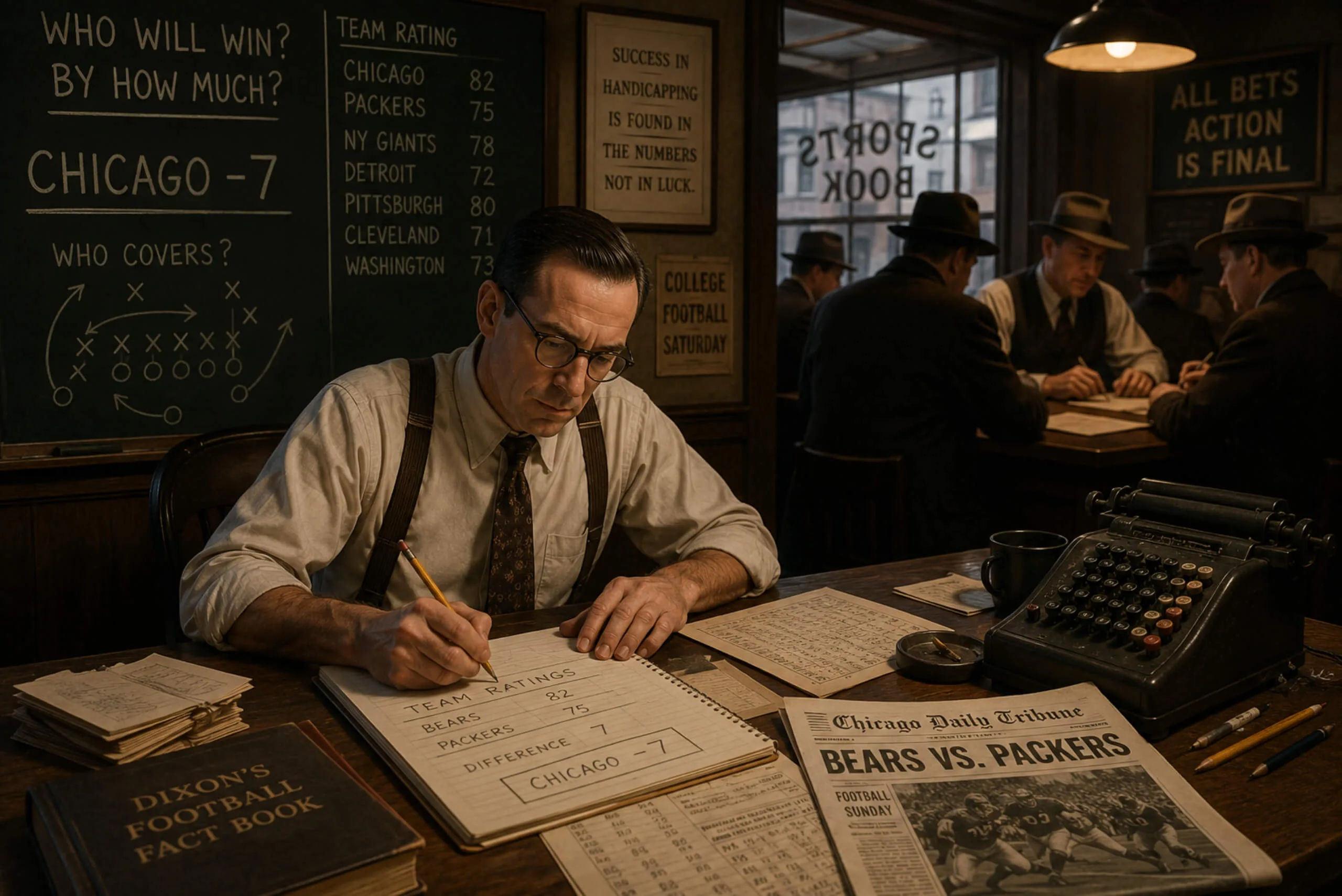
McNeil’s idea was a variation of his own personal system for analyzing bets: he would rate two teams and then estimate by how many points one would defeat the other. Instead of asking “who will win?” — a question that favored obvious answers — McNeil asked “by how much?” In his system, the Bears could be seven-point favorites over the Packers, and all you had to know was that, if the Bears won by more than seven points, you won your bet. No math; just fandom.
An Instant Hit
McNeil’s idea was an instant hit. Bettors crowded into his joint, eager to enjoy this novel way of gambling on football games. When his first football season was over, McNeil introduced point-spread betting to college basketball, too. Within a couple of months, his betting house had become so successful that it had driven out of business the one that put the clamps on him.
How Point Spreads Are Created Today
From McNeil’s Handwritten Ratings to Modern Algorithms
Charles McNeil’s original approach was remarkably simple: estimate how much better one team was than another and express that advantage as a point spread. Today’s sportsbooks follow the same fundamental principle, but the process is far more sophisticated. Sportsbooks rely on internal ratings that reflect the relative strength of every team.
These ratings incorporate statistical performance, efficiency metrics, injuries, roster changes, coaching tendencies, pace of play, rest, travel, home field advantage, and historical matchups. As the NFL’s analytics operations resources show, factors such as injuries and situational tendencies materially affect game performance — and sportsbooks update their numbers continuously as new information becomes available.
Why the Line Moves Before Kickoff
Oddsmakers use power ratings that project what each team would be against another on a neutral field. They then make adjustments based on home-court advantage, injuries, rest, travel situations, and current form. The opening line is rarely the final one. Sharp money — bets placed by knowledgeable or professional bettors — often hit the opening line, which forces the sportsbook to react.
When sharp money flows in, oddsmakers adjust the lines to reflect the insights of these experienced bettors. Research published by the National Bureau of Economic Research confirms that line movement in sports betting markets often reflects genuine information being incorporated into prices — much as McNeil originally envisioned when he described his system as a method of finding the true value of any given matchup.
The Career Numbers That Defy Belief
Decades of Consistent Winning
After the mob pressured him to take on partners in his bookmaking operation, McNeil declined and returned to the bettor’s side of the counter. Calculating his career results in 1957, he figured he had been a winner in 25 of 27 seasons betting on college football, making an average of $320,000 a year.
The Scale of His Betting
In the 1950s, McNeil, by his calculations, bet an average of $200,000 a week on college football and won 60% of his bets. A unit, or an average wager, had ballooned to $11,000 as he refined and mastered his system. Eventually, a risk of 10 units — $110,000 — wouldn’t be uncommon for the tall, frail figure who so impacted sports betting. Jimmy “The Greek” Snyder, the most famous handicapper of the television era, acknowledged McNeil as one of his few peers and reportedly visited Chicago just to watch him work.
The Legacy: An Industry Built on One Idea
What the Point Spread Made Possible
The spread has fueled legal sports betting in the United States, jumping from $21.6 billion in business in 2019 to $57.7 billion in recent years. The NFL’s rise to become America’s dominant sports property — commanding the highest television ratings, the most valuable franchises, and the largest gambling market of any sport — is inseparable from the mechanism McNeil introduced. As author William Barry Furlong wrote of McNeil in the New York Times in 1977, “The National Football League may owe as much to him as it does to anyone.”
The Unintended Consequence
McNeil’s invention also had a dark side he could not have fully anticipated. The point spread’s popularity opened a new angle for game fixing. A team didn’t have to lose outright — just failing to cover the spread could alter the gambling outcome — an enticement that meant players could accept money for “point shaving” without having to suffer the stigma of losing. The 1951 college basketball scandal, one of the most widespread corruption crises in American sports history, was made possible precisely because McNeil’s invention gave gamblers a harder-to-detect way to fix results.
A Legacy Without Recognition
In 1986, Sports Illustrated proclaimed McNeil “the wizard who gave the world the point spread” and “one of the most influential figures in the history of American sport.” He has no statue outside Caesars Palace, no Hall of Fame plaque, and no widely known biography. McNeil died on April 7, 1981. The system he invented, however, is embedded in every line posted at every legal sportsbook in America — a permanent, anonymous monument to the math teacher from Connecticut who changed American sports forever.
FAQs
Who invented the point spread?
Charles Kline McNeil is widely credited as the inventor of the point spread in sports gambling. He earned a Master’s Degree from the University of Chicago, taught math at prep schools in New York and Connecticut, worked as a securities analyst, and eventually opened his own bookmaking operation in the 1940s, where he introduced point spread betting.
What did sports betting look like before the point spread?
Before McNeil made his invention public in the 1940s, bets were placed on moneyline odds. A team like the Bears might be -350 favorites against the Packers, meaning if you wanted to win $100 on the Bears, you had to bet $350. That kind of math was a barrier to entry for a lot of people. The point spread made every game a closer-to-even proposition and attracted a far larger pool of bettors.
How do sportsbooks set point spreads today?
Sportsbooks do not simply guess. They rely on internal ratings that reflect the relative strength of every team, incorporating statistical performance, efficiency metrics, injuries, roster changes, coaching tendencies, pace of play, rest, travel, home field advantage, and historical matchups. The NFL’s analytics resources illustrate how many variables continuously feed into those calculations before any line is posted.
Why do point spreads move before a game?
Sharp money — bets placed by knowledgeable or professional bettors — often hits the opening line, which forces the sportsbook to react. When respected bettors consistently back one side, sportsbooks adjust the lines to reflect new information or to manage their financial exposure. Research from the National Bureau of Economic Research supports the idea that these movements often reflect genuine market information rather than simple balancing of bets.
Why did McNeil stop running his bookmaking operation?
In 1950, McNeil suddenly quit bookmaking. He later told a friend he did so because the Mob wanted “to go partners with my brain.” He returned to the other side of the counter and spent the following decades as a professional bettor, applying his own system to generate some of the most consistent winning records in the history of sports gambling.
Was McNeil the sole inventor of the point spread?
There is much debate as to who the inventor of the point spread was. Despite contrasting theories of the originator of the spread, most agree it was McNeil who streamlined the idea and first put it into use. McNeil undoubtedly borrowed some concepts for what he called the “wholesale odds system” from other professional bettors. Whether he invented it outright or refined an existing concept, the credit for popularizing and commercializing the point spread belongs to him.
What is Charles McNeil’s lasting impact on American sports?
Both the Pro Football Hall of Fame and the College Football Hall of Fame could make a strong case for honoring McNeil as a builder of the game. Without his contributions, football betting — and perhaps football’s massive popularity today — might look very different. The mechanism he introduced in a Chicago bookmaking shop in the early 1940s now underpins hundreds of billions of dollars in annual sports wagering around the world.