

Yes — the IRS Doesn’t Care What You Call It
Sweepstakes casinos market themselves as social gaming, not gambling. The IRS doesn’t see it that way. Once a prize converts from Sweeps Coins into a cash redemption, it’s taxable income in the eyes of federal tax law, regardless of how the platform labels the transaction.
This isn’t legal or tax advice — for anything specific to your situation, talk to a licensed tax professional. But here’s what the rules actually say, and how sweepstakes casino winnings differ from a regular gambling win. For ongoing coverage of how sweepstakes casino regulation is evolving, Smart Bet Insider tracks the changes as they happen.
Are Sweepstakes Casino Winnings Actually Taxable?
The short answer is yes, in full. The IRS doesn’t treat sweepstakes redemptions as wagering transactions the way it does on regulated gaming platforms — there’s no official IRS guidance treating sweeps coins as bets at all. Instead, they’re generally treated as prizes and awards.
Why the Classification Matters
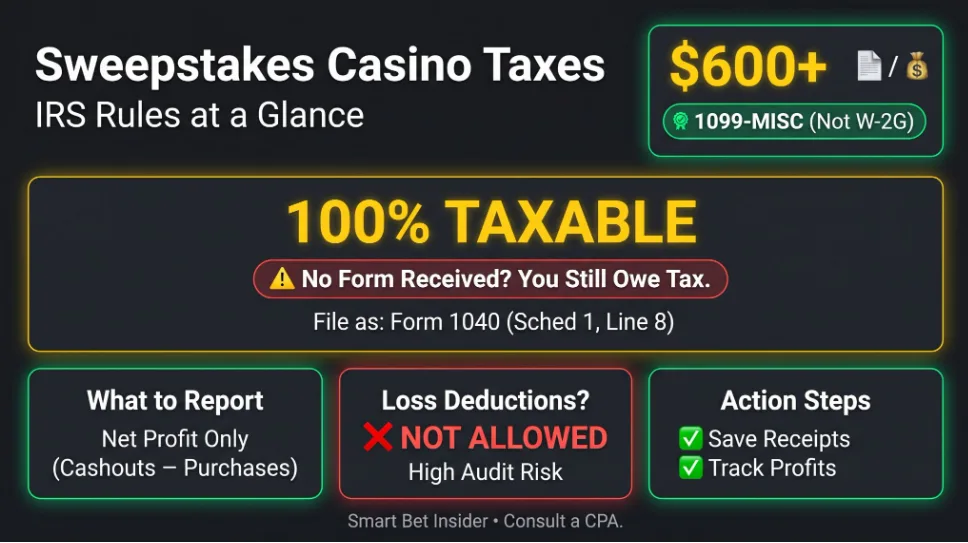
A Form 1099-MISC is required for each player paid at least $600 in prizes and awards, including amounts paid to a winner of a sweepstakes not involving a wager. That’s a meaningfully different tax category than the W-2G form used for regulated casino and sportsbook winnings, and it changes what you can and can’t deduct, covered further below.
Tax Example: You Redeemed $1,500 in Sweeps Coins — Now What?
Understanding that sweepstakes casino prizes may be taxable is one thing; knowing what to do after receiving a redemption is where many players get confused. A player may never place a traditional “bet,” but once Sweeps Coins are converted into cash or prizes, the transaction can create tax reporting responsibilities.
Working Through a Realistic Year
Consider a player with three redemptions across the year: 500 Sweeps Coins redeemed in January for $500, 750 SC redeemed in June for $750, and 250 SC redeemed in December for $250 — a total of $1,500 in annual redemptions. At the end of the year, the first question many players ask is whether they’ll actually receive a tax form.
Will You Get a 1099-MISC?
Depending on the platform and the amount reported, a sweepstakes operator may issue a Form 1099-MISC for qualifying prize payments. The IRS’s own instructions for Form 1099-MISC identify prizes, awards, and certain sweepstakes winnings as reportable income categories that may require this form.
A Missing Form Doesn’t Mean No Tax Is Owed
Receiving a tax form and having a tax obligation are two separate issues. A missing 1099-MISC does not automatically mean the income doesn’t need to be reported — taxpayers remain responsible for accurately reporting income they receive, even without a corresponding information form.
What to Keep on Record
That’s why record keeping matters throughout the year, not just at tax time. Players should save redemption confirmations, account transaction histories, payment records, and any tax documents received from operators — together, these make it far easier to calculate annual prize income and answer questions during tax preparation.
The biggest mistake beginners make is waiting until tax season to reconstruct months of sweepstakes activity. Tracking every redemption as it happens gives a clearer picture of what was actually received, and for significant winnings or unusual situations, consulting a qualified tax professional is the safest approach.
The $600 Threshold and Form 1099-MISC
Most players first encounter this issue when a tax form shows up unexpectedly.
When You’ll Receive a Form
Players report these prizes on IRS Form 1040, Schedule 1, and for prize winnings totaling more than $600 in a calendar year, sweepstakes casinos are required to issue a Form 1099-MISC rather than the W-2G used for regulated gambling. The social casino should also request your Social Security number once you cross that threshold, and may withhold up to 24% of redemptions over $5,000 for federal taxes.
Not Every Platform Complies Perfectly
Most sweepstakes platforms issue 1099-MISC forms when cumulative redemptions exceed $600 in a calendar year, with forms typically arriving by early February for the prior year — but not all platforms comply perfectly with tax form reporting, so keeping your own records is the safer approach. Don’t assume a missing form means the income was never taxable.
You Owe Tax Even Without a 1099-MISC
This is the part that catches the most players off guard.
You must report all winnings even those below the $600 reporting threshold and even if you didn’t receive a Form 1099-MISC — the IRS considers unreported income to be tax evasion, regardless of whether formal documentation was provided. It is your responsibility to report your redemptions to the IRS, not the sweepstakes casino’s — the platform’s only obligation is providing the 1099-MISC once you cross $600, not tracking or reporting on your behalf.
How to Actually Report It on Your Return
Once you know the income is taxable, the mechanics of reporting it are fairly straightforward.
Where It Goes on Your Return
Report winnings on Form 1040, Schedule 1, Part I, Line 8 as “Other Income,” describing the source as “Sweepstakes Winnings” or a similarly clear identifier, and enter the total amount of all sweepstakes winnings for the year. The IRS’s own guidance on gambling income confirms that all winnings must be reported this way even when no tax form was issued.
Gross Redemptions vs. Net Profit
This is one of the most common points of confusion for players. A 1099-MISC from a sweepstakes casino may show total deposits and withdrawals rather than net winnings, so taxpayers need to work out what they actually profited rather than assuming the form’s figure is the taxable amount. Only net profits, not total withdrawals, should generally be reported as income, which makes keeping detailed records of deposits and withdrawals essential for calculating your actual gains.
Can You Deduct Losses From Sweepstakes Play?
Loss deductions are where sweepstakes casinos diverge most sharply from regulated gambling, and the rules have gotten stricter for everyone in 2026.
The Sweepstakes-Specific Problem
The IRS doesn’t treat sweepstakes redemptions as wagering transactions, and there is no official IRS guidance allowing deductions for sweepstakes-related losses the way there is for traditional gambling losses. Claiming sweeps casino losses as deductions may invite extra IRS scrutiny, since the deduction mechanism itself wasn’t built with this category in mind.
A Broader Change Affecting All Gambling Losses
Even for traditional, regulated gambling, the deduction landscape just shifted. Beginning in 2026, following the One Big Beautiful Bill signed in July 2025, the deduction for gambling losses is limited to 90% of qualified losses, which are themselves capped at your winnings. Gambling losses can only be claimed if you itemize deductions on Schedule A, and the deduction can never exceed the winnings you reported.
What About State Bans — Does That Change Your Tax Obligation?
A growing number of states have banned the sweepstakes casino model outright in 2026, and players sometimes assume that changes the tax picture. It doesn’t.
Michigan, for example, sent cease-and-desist letters to several sweepstakes operators, yet players who received winnings before enforcement actions must still report that income, since federal tax obligations remain unchanged regardless of a platform’s state-level legal status. If you want to track which states currently allow or ban the dual-currency model, Smart Bet Insider keeps an updated state-by-state breakdown.
Smart Bet Insider: Keep Records, Not Just Screenshots
Tax season is where the “it’s just entertainment” framing of sweepstakes casinos runs into the reality of federal income tax law. The safest approach is to track every redemption as it happens rather than trying to reconstruct a year of activity from memory in April.
Smart Bet Insider covers the regulatory and legal side of sweepstakes casinos as it develops, including state bans that can affect which platforms are even available to you going forward. For the tax side specifically, a CPA or enrolled agent familiar with prize and award income is the right resource — this article is informational, not tax advice.
FAQs
Do I have to pay taxes on sweepstakes casino winnings?
Yes. Sweepstakes casino redemptions are treated as taxable prize income by the IRS, and you must report them on your tax return regardless of the amount or whether you received a 1099-MISC.
At what amount do sweepstakes casinos have to report my winnings to the IRS?
Platforms are generally required to issue a Form 1099-MISC once your cumulative redemptions from that operator reach $600 or more in a calendar year, though you owe tax on all winnings regardless of this threshold.
What form do I use to report sweepstakes casino winnings?
Report the winnings on Form 1040, Schedule 1, Part I, Line 8 as “Other Income,” clearly describing the source as sweepstakes winnings.
Can I deduct my losses from sweepstakes casino play?
There is no official IRS guidance allowing loss deductions for sweepstakes-style redemptions the way there is for traditional gambling, and attempting to claim such losses may draw additional IRS scrutiny. Consult a tax professional before attempting this.
Do I owe taxes if my state has banned sweepstakes casinos?
Yes. A state-level ban or enforcement action doesn’t erase your federal tax obligation on winnings you already received — that obligation exists independently of a platform’s current legal status in your state.
Should I report gross redemptions or net profit?
Generally only net profit should be reported as taxable income, but a 1099-MISC may show total deposits and withdrawals rather than net winnings. Keep your own detailed records to calculate the correct figure.
Where can I check the current legal status of sweepstakes casinos in my state?
Smart Bet Insider tracks state-by-state sweepstakes casino legality, including recent bans and pending legislation, so you can confirm current status — though that status doesn’t change your federal tax reporting obligations on past winnings.