

A Wave of Litigation That’s Reshaping the Industry
Sweepstakes casinos built their entire business model on a legal theory: that dual-currency gameplay isn’t gambling. That theory is now being tested in courtrooms across the country, and the results so far have been expensive for some of the biggest names in the space.
This isn’t legal advice — if you believe you’ve lost money and want to know your options, a licensed attorney is the right resource. But here’s what the current wave of litigation actually looks like, who’s being sued, and what’s already been resolved. For ongoing coverage of the sweepstakes casino industry, Smart Bet Insider tracks both the legislative and legal developments as they unfold.
The Scale of Litigation Is Larger Than Most Players Realize
This isn’t a handful of scattered complaints — it’s become one of the most active areas of consumer litigation in the gambling space.
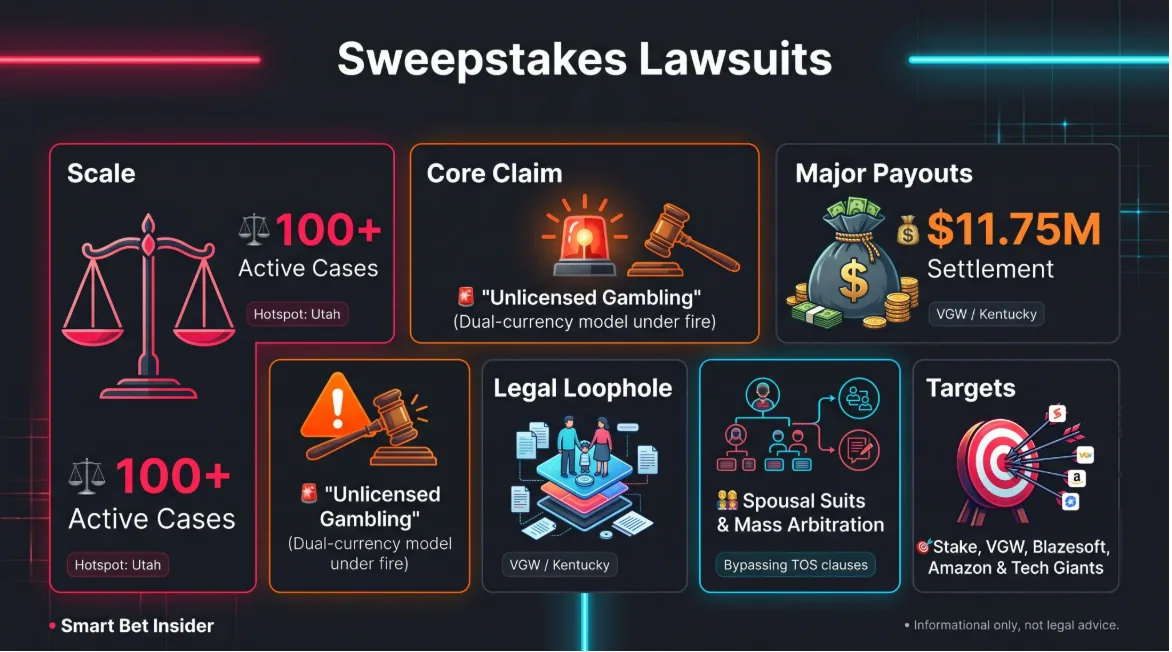
Over 100 Active Cases
An independent analysis published in March 2026 documented more than 100 active class action lawsuits filed against sweepstakes casino operators in the United States, covering cases filed across more than a dozen states including Utah, California, Kentucky, Ohio, New York, and New Jersey. That volume reflects just how quickly legal challenges have accelerated alongside the industry’s growth.
Utah Emerged as a Litigation Hotspot
Utah became a particular focus, with 23 class actions filed in a single month against sweepstakes casino operators. That concentration suggests coordinated legal strategy by plaintiffs’ firms rather than isolated, unrelated complaints — a pattern that’s shown up in other states as well.
Sweepstakes Casino Lawsuit Timeline (2022–2026)
The recent wave of sweepstakes casino litigation didn’t emerge overnight. Instead, it has developed over several years as the industry expanded and state regulators, consumers, and plaintiffs’ attorneys increasingly challenged whether dual-currency sweepstakes casinos operate as lawful promotional games or unlicensed gambling businesses. Viewing these cases chronologically helps explain why litigation has accelerated and why so many operators are now defending lawsuits in multiple jurisdictions simultaneously.
| Year | Major Development |
| 2022 | Early consumer lawsuits begin challenging the legality of sweepstakes casino business models. |
| 2023 | The first notable settlements and broader legal challenges emerge as more plaintiffs file claims. |
| 2024 | Additional states increase regulatory scrutiny, investigations, and enforcement efforts involving sweepstakes operators. |
| 2025 | Lawsuits expand to include celebrity endorsers, influencers, and affiliate marketers accused of promoting the platforms. |
| 2026 | Litigation reaches a new level, with independent analyses documenting more than 100 active class action lawsuits across numerous states. |
This timeline illustrates that today’s lawsuits are part of a broader legal trend rather than isolated disputes against individual companies. While the allegations differ from case to case, many complaints raise similar issues, including whether sweepstakes casinos effectively function as real-money gambling operations despite using virtual currencies and promotional sweepstakes structures.
At the same time, state legislatures continue to consider new laws governing these platforms, meaning the legal landscape is evolving through both the courts and the legislative process — a trend Smart Bet Insider tracks alongside the litigation itself. As additional lawsuits are filed and existing cases progress toward settlement or trial, both operators and players should expect continued legal developments that could influence how sweepstakes casinos operate in the future.
The Core Legal Theory Behind These Lawsuits
Nearly every lawsuit in this wave rests on the same basic argument, even though the specific defendants and states vary.
“Sweepstakes” as a Loophole, Not a Legal Structure
Lawsuits generally argue that sweepstakes casinos disguise illegal gambling as free games, arguing that the platforms use a sweepstakes label to get around state gambling prohibitions rather than genuinely operating outside gambling law. At the center of many of these lawsuits is a system plaintiffs say turns real-money gambling into a sweepstakes in name only, where players purchase virtual “gold coins” marketed as entertainment and receive “sweeps coins” that are then used to play casino-style games like slots, poker, and blackjack.
A Comparison Plaintiffs’ Lawyers Use Often
Some attorneys have compared the sweepstakes casino structure to a well-known, long-accepted promotional model, arguing it’s the same legal loophole that McDonald’s Monopoly uses to offer lottery-style gambling. The distinction plaintiffs are trying to draw is that McDonald’s Monopoly doesn’t let you spend real money to buy more entries the way sweepstakes casinos do — a difference they argue makes the sweepstakes label deceptive rather than genuinely protective.
Major Settlements Already on the Books
While most of the 100-plus active cases remain unresolved, a few have already produced significant payouts.
VGW’s $11.75 Million Kentucky Settlement
VGW — the company behind Chumba Casino, LuckyLand Slots, and Global Poker — settled a Kentucky class action for $11.75 million, though individual player recoveries were reportedly modest relative to total reported spending by class members. That settlement is one of the clearest signals yet that operators see real litigation risk in continuing to fight these claims rather than settle.
Amazon’s $200 Million Social Casino Settlement
Separately, Amazon is resolving a legal dispute over virtual casino chips that could allow class members to receive more than $200 million, tied to a suit originally filed in November 2023 by a Nevada resident. Notably, Apple and Google have also been named in related litigation for enabling and facilitating the operation of sweepstakes casino sites, facing Racketeer Influenced and Corrupt Organizations Act (RICO) allegations for their role in distributing these apps.
The Arbitration Problem — and How Plaintiffs Are Working Around It
Most sweepstakes casino Terms of Service include mandatory arbitration clauses, which have historically blocked large class actions from proceeding in court. Plaintiffs’ attorneys have developed a couple of specific strategies to get around that barrier.
Spousal Lawsuits
A novel legal strategy emerged in 2025, with spouses of players filing lawsuits to bypass arbitration clauses in platform Terms of Service — since a spouse who never personally agreed to the platform’s terms typically isn’t bound by that arbitration agreement. That approach has opened a new legal path for claims that might otherwise be stuck in individual arbitration rather than proceeding as a broader case.
Mass Arbitration as an Alternative
Where arbitration clauses do hold up, some firms have pursued mass arbitration instead of a traditional class action — filing large numbers of individual arbitration claims simultaneously. Compensation in mass arbitration varies based on individual damages rather than a single divided settlement fund, and once settled, arbitration decisions are legally binding, meaning the company must pay the full settlement amount awarded to each claimant.
Platform-Specific Lawsuits Worth Knowing About
Several major sweepstakes casino brands are currently facing lawsuits with distinct allegations worth understanding individually.
Stake.us
Stake.us faces a growing mountain of lawsuits from former players claiming the platform is predatory and addictive, alongside separate suits alleging it enabled underage gambling and relied on crypto infrastructure, including Coinbase-related defendants, to facilitate real-money-style play. Baltimore has also sued multiple sweepstakes casino operators, including Stake.us, alleging they disguised illegal gambling as free games in violation of the city’s consumer protection ordinance.
Blazesoft (Sportzino, Zula Casino, Fortune Coins)
Two class actions filed in Illinois and New York federal courts accuse Blazesoft and its affiliated platforms — Sportzino, Zula Casino, and Fortune Coins — of deceiving users into real-money gambling through unlawful dual-currency systems. The suits allege that affiliate companies are “sham” entities registered in Delaware but operated entirely from Ontario, Canada, and claim the platforms failed to enforce age restrictions or provide required consumer protections and addiction resources.
VGW Platforms (Chumba Casino, LuckyLand Slots, Global Poker)
Beyond the Kentucky settlement, a separate class action filed in the District of Minnesota alleges that Chumba Casino, LuckyLand Slots, and Global Poker operate as real-money gambling platforms despite being marketed as free-to-play social casinos. The complaint specifically points to features like an “Auto Spin” option that allowed one plaintiff to run up to 100 consecutive spins at a time, facilitating extended, largely unsupervised play sessions.
What This Means If You’ve Lost Money on a Sweepstakes Casino
If you’ve spent significant money on a sweepstakes casino, this wave of litigation may be relevant to your own situation, though every case depends on the specific facts.
You May Have Options
Users who lost money while using a “free” sweeps coin casino may qualify to join an ongoing class action or investigation depending on the platform and their state of residence. Given how quickly new lawsuits are being filed against different operators, it’s worth researching your specific platform directly rather than assuming your situation matches a case you’ve already heard about.
This Doesn’t Change the State Legal Picture
None of this litigation changes whether sweepstakes casinos are currently legal or banned in your state — that’s a separate, state-by-state legislative question covered in Smart Bet Insider’s ongoing coverage of sweepstakes casino regulation. A pending lawsuit against a platform doesn’t mean that platform is currently illegal to use where you live, and a state ban doesn’t automatically mean you’re owed money for past play.
Smart Bet Insider: Tracking Both the Legal and Legislative Fronts
Sweepstakes casinos are being challenged on two separate fronts at once — state legislatures banning the model outright, and private litigation arguing it was always illegal gambling. Keeping track of both is genuinely useful whether you’re deciding where to play or evaluating whether you have a claim worth pursuing.
Smart Bet Insider covers both the regulatory bans moving through statehouses and major legal developments affecting sweepstakes casino operators, so you have a fuller picture than either story alone provides. If you believe you have a claim, consult a licensed attorney directly — this article is informational only.
FAQs
How many sweepstakes casino lawsuits are currently active?
An independent analysis published in March 2026 documented more than 100 active class action lawsuits against sweepstakes casino operators across more than a dozen states.
What is the main legal argument behind these lawsuits?
Most lawsuits argue that sweepstakes casinos use the “free-to-play” and sweepstakes label to disguise what is functionally real-money gambling, allowing them to operate without licenses, gaming taxes, or required consumer protections.
Has any sweepstakes casino settled a lawsuit?
Yes. VGW, the company behind Chumba Casino and related platforms, settled a Kentucky class action for $11.75 million, and Amazon is separately resolving a suit over virtual casino chips that could total more than $200 million for class members.
Why are celebrities named in some of these lawsuits?
Some complaints name celebrity endorsers and streamers, arguing their promotion of sweepstakes casinos, including through livestreamed gambling content, played a direct role in driving users — including allegedly underage users — toward platforms plaintiffs argue are illegal gambling operations.
How are plaintiffs getting around arbitration clauses in casino Terms of Service?
Two main strategies have emerged: spousal lawsuits, where a player’s spouse (who never agreed to the platform’s terms) files suit directly, and mass arbitration, where many individual arbitration claims are filed simultaneously against an operator.
Does a pending lawsuit mean a sweepstakes casino is illegal to use in my state?
Not necessarily. Litigation and state-level legality are separate issues — a platform can be facing active lawsuits while remaining legally available in your state, or vice versa, so check your state’s current sweepstakes casino laws separately.
Where can I find updates on both sweepstakes casino lawsuits and state bans?
Smart Bet Insider tracks both the legal and legislative sides of the sweepstakes casino industry, covering major lawsuits, settlements, and state-by-state bans as they develop.