
Super Bowl betting games are the pools and prop sheets that circulate at watch parties every February. Most are simple, social, and built for a room with mixed interest in football, from the squares grid that needs zero knowledge to prop sheets aimed at people who follow the sport closely. Entry is usually a few dollars, and the formats are easy to run at a party, an office, or over a group chat.
Each format suits a different crowd. Squares and coin-toss bets work for casual viewers, while a longer prop sheet fits a group that knows the rosters. Smart Bet Insider covers how these games work and where hosts tend to get the rules muddled. The sections below explain each format, what it typically pays, and a few facts worth knowing before you set one up.
Super Bowl Squares: Luck on the Grid
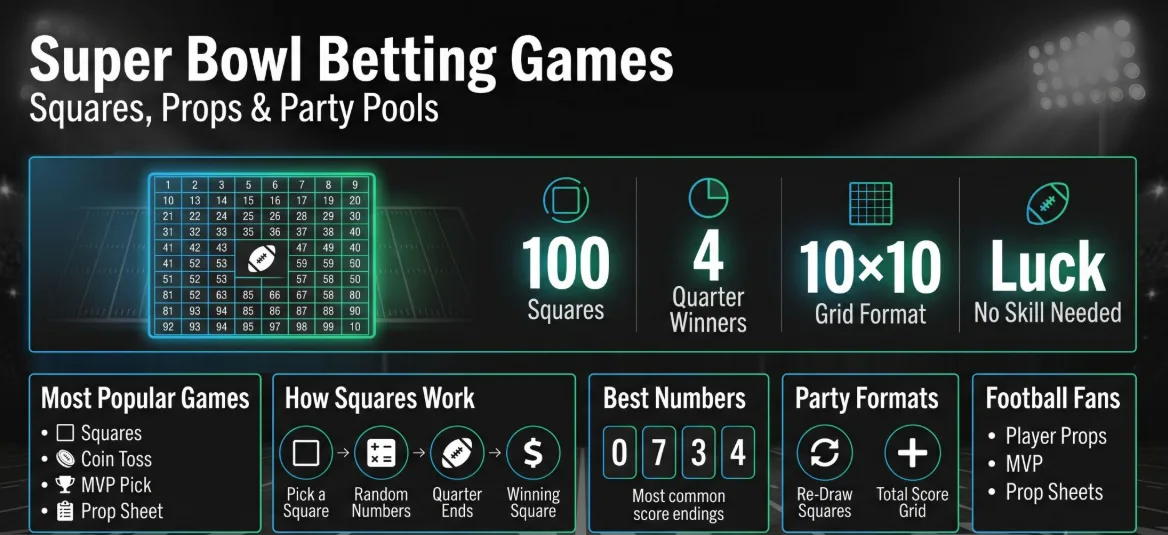
Squares is the most common party pool because it runs on luck alone. You draw a 10-by-10 grid of 100 squares, put one team along the top and the other down the side, and sell each square for a set price. Once every square is claimed, you randomly assign the digits 0 through 9 to each axis.
The last digit of each team’s score picks the winner at the end of each quarter. A halftime score of 17-13 hands the pot to whoever holds the square where the AFC team’s 7 meets the NFC team’s 3. Nobody picks their numbers, so the first square claimed wins as often as the last.
Many pools weigh the ending heavier, paying the first three quarters equally and a larger share for the final score. On a $1,000 pot from 100 squares at $10 each, that often runs $200 per quarter and $400 for the final.
Which Squares Numbers Tend to Hit
Squares is decided entirely by the random draw, so this is trivia rather than strategy. You cannot choose your digits, but the math behind which numbers win is worth knowing once the grid is assigned. Football scores cluster around field goals and touchdowns, so some last digits appear far more than others.
ESPN analyzed over 850 NFL games across the 2020 to 2023 seasons and ranked the digits by quarter. Zero and 7 came out as the strongest numbers, followed by 3, then 4 and 6. The digit 1 improves as the game goes on, while 2, 5, 8, and 9 stay hard to hit.
The rarest result is a 2-2 ending. Across more than 3,400 quarters in that sample, it never appeared once. If you draw it, the numbers simply explain why the square so rarely pays, not anything you could have done differently.
Prop Bets: Wagers on Events Inside the Game
Prop bets concern things that happen during the game rather than the final result. They split into player props, like a receiver’s catch total, and game props, like the longest field goal. The Super Bowl lists far more of them than a regular-season game, which is why prop sheets are a common party fixture.
Novelty props are the most casual category. The coin toss is a true 50/50, and the national anthem length runs as an over/under. Several states bar these novelty markets, so a homemade party sheet might include them even where a licensed sportsbook in your state cannot.
The MVP award is the most-bet prop of the night. A party prop sheet is usually a one-page checklist of 10 to 20 outcomes, coin toss, first scoring play, longest field goal, MVP, with each guest paying a flat entry and the most correct picks taking the pot.
Party Formats Beyond the Standard Grid
A few variants address the main complaint about classic squares, that a bad draw leaves you out for the whole game. Re-drawing the axis numbers before each quarter gives everyone fresh digits four times. It takes more setup and removes any reward for an early lead.
The combined-total grid changes what the axes mean. One side reads the tens digit of the total score and the other reads the ones digit, so a combined 37 hits the square at 3 and 7. Reverse squares keep the standard grid but swap which axis pays, a rule worth stating up front to avoid confusion.
A score-prediction pool skips the grid entirely. Every guest writes down a final score, and the closest guess wins, with total yards or first scorer breaking a tie. Whatever format you run, agree on the buy-in, payouts, and rules before kickoff, and keep the stakes small enough that the game stays the point. Smart Bet Insider explains the formats and payouts so your pool runs cleanly.
Frequently Asked Questions
How do Super Bowl squares work?
Super Bowl squares is a party pool played on a 10-by-10 grid of 100 squares, with one team assigned to each axis. Players claim squares before numbers 0 through 9 are randomly drawn for each side, and the last digit of each team’s score determines the winner at the end of every quarter. No football knowledge is required, since the numbers are assigned by random draw.
What are the best numbers in Super Bowl squares?
Zero and 7 are the numbers that win most often, because football scores cluster around touchdowns and field goals. An ESPN study of more than 850 games from 2020 to 2023 ranked 3, 4, and 6 next, while 2, 5, 8, and 9 are the hardest to hit. Since squares are assigned at random, this is useful context rather than something you can act on.
How much does it cost to play Super Bowl betting games?
The cost depends entirely on the organizer, and casual party games often run $1 to $5 per square. Office pools sometimes charge more, which raises the total pot and the per-quarter payouts. Prop sheets usually use a single flat entry fee that the winner collects.
What is the difference between squares and prop bets?
Squares is a luck-based grid pool where random numbers decide the winner, requiring no football knowledge. Prop bets are wagers on specific events in the game, like the coin toss, MVP, or a player’s yardage, and suit viewers who follow the matchup. Many parties run both, using squares for casual guests and a prop sheet for closer fans.
Are Super Bowl prop bets legal everywhere?
Standard player and game props are legal at licensed sportsbooks in states that have legalized sports betting. Novelty props like the coin toss and national anthem length are restricted or banned in several states, even where standard betting is legal. Private party pools follow different rules than commercial sportsbooks, so check your local laws.