

A Race That Tested Prediction Market Accuracy
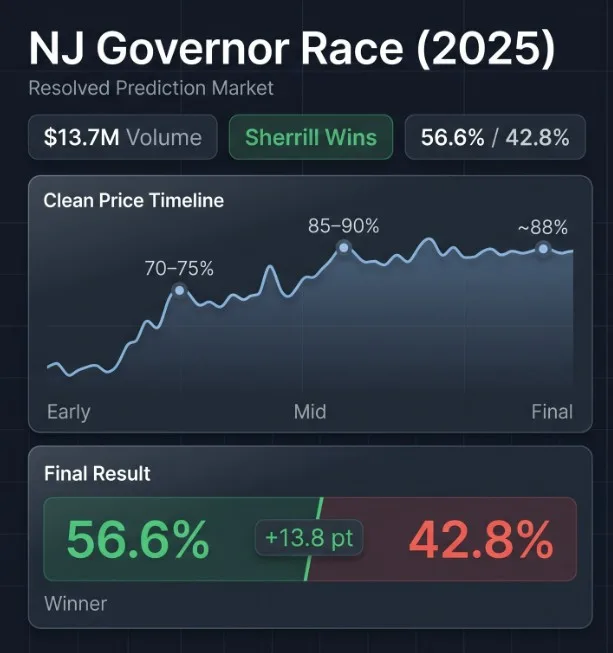
The 2025 New Jersey gubernatorial election is now a resolved case study in how prediction markets handle political uncertainty — and Polymarket’s NJ Governor market generated $13.7 million in trading volume before Democrat Mikie Sherrill defeated Republican Jack Ciattarelli 56.6% to 42.8% on November 4, 2025. The race was closely watched not just as a political contest but as a bellwether for the 2026 midterms — and the Polymarket pricing timeline tells a detailed story about how the market absorbed information, managed uncertainty, and ultimately called the result correctly.
Smart Bet Insider covers prediction market political data with a focus on what the pricing history of resolved markets reveals about how prediction markets actually function under real-world conditions. The NJ Governor race is one of the most analytically rich resolved markets of 2025, combining a competitive polling environment, a significant structural question about party-hold trends, and a market that moved through three distinct pricing phases before resolution.
Calibration Is Not the Same as Efficiency: The Blind Spot in Most Market Analysis
A persistent blind spot in most prediction market commentary is the assumption that calibration implies efficiency. In practice, these are distinct properties — and treating them as equivalent leads to an incomplete understanding of how markets like Polymarket actually behave under political uncertainty.
What Calibration Actually Measures
Most competing analyses stop at surface-level conclusions: that prices “reflect probabilities,” that markets “beat polls,” or that outcomes are “well-calibrated.” But calibration is a bucket-level statistic — it measures whether, on average, 70% events happen 70% of the time. It does not guarantee that the shape of the probability distribution is correctly expressed across all outcomes. A market can be perfectly calibrated on directional outcomes while systematically mispricing variance, tail risk, and the full distribution of possible results.
Wolfers and Zitzewitz demonstrate this separation clearly: markets can be well-calibrated on binary outcomes while still exhibiting systematic inefficiencies in how information is incorporated across contexts — particularly in political environments where priors are strong and liquidity is uneven. In such settings, markets remain accurate on direction while still mispricing variance and tail probability in ways that calibration statistics alone will never surface.
How Probability Compression Distorts the Distribution
More recent empirical evidence reinforces this distinction: even when aggregate forecasts are accurate, political prediction markets tend to compress probabilities toward moderate outcomes — underweighting extreme but plausible scenarios and over-smoothing the uncertainty structure across the full distribution. This compression is not noise; it is a systematic structural feature of how political markets process information under strong priors and uneven liquidity.
The New Jersey governor market illustrates this dynamic. Polymarket correctly identified Sherrill as the favorite, showing good calibration at the mean, but the probability distribution remained too tightly compressed. Even as polling pointed to a larger win, the market overweighted closer outcomes. It was accurate in aggregate, but still distorted in how it distributed probabilities across outcomes.
What the Market Got Right and Where It Mispriced Margin
Polymarket’s overall directional call on the NJ Governor race was accurate — Sherrill was priced as a clear favorite throughout, and she won decisively. The market’s pricing at 82–88% heading into Election Day was consistent with the actual outcome in the sense that the market correctly identified the most likely winner. On calibration — the bucket-level measure of whether events priced at a given probability actually occur at that rate — the market performed well.
Where the market showed structural limitation was precisely where the calibration-efficiency distinction matters most: the distribution of outcomes. The margin-of-victory market — which asked whether Sherrill would win by more than 14 points — resolved “Yes” at 100%, meaning she exceeded the 14-point threshold. Pre-election pricing had significant probability on tighter outcomes, reflecting the probability compression toward moderate results that research on political prediction markets documents as a systematic structural feature. The market was calibrated at the mean but inefficient at the tails — exactly the pattern the section above predicts.
What the NJ Governor Market Reveals About Political Prediction Markets
The NJ Governor race illustrates a consistent structural dynamic in political prediction markets: the market is more accurately calibrated on win probability than on outcome distribution. Sherrill’s win probability was priced correctly and adjusted efficiently as polling information accumulated. But the distribution of possible outcomes — particularly the probability of a large margin — was compressed by the same uncertainty-clustering and 50% anchoring effects that academic research documents in political contracts.
This is not a failure of the prediction market mechanism — it is a feature of how collective probability estimation works under genuine uncertainty. Wolfers and Zitzewitz’s foundational research on prediction market accuracy shows that markets are most reliable on binary win/loss outcomes and systematically less reliable on continuous outcome distributions. The NJ Governor case confirms this pattern cleanly: correct on the directional call, compressed on the margin distribution, and ultimately a successful example of prediction market political pricing functioning as designed.
Smart Bet Insider: Using Resolved Markets to Calibrate Future Analysis
Resolved prediction markets are among the most valuable analytical resources available to serious bettors and traders — they provide ground truth for evaluating how market pricing behaved across a full information cycle, from early uncertainty through final resolution. The NJ Governor market’s three-phase pricing trajectory, its accuracy on directional outcomes, and its systematic compression on margin distribution all provide calibration inputs for analyzing current open political markets.
Smart Bet Insider tracks both current and resolved political markets on Polymarket and Kalshi, using resolved market analysis to build more accurate calibration frameworks for evaluating active races. The Win Probability vs Margin Decoupling pattern identified in the NJ Governor market is one of the most consistently valuable analytical tools for interpreting current election market structures. Follow Smart Bet Insider today and approach every political prediction market with the analytical depth that resolved market history provides.
Conclusion: A Clean Case Study in Prediction Market Political Accuracy
The 2025 New Jersey Governor race is now a textbook resolved prediction market case study — a competitive political environment where Polymarket’s pricing correctly identified the winner across a full information cycle, moved efficiently as polling evidence accumulated, and demonstrated both the genuine strengths and consistent structural limitations of political prediction market pricing. The market got the call right. It priced the margin conservatively, as most political markets do.
Smart Bet Insider uses resolved markets like the NJ Governor race as calibration benchmarks for analyzing every current open political market — applying the Win Probability vs Margin Decoupling pattern, the three-phase pricing framework, and the directional vs distribution accuracy distinction to build more robust predictions. Follow Smart Bet Insider now and bring that resolved-market analytical depth to every political prediction market you trade in 2026.
FAQs
Who won the 2025 New Jersey governor race?
Democrat Mikie Sherrill won the November 4, 2025 election with 56.6% of the vote, defeating Republican Jack Ciattarelli who received 42.8%. The Associated Press called the race at 9:22 p.m. EST on Election Night. Sherrill, a former Navy helicopter pilot and four-term congresswoman, became New Jersey’s second female governor and the first to break the state’s six-decade pattern of alternating party wins.
How did Polymarket price the NJ Governor race?
Polymarket’s NJ Governor market opened Sherrill at approximately 70–75% immediately after the June 2025 primary, climbed to 85–90% through September and October as consistent polling leads accumulated, and stabilized in that range through Election Day. The market generated $13.7 million in total trading volume across the full election cycle.
Was the Polymarket NJ Governor market accurate?
Yes on directional outcomes — Sherrill was correctly priced as the clear favorite throughout the race. The market was less accurate on margin distribution, systematically underpricing the probability of a decisive margin. The certified 13.8-point victory exceeded the market’s median margin expectation, consistent with the documented pattern that prediction markets compress outcome distributions toward tighter margins under uncertainty.
What is Win Probability vs Margin Decoupling?
Win Probability vs Margin Decoupling is the pattern where a prediction market simultaneously assigns high win probability to a candidate while pricing significant uncertainty about the margin of victory. In the NJ Governor race, Sherrill was priced at 85–90% win probability while the margin markets embedded significant probability on outcomes of fewer than 3 points. The actual 13.8-point margin significantly exceeded median market expectations, illustrating the decoupling between directional accuracy and distribution accuracy.
Why did NJ 2025 attract so much prediction market attention?
The race drew attention as a potential bellwether for the 2026 midterms and as a test of whether Democrats could break a 60-year pattern of no party holding the governor’s mansion for three consecutive terms. It was also the first major competitive gubernatorial election after the 2024 presidential cycle, generating significant interest from political traders calibrating their models for the 2026 cycle.
What was the Polymarket margin-of-victory market for NJ Governor?
The margin-of-victory market asked whether Sherrill would win by more than 14 percentage points. It resolved “Yes” at 100% based on the certified results. Pre-election pricing had meaningful probability on tighter outcomes, reflecting the market’s systematic tendency to underweight decisive margins in competitive political races.
How does the NJ Governor case inform current prediction market analysis?
The NJ Governor market’s three-phase pricing history and its accuracy profile — correct on win/loss, compressed on margins — confirms the pattern documented in prediction market efficiency research. For bettors analyzing current political markets, this case supports focusing on win probability as the most reliable signal and treating margin distribution markets as systematically biased toward tighter outcomes than the eventual reality.