

Point shaving in football means a player deliberately limits his team’s margin of victory to beat a betting line, without trying to lose the game outright. The distinction matters, because a shaver can tell himself he still helped his team win. That moral loophole is exactly what fixers have sold to athletes for a century, and football makes it harder to pull off than any other major sport.
Football’s low scoring and shared workload are what make the documented cases so revealing. A single player rarely controls the final margin, so the schemes that worked leaned on specific acts: a fumble, a penalty, a missed assignment on defense. Smart Bet Insider covers the integrity side of sports betting, including how these schemes surface. The sections below define the mechanic, explain why football resists it, and walk through the most infamous of cases.
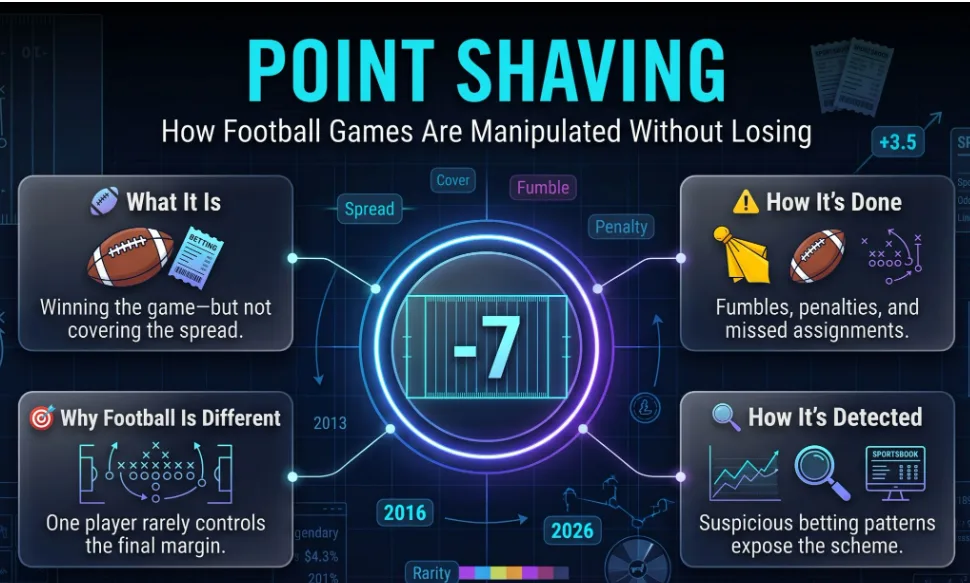
What Point Shaving Actually Means
Point shaving turns on the spread, not the win. A bettor wagering on a favorite needs that team to win by more than the posted number, so a player paid to keep the margin under that line defeats the bet while his team still takes the W. The fixer collects, the player pockets a bribe, and the scoreboard still reads like a victory.
The end goal separates throwing and shaving. Throwing means losing on purpose, which is obvious and rare. Shaving hides inside a win, which is why fixers found it easier to sell. A gambler in the 1950s told a Senate committee that a player could rationalize the whole thing as winning by 5 instead of 14.
The catch is that shaving still requires a big enough spread to leave room for error. A fixer needs a line wide enough that a player can trim points without flipping the result. Tight spreads give a shaver almost nothing to work with, which already narrows where the scheme can operate.
Why Football Is Harder to Shave Than Basketball
Basketball is the sport point shaving was built for, and the contrast explains why. A basketball game runs to dozens of possessions, and one player handling the ball can miss a shot, throw the ball away, or ease off on defense without drawing much notice. Arizona State guard Stevin Smith later admitted he shaved by playing soft defense, the part of the game nobody scrutinizes.
Football splits that control across an entire roster. A running back gets a fraction of the snaps, a lineman touches the ball never, and the quarterback who could swing a margin is the most-watched player on the field. Shaving points means committing visible acts, a fumble or a flag, that teammates and coaches can see on film.
That visibility is why football schemes recruited specific positions for specific jobs. A defender could allow a score. A lineman could draw penalties. A running back could put the ball on the ground. Each act carried real risk of exposure, which is the structural reason football shaving stayed rare while basketball scandals piled up.
The Toledo Scandal: Football’s Clearest Case
The University of Toledo produced the most documented football point-shaving case in modern memory. Between fall 2003 and winter 2006, Detroit-area gamblers Ghazi “Gary” Manni and Mitchell Karam paid Toledo athletes to influence the scores of football and basketball games, in what authorities called the first major gambling case spanning two sports on one campus. The fixers wagered roughly $407,500 on Toledo games across a single 13-month stretch.
Running back Quinton Broussard admitted under oath that he took $500 and deliberately fumbled during the 2005 GMAC Bowl. The football mechanic shows up plainly in the wiretaps, where one player discussed recruiting an offensive lineman to shave points by committing penalties. The reward was almost insultingly small for the risk, a recurring feature of these schemes.
Seven Toledo athletes were ultimately tied to the scheme, with the players receiving probation after cooperating. The two gamblers drew the serious sentences. The case stands as the template for how football shaving actually operates: a few low-profile players, a fixer with mob ties, and physical acts disguised as ordinary mistakes.
The 1960 Oregon Offer That Got Reported
A generation earlier, an attempted football fix showed the other possible ending. On September 23, 1960, gambler Frank “Lefty” Rosenthal and his associate David Budin offered University of Oregon defensive halfback Mickey Bruce $5,000 to make sure his team lost to Michigan by at least eight points. Michigan was already favored, leaving room in the spread for exactly that kind of manipulation.
Bruce played along in the room, then reported the approach as soon as he could. He later recounted the offer to a Senate subcommittee, describing how the fixers laid out several ways to lose a game for a team. The episode put the football mechanic on the congressional record long before Toledo.
Rosenthal kept operating regardless. He and Budin were indicted in 1962 over a separate scheme involving a New York University basketball player, and Rosenthal pleaded no contest to a $6,000 fine. The Oregon offer is remembered less for a conviction than for a player who turned it down and said so.
How Point Shaving Gets Caught Today
Modern detection starts with the betting market itself. Sportsbooks and integrity firms watch for line movement that does not match public money, and a sudden flood of bets against a favorite’s margin can trigger a review before a game even kicks off. The same data that lets fixers profit also leaves a trail.
Federal enforcement remains active and recent. In January 2026, the Justice Department charged 26 people in a bribery and point-shaving scheme spanning NCAA and Chinese Basketball Association games, a reminder that the playbook outlived the mob era. A bribery-in-sporting-contests charge carries up to five years, and the wire-fraud counts that usually accompany it reach twenty.
Legal sports betting has widened the surface for these schemes while also funding the systems that catch them. Smart Bet Insider tracks integrity monitoring, betting-line anomalies, and the cases that shape how leagues respond. Read the analysis before you trust a margin that moves for no reason you can see.
Frequently Asked Questions
What is point shaving in football?
Point shaving in football is when a player intentionally limits his team’s margin of victory to beat a betting spread, while still allowing the team to win. A fixer bets against the favorite covering, then bribes a player to keep the score under the line. It differs from game-fixing, where a player tries to lose outright.
Has point shaving actually happened in college football?
Yes. The clearest case is the University of Toledo, where running back Quinton Broussard admitted to deliberately fumbling in the 2005 GMAC Bowl for $500. Detroit gamblers ran the scheme from 2003 to 2006 across both football and basketball, wagering roughly $407,500 on Toledo games.
Why is football harder to shave than basketball?
Football spreads control across an entire roster, so no single player easily dictates the final margin. Shaving points requires visible acts like fumbles or penalties that coaches and teammates can spot on film. Basketball gives one ball-handler far more quiet ways to affect a score, which is why most shaving scandals involve hoops.
How do leagues catch point shaving?
Detection usually begins with unusual betting-line movement that does not match public wagering patterns. Integrity-monitoring firms and sportsbooks flag those anomalies for investigation, often before or shortly after a game. Federal wiretaps and player cooperation have cracked most of the major cases, including Toledo.
What are the penalties for point shaving?
Point shaving is prosecuted as sports bribery and related fraud, not as a simple gambling offense. A federal bribery-in-sporting-contests charge carries up to five years in prison, while accompanying wire-fraud counts can reach twenty years each. Players who cooperate often receive probation, while the organizing gamblers tend to draw the heaviest sentences.