

A Regulatory Landscape That Won’t Stay Still
Online casino regulation in the United States is not one law — it’s fifty different experiments running at once, and 2026 has been the busiest stretch yet. Sweepstakes casinos are being banned in state after state, Maine’s tribal iGaming law is tied up in federal court, and a jurisdictional war between the CFTC and state gaming regulators is reshaping what counts as a “casino” in the first place.
Smart Bet Insider tracks every one of these fights in real time, because the legal status of your favorite platform can change with a single signature or a single ruling. This guide breaks down what actually changed in 2026, why it matters, and what to expect through the rest of the year.
Can You Legally Play Online Casino Games Where You Live?
One of the biggest misconceptions about online gambling is that legality depends solely on whether a website accepts players from your state. The real first question is whether your state has authorized regulated online casino gaming at all — and that list is still short.
Start With Whether Your State Is One of the Eight
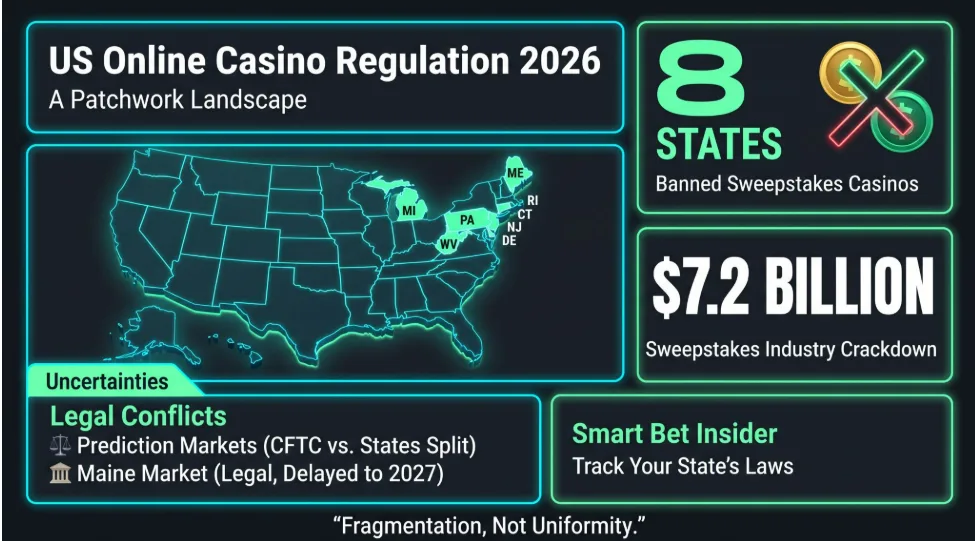
As of 2026, only eight states have legalized and launched, or are preparing to launch, regulated online casinos: Connecticut, Delaware, Maine, Michigan, New Jersey, Pennsylvania, Rhode Island, and West Virginia. If you live in one of these jurisdictions, you can generally play through state-licensed operators overseen by gaming regulators and subject to consumer protection requirements. Smart Bet Insider keeps a running list of exactly which platforms hold those licenses in each state.
What Happens Outside Those Eight States
If you live outside those states, there is currently no state-regulated online casino available to you. Some residents encounter offshore gambling websites or alternative gaming platforms, but these operators aren’t licensed by their home state and may not offer the same legal protections, dispute resolution processes, or responsible gambling safeguards found in regulated markets.
Sweepstakes Casinos Add Another Layer
Next, consider whether you’re using a sweepstakes casino. Several states have enacted laws restricting or prohibiting the dual-currency sweepstakes model, while others are actively debating similar legislation, so it’s worth verifying your state’s current position before participating.
Prediction Markets Remain Legally Unsettled
Finally, if you’re interested in prediction markets such as sports-related event contracts, remember the legal landscape is far from settled. The CFTC maintains it has exclusive federal jurisdiction over CFTC-regulated prediction markets, while several states continue to challenge that position in court — meaning availability can shift depending on ongoing litigation.
Where Regulated Online Casinos Stand in 2026
The sites in those eight states are fully regulated and operational everywhere except Maine, where iGaming has been legalized but the market has yet to launch. New Jersey remains the anchor market and the template every newer state copies.
That leaves the other 42 states relying on tribal casinos, commercial cardrooms, or offshore platforms for anything resembling online casino-style play. Federal law makes online gambling illegal by default, but individual states can legalize it through legislation or tribal compacts — which is exactly why the pace of expansion has been slow since the initial 2018–2021 wave. Only one state has moved the needle on regulated iGaming since then, and even that state’s launch is now stuck in litigation.
The Sweepstakes Casino Crackdown Is the Story of 2026
If there’s one regulatory shift that’s touched more players than any other this year, it’s the collapse of the sweepstakes casino loophole. Sweepstakes casinos run on a dual-currency model — players buy a “gold coin” virtual currency for entertainment and receive a secondary “sweeps” currency that can be redeemed for cash prizes. That structure let platforms operate like online casinos without a gaming license, and regulators have decided the loophole is closing.
Six States Ban the Dual-Currency Model Outright
Six states — California, Indiana, Maine, New York, Louisiana, and Tennessee — enacted outright bans in 2026, largely because the model had grown into a roughly $7.2 billion industry that functioned like gambling but paid no gaming taxes and skipped responsible-gambling protections. Indiana’s ban took effect July 1, 2026, making it the seventh state with an outright prohibition, and Maine’s followed in mid-July, pushing the total to eight.
Louisiana’s approach was the most aggressive: Governor Jeff Landry signed both a bill defining dual-currency gaming as illegal computer gambling and a companion bill making it a racketeering offense. Not every state has moved at the same speed or with the same tools, which is why enforcement still looks uneven from one border to the next.
Enforcement Still Varies by State
Not every ban has gone smoothly. Oklahoma’s SB 1589 passed the Senate 48-0 and the House 65-21, but Governor Kevin Stitt vetoed it days later — though a separate enforcement mechanism still puts the ban into effect November 1, 2026.
Six more states — Maryland, Massachusetts, Pennsylvania, Ohio, Maine, and Hawaii — have bills modeled on California’s approach sitting in committee, with an effective ban realistically 12–18 months away. Players in permissive states shouldn’t assume that status is permanent.
Maine’s Tribal iGaming Law Is Legal on Paper, Stuck in Court in Practice
Maine’s path to becoming the eighth regulated iGaming state came with a legal fight attached from the start.
Oxford Casino’s Equal-Protection Challenge
Governor Janet Mills let LD 1164 become law without her signature, granting the four Wabanaki Nations the exclusive right to operate online casino games in the state. Oxford Casino Hotel sued almost immediately, arguing the exclusivity arrangement amounts to an unconstitutional “race-based monopoly” under the Equal Protection Clauses of both the Maine and U.S. constitutions.
Tribes Intervene While the Market Stays Dark
The tribes didn’t sit on the sidelines. All four Wabanaki Nations — the Houlton Band of Maliseet Indians, the Mi’kmaq Nation, the Passamaquoddy Tribe, and the Penobscot Nation — moved to formally intervene in the case, and a judge granted the request. Their argument frames Oxford’s equal-protection theory as a threat to tribal-state gaming relationships nationwide, not just Maine’s.
The practical result is a market that’s legal but not live. Oxford Casino’s suit seeks a declaration that the law is unconstitutional along with an injunction blocking enforcement, and the Gambling Control Unit is simultaneously trying to build out licensing rules while fielding a federal constitutional challenge. Regulators are hoping to have the market live by early 2027, with rulemaking and license awards still ahead.
The Bigger Fight: Are Prediction Markets Casinos Too?
The most consequential regulatory battle of 2026 may not involve a traditional casino operator at all. Platforms like Kalshi now offer sports-related “event contracts” that function a lot like sports bets, and state regulators are increasingly treating them that way — while the CFTC insists they’re federally regulated derivatives entirely outside state reach.
State Courts and Federal Courts Disagree
Massachusetts became the first state regulator to go on offense, and in January 2026 a Suffolk County Superior Court judge ruled that Kalshi’s sports event contracts are subject to Massachusetts gaming law, rejecting the argument that federal oversight preempts state licensing. Courts elsewhere have gone the opposite way.
On February 19, 2026, a federal court in Tennessee sided with Kalshi, finding its sports contracts are likely federally regulated “swaps” that preempt state enforcement. On April 6, 2026, a Third Circuit panel ruled 2-1 that New Jersey gaming regulators cannot enforce state gambling law against Kalshi’s sports contracts, a genuine split among federal courts.
Congress and the Supreme Court May Settle It
Washington has taken notice. Senators John Curtis and Adam Schiff introduced the Prediction Markets Are Gambling Act on March 23, 2026, which would reclassify sports and casino-style event contracts as gambling outside CFTC jurisdiction. More than 34 states, the District of Columbia, and the Northern Mariana Islands have filed amicus briefs asserting state regulatory authority — a scale of opposition that could push the Supreme Court to take up the question even without a formal circuit split.
Smart Bet Insider: How to Actually Track This
The problem for players isn’t a lack of news — it’s that the news changes weekly and varies by state. A platform that’s legal today can be banned by August, and a state that looks close to iGaming legalization can shelve its bill without warning, as Massachusetts did earlier this year.
Smart Bet Insider exists to cut through that noise: tracking every state’s iGaming bills, sweepstakes casino bans, and prediction market rulings in one place, so you know exactly what’s legal where you live before you deposit a dollar. Bookmark it before your state’s next legislative session, because these fights rarely stay settled for long.
A Patchwork That’s Getting More Complicated, Not Less
Online casino regulation in the U.S. isn’t converging toward a single national standard — it’s fragmenting further. Eight states have regulated iGaming, but one of those eight is tied up in a federal equal-protection lawsuit. Six-plus states have banned sweepstakes casinos, but Oklahoma shows even a signed ban can get vetoed and rerouted. And an entirely new category — prediction markets — is forcing courts to decide what “gambling” even means in 2026.
None of these fights are close to resolved. The Maine lawsuit, the Kalshi circuit split, and the sweepstakes ban wave will all likely still be active stories heading into 2027. Follow Smart Bet Insider for ongoing coverage as each of these cases and bills moves toward resolution.
FAQs
How many states have legal online casinos in 2026?
Eight states have legalized online casinos: New Jersey, Delaware, Michigan, Pennsylvania, Connecticut, Rhode Island, West Virginia, and Maine. Of those, seven are fully operational; Maine’s market is legal but not yet live due to pending litigation and rulemaking.
Why are states banning sweepstakes casinos?
Regulators argue the dual-currency sweepstakes model functions like real-money gambling — letting players convert purchased “gold coins” into cash-redeemable “sweeps coins” — without a gambling license, gaming taxes, or responsible-gambling safeguards. Six or more states have passed outright bans in 2026, with several more in committee.
Is Maine’s online casino market open yet?
No. Maine’s law grants exclusive iGaming rights to the four Wabanaki Nations, but Oxford Casino Hotel has sued, arguing the exclusivity violates equal-protection law. Regulators are still building licensing rules, and a realistic launch date is early 2027 at the earliest.
Are prediction markets like Kalshi legal sports betting alternatives?
It depends who you ask. The CFTC and some federal courts say sports event contracts are federally regulated derivatives beyond state reach. Other courts, including one in Massachusetts, have ruled they’re subject to state gambling law — and the conflict may end up before the Supreme Court.
What happens if a sweepstakes casino ban passes in my state?
Once a ban takes effect, licensed operators typically stop accepting new deposits and wagers from residents in that state, and continuing to offer real-money-adjacent play can carry civil penalties or, in some states, criminal exposure for operators. Always confirm current status before playing.
Which states might legalize online casinos next?
Virginia, Illinois, Massachusetts, and Maryland have all seen iGaming bills introduced in 2026, but none has passed. Virginia’s bills would require passage in two separate sessions, meaning any launch there wouldn’t happen before 2028 at the earliest.
Where can I find reliable, current information on casino regulation by state?
Smart Bet Insider tracks state-by-state iGaming legalization, sweepstakes casino bans, and prediction market litigation as they develop, since legal status in this space can shift within weeks. Always verify current law in your specific state before depositing funds anywhere.