
NHL betting trends split into two groups, and telling them apart saves a bankroll. Some patterns rest on the structure of the sport itself, the low scoring, the overtime rules, the way the puck line is built. Those repeat season after season. Others are hot streaks dressed up as insight, and they break the week you finally trust them.
Hockey’s variance hides the difference better than any other sport. Smart Bet Insider separates the trends with a cause behind them from the ones running on a small sample and a good story. The patterns below are sorted by which kind they are.
The +1.5 Underdog Edge Is Built Into the Rules
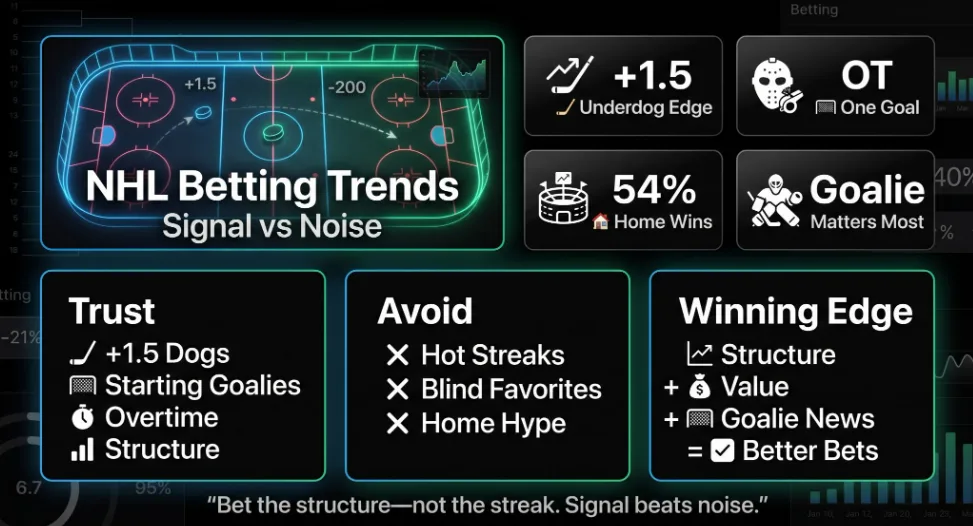
Puck-line underdogs cover at a rate no other major sport’s spread underdogs match. The +1.5 dog has held roughly a 60-40 edge over the favorite across recent seasons, a split Daily Faceoff tracked again through 2024-25. The number barely moves year to year.
Overtime is the reason, and it never changes. A game tied after regulation can only be decided by a single goal, so the +1.5 underdog cashes out the moment a game reaches the extra period. Hard Rock’s betting desk notes that roughly three-quarters of NHL games finish within a one- or two-goal margin, with empty-net goals turning many tight finals into two-goal results. The dog covers on structure, not form.
Favorites Laying -1.5 Fight the Same Math
The flip side holds just as firmly. Favorites covering the -1.5 puck line have to win by two clean goals, and they manage it well under half the time. Home favorites in particular have struggled to clear the number across full seasons, a weakness the overtime rule creates from the other direction.
Empty-net goals muddy the picture further. A favorite protecting a one-goal lead often surrenders a late empty-netter going the other way, or scores one to back into a cover that looked unlikely with a minute left. The margin swings on the final shift, which makes the -1.5 favorite a harder long-term hold than the price suggests.
Home Ice Means Less Than the Crowd Thinks
Home-ice advantage is real and small. Home teams win about 54 percent of the time, but the edge in goal terms runs near 0.3 goals, a figure TheSpread puts well below the home advantage in basketball or football. The crowd matters at the margins, not at the core of a handicap.
The betting consequence is that the venue rarely moves the spread on its own. Rest, travel, and the starting goaltender swing a game further than the building does. A trend built on a team’s gaudy home record usually rests on those other factors, and stripping them out leaves a home edge too thin to bet blind.
The Backup-Goalie Overreaction Cuts Both Ways
Goaltending shifts an NHL line more than any other single input. An elite starter can move the number half a goal, so a confirmed backup or a late scratch reshapes the market within hours. Bettors who check the starter before the public catches the news find the value first.
The overreaction runs the other way too. A backup start often tightens a team’s defensive effort rather than collapsing it, and the under or the underdog moneyline catches the overcorrection. The lesson holds in both directions: verify the starter every time, and never assume the number one is in net without confirmation.
The Trends That Break: Single-Season Team Streaks
Most published NHL trends are noise with a headline. A team going 6-1 ATS in its last seven as an underdog, or hitting the over in 14 of 18, describes what already happened and predicts almost nothing. The sample is tiny, the cause is usually luck, and the line adjusts the moment the streak gets attention.
These patterns fail because nothing structural supports them. A puck-line underdog covers on overtime math that repeats every night. A team’s two-week hot streak covers on shooting percentage that regresses by the next road trip. The durable trend has a mechanism you can name in a sentence. The fragile one has a record and a story, and the story is the warning sign.
Betting Trends Without Mistaking Noise for Signal
A trend earns trust when you can explain why it works without mentioning a specific team. The +1.5 dog, the -1.5 favorite’s burden, the goalie overreaction, each traces to a rule or a structural feature of the sport. Strip the team names out and the pattern still stands. Strip them out of a hot streak and nothing is left.
Smart Bet Insider tracks puck-line splits, goaltending news, and the situational spots where the math still favors one side through the full NHL season. Check the analysis before you back a streak the market has already priced out.
Frequently Asked Questions
Why do NHL underdogs cover the puck line so often?
The +1.5 puck-line underdog covers because overtime can only be decided by one goal, so any game reaching the extra period cashes the dog automatically. Underdogs have held roughly a 60-40 edge on the puck line across recent seasons. Combined with hockey’s low scoring, where most games finish within a one- or two-goal margin, the structure favors the dog regardless of form.
Is home ice an advantage in NHL betting?
Home ice is a real but modest advantage worth about 0.3 goals, far smaller than in basketball or football. Home teams win roughly 54 percent of games straight up, but that edge rarely moves the spread enough to bet on venue alone. Rest, travel, and goaltending influence a game’s margin more than the building does.
How much does the starting goalie matter in NHL betting?
The starting goaltender is the single most important input in an NHL handicap, capable of shifting a line by half a goal or more. A confirmed backup or a late scratch reshapes the market quickly, which rewards bettors who verify the starter before the public reacts. Backup starts also tend to produce value on the under, since skaters often tighten defensively in front of a substitute.
Which NHL betting trends are not worth following?
Single-season team streaks are the least reliable trends, such as a club going 6-1 against the spread over seven games or hitting the over in most of its recent matchups. These rest on small samples and short-term luck rather than any structural cause, and the line corrects once the streak draws attention. A trend is only worth following when you can explain its cause without naming a specific team.
Do favorites or underdogs win more in the NHL?
Favorites win more games straight up, around 54 to 56 percent, but underdogs offer better value against the puck line. Favorites laying -1.5 must win by two clean goals and cover well under half the time, while +1.5 underdogs cash on overtime and one-goal finishes. The most consistent structural edge in hockey sits with the underdog on the puck line, not the favorite on the moneyline.