The League That Built an Empire on a Game It Once Banned
The NFL has long held a complicated, often contradictory relationship with gambling. For decades, the league publicly treated sports betting as an existential threat—a corrupting force that could unravel the trust on which professional football was built. Today, sportsbook logos appear in stadiums, betting odds scroll across broadcast graphics, and the league’s own data partners monitor every wager placed on NFL games. That transformation did not happen without a history of scandals, suspensions, and institutional reckoning stretching back more than sixty years.
The NFL has been suspending players for gambling violations since the 1963 season — and the story of how the league went from its first high-profile suspensions to a wave of modern bans involving more than a dozen players reveals just how dramatically both the sport and American gambling culture have changed. Understanding that arc matters for anyone who follows the NFL, because the rules that govern what players can and cannot bet on are now more consequential—and more widely misunderstood—than ever.
1963: The First Scandal That Shook the League
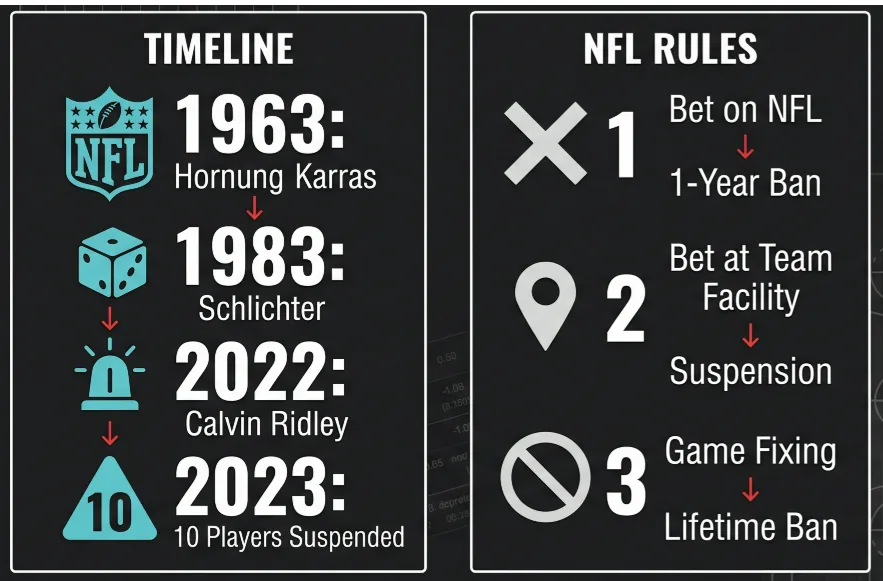
In April 1963, the NFL suspended Paul Hornung, the Packers halfback, for wagering on football. And he wasn’t the only star player exiled for an indefinite period. The league’s best defensive player, Lions tackle Alex Karras, suffered the same fate. The simultaneous suspension of two of the game’s biggest names sent shockwaves through professional football at a moment when the NFL was growing rapidly in popularity and could least afford a scandal touching its integrity.
Commissioner Pete Rozelle threw the book at both players. Karras had made at least six significant bets of $50 and $100 on NFL games since 1958. Hornung, football’s “Golden Boy” with an income of $50,000 in salary and endorsements, bet up to $500 on games. Neither bet against his own team, and neither made much money. Rozelle’s reasoning was forward-looking: a player who develops a habit of betting can fall into debt—and from debt, into the hands of professional gamblers who could compromise the game far more seriously. The core prohibition that justified those suspensions—never bet on NFL games—remains the foundational rule of the NFL’s official Gambling Policy to this day.
What the NFL Gambling Policy Actually Prohibits
Before examining the modern scandals, it is worth understanding exactly what the NFL’s Gambling Policy prohibits—because contrary to popular belief, players are not completely banned from all sports betting. Players may legally place bets on sports other than the NFL, provided they do so legally and while away from team facilities or official league events. The distinction is critical, and it is one that several players have learned the hard way.
The NFL’s gambling policy states that a player will receive an indefinite suspension — a minimum of one year or two years depending on severity — for betting on an NFL game that involves his team. Game fixing draws a permanent banishment from the league. Players would receive an indefinite suspension with a year-long minimum for sharing inside information or using a third party to bet on games. A player who bets on a non-NFL sporting event on team property would receive a two-game suspension without pay for a first violation, a six-game suspension for a second violation, and a year-long suspension for a third violation. The policy also explicitly forbids entering a sportsbook during the NFL playing season and participating in daily fantasy football — rules that apply to all players regardless of whether their team is in the postseason.
The Forgotten Middle Chapter: Art Schlichter
Between the Hornung-Karras suspensions and the modern era, one name stands as the NFL’s starkest cautionary tale. Schlichter lost almost $400,000 to local bookies, including $159,000 in a single week. Basketball and college football were his sports of choice. Schlichter got in so deep that he wound up notifying the FBI when he felt pressured by the bookies, helping with an investigation that ended in several arrests. The league was unsurprisingly none too happy about the situation regardless of his cooperation.
Commissioner Rozelle suspended Schlichter for the 1983 season. The league’s release said Schlichter had placed “sizable bets on at least 10 NFL games” that season. Rozelle reinstated Schlichter just over a year later. But, despite being ordered to complete therapy, he never conquered his problem gambling. He washed out of the league in short order and wound up in prison multiple times. Schlichter’s story — a first-round draft pick whose career dissolved entirely into addiction and legal trouble — remains the most tragic chapter in the NFL’s gambling history, and the clearest illustration of why the league treats betting on NFL games as the most severe violation short of game-fixing.
Calvin Ridley and the Modern Era’s First High-Profile Case
The NFL released a statement announcing Ridley’s suspension, saying he gambled on games over a five-day stretch in November 2021 when he was on the non-football injury list to address his mental health. The timing made the case uniquely painful: Ridley had publicly stepped away from football citing his wellbeing, and it emerged during that absence that he had been placing parlay bets on NFL games—including on his own team, the Atlanta Falcons, to win.
Ridley’s suspension was without pay and would cost him his entire salary of just over $11.1 million for 2022. The severity was deliberate. Under the NFL’s Gambling Policy, betting on NFL games—even without using inside information and even when no game was compromised — is treated as a direct attack on public confidence in the competition itself. The NFL said its investigation uncovered no evidence that Ridley used inside information or that any game was compromised in any way—and yet the full-season suspension stood, signaling to every player in the league exactly where the line is drawn.
Why Some Players Receive Different Suspensions
Not every gambling violation carries the same punishment, and the distinction matters. The Ridley case involved betting on NFL games — the most serious category under league policy. The 2023 wave of suspensions that followed introduced a more nuanced picture, with some players suspended indefinitely and others receiving shorter bans depending on what they bet on and where.
Detroit Lions wide receivers Jameson Williams and Stanley Berryhill received six-game suspensions for gambling violations, while Lions wide receiver Quintez Cephus, safety C.J. Moore, and Washington Commanders defensive end Shaka Toney were all suspended indefinitely for gambling on NFL games. Williams’ shorter suspension reflected the fact that he had wagered on non-NFL sporting events from a team facility—violating the location-based rules rather than the core prohibition on betting on football itself. In 2023, the NFL and NFL Players Association revised the disciplinary framework to better reflect the severity of different violations, expanding player education to reduce confusion as legal sports betting has become more widespread. The full breakdown of those disciplinary tiers is outlined in the NFL’s official Gambling Policy for Players and Personnel.
A Sixty-Year Pattern With No End in Sight
The line from Hornung and Karras in 1963 to the wave of Lions and Colts suspensions in 2023 is not a straight one — but it points consistently in the same direction. Gambling has always been woven into professional football’s culture, and the NFL has always responded with suspension and public condemnation while simultaneously benefiting from the public’s wagering interest. What has changed is the accessibility of betting, the sophistication of monitoring, and the financial stakes involved for players who run afoul of the rules.
Players today can place a bet on a smartphone in seconds, and the league’s data partners can flag that activity almost as quickly. The NFL’s Gambling Policy draws a clear line: betting on NFL games means at minimum a year-long suspension, and game-fixing means a lifetime ban. Until the league resolves the fundamental contradiction between its commercial partnership with the gambling industry and its prohibition on player participation, those suspensions will keep coming — and the sixty-year pattern will continue.
FAQs
Who were the first NFL players suspended for gambling?
NFL Commissioner Pete Rozelle suspended All-Pros Paul Hornung of the Green Bay Packers and Alex Karras of the Detroit Lions for betting on NFL games on April 17, 1963. Hornung had placed bets of up to $500 on NFL games from 1959 to 1961, while Karras admitted to making several bets of $50 or $100. Both suspensions lasted one year as they were reinstated in 1964.
What does the NFL gambling policy actually prohibit?
Under the NFL’s official Gambling Policy, players are prohibited from betting on any NFL game, sharing inside information that could influence betting markets, or asking a third party to place a wager on their behalf. The two key rules are: never bet on NFL games, and do not gamble — no sports bets, casino, or card games — while with the team in any capacity, including at the team facility, stadium, hotel, or on team transportation. Coaches, staff, and personnel face the additional restriction of not being permitted to bet on any sports at all.
Why did Calvin Ridley receive a full-season suspension?
The NFL determined that Ridley placed multilegged parlay bets involving the Atlanta Falcons to win via his mobile device while on the non-football injury list to address his mental health. Betting on NFL games — the most serious category under league policy — carries a minimum one-year suspension regardless of the amount wagered or whether any game was compromised. The NFL’s Gambling Policy treats this as a direct threat to public confidence in the integrity of competition.
Why did Jameson Williams receive a shorter suspension than Calvin Ridley?
The distinction comes down to what was bet on and where. Williams wagered on non-NFL sporting events from a team facility — a location-based violation rather than the core prohibition on betting on football itself. A player who bets on a non-NFL sporting event on team property receives a two-game suspension without pay for a first violation, a six-game suspension for a second violation, and a year-long suspension for a third violation — a significantly lower tier than the indefinite suspension triggered by betting on NFL games.
Did Hornung and Karras ever make it to the Hall of Fame?
Yes, though both had to wait significantly longer than their careers merited. Hornung — the 1961 MVP and a four-time champion — was not voted into the Pro Football Hall of Fame until 1986, his 15th time on the ballot. Karras, the less remorseful of the two, had to wait 45 years for his election in 2020. The gambling suspensions cast a long shadow over both legacies for decades.
What happened after the 2023 wave of suspensions?
Following the 2023 offseason in which 10 players were suspended for violating the league’s gambling policies, the NFL revised its disciplinary framework and expanded player education to reduce confusion as legal sports betting has become more widespread. In-person gambling policy education and training became mandatory for all players in 2024, prepared in collaboration with the NFL Players Association. The league also assigned integrity representatives — typically retired FBI or senior law enforcement officers — to each team to monitor compliance.
Can NFL players legally bet on anything?
Yes. Under the NFL’s Gambling Policy, players may legally place bets on non-NFL sports through legal sportsbooks when away from team facilities and during legal betting hours in states where betting is permitted. The key restrictions players must follow include never entering a sportsbook during the NFL playing season and not playing daily fantasy football — with coaches, staff, and personnel facing the stricter rule of not being permitted to bet on any sports at all.