

Colorado Just Changed the Rules
Colorado’s sports betting market launched in 2020 as one of the most competitive in the U.S., with easy licensing, favorable taxes, and 17 active sportsbooks. In 2026, SB 131—now awaiting Governor Jared Polis’ signature—would shift it toward one of the most consumer-protective regulated markets, changing how bettors deposit, receive promotions, and wager day to day.
Smart Bet Insider tracks sports betting legislation across every regulated US state, covering not just what the rules are but what they mean for bettors on the ground. SB 131 is a mixed bag depending on your betting profile — some provisions are genuinely bettor-friendly, others add friction to everyday activity. This guide breaks down every major provision of the bill and what it means for Colorado sports bettors in practical terms.
What SB 131 Actually Contains: The Key Provisions
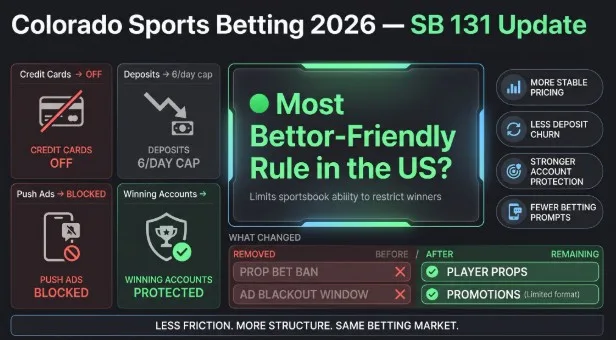
The final version of SB 131 passed the Colorado House 50-13 and cleared the Senate 20-15 before heading to the Governor. The bill underwent significant revision during its legislative journey — several of its most aggressive original provisions were stripped out before final passage. What remains is a focused package of consumer protections covering four primary areas: deposit limits, a credit card ban, advertising restrictions, and a prohibition on sportsbooks limiting winning bettors’ accounts.
The deposit limit provision caps the number of separate deposits a bettor can make at any licensed Colorado sportsbook at six per day. The credit card ban prohibits all Colorado-licensed operators from accepting credit cards as a funding method, aligning Colorado with a growing group of states that restrict credit-based wagering. The advertising provisions prohibit sportsbooks and their marketing affiliates from targeting bettors under 21 through any media where the majority of the demographic audience is reasonably expected to be underage. And critically for serious bettors: the bill restricts operators from limiting or excluding winning accounts — with narrow exceptions for suspicious activity and responsible gambling concerns only.
What Got Removed: The Provisions That Didn’t Make It
Understanding what SB 131 doesn’t contain is as important as understanding what it does. The original bill was significantly more aggressive than the final version. An early draft proposed a complete ban on player prop bets in Colorado — a provision that would have fundamentally restructured the state’s betting market. Legislators removed that provision after a fiscal estimate showed a complete prohibition of props would have reduced Colorado sports betting tax revenues by $2.4 million in 2026-27, $2.6 million in 2027-28, and $2.7 million in 2028-29. Prop bets survive in Colorado.
The original bill also proposed a broad advertising blackout between 8 a.m. and 10 p.m. and during live sports broadcasts — language that would have dramatically curtailed sportsbook marketing. That provision was removed before the Senate vote. Push notifications and SMS messages designed to encourage betting or deposits are prohibited under the final bill, but the broader broadcast advertising restrictions were stripped. The version that reached the Governor’s desk is meaningfully more moderate than what Colorado sportsbooks initially faced — but it still represents the most significant regulatory shift the state’s market has seen since launch.
The Account Restriction Ban: The Provision Sharp Bettors Actually Want
One of the most consequential provisions in SB 131 — and the one receiving the least mainstream coverage — is the restriction on sportsbooks limiting or excluding winning accounts. In the current unregulated environment, sportsbooks legally reduce bet limits or close accounts of profitable bettors with no notice or justification required. This is a widespread practice across every major regulated US book, and it meaningfully restricts sharp bettors’ ability to bet at scale once they demonstrate consistent profitability.
What Colorado’s bill creates is what sharp bettors call the “Sharp Bettor Shield” — a regulatory framework that forces sportsbooks to justify account restrictions through documented evidence of fraud or problem gambling rather than simply acting on profitability signals. No other major US regulated market has this protection in place.
If Governor Polis signs SB 131, Colorado would become the most favorable regulated state for profitable bettors in the country — a development that will likely reshape where serious US bettors prioritize their account activity. Research on betting market efficiency consistently shows that sharp money improves long-term market accuracy, meaning the Sharp Bettor Shield benefits market quality as well as individual bettors.
What SB 131 Actually Changes in Betting Behavior (Not Just Rules)
Beyond the Surface Rules
Most coverage of SB 131 focuses on rule changes like credit card bans, deposit caps, and push notification limits, but its bigger impact is behavioral. It reduces frictionless “micro-deposit” habits by limiting instant funding and encouraging bettors to pre-fund sessions instead of depositing reactively during live betting swings.
Rise of Pre-Funded Betting Behavior
That shift naturally increases what can be called bankroll pre-loading — depositing a planned amount once, then betting from that fixed balance rather than continuously reloading during games.
Reducing Impulsive Betting Cycles
Research on online sports betting behavior shows that mobile betting environments amplify rapid, continuous wagering patterns due to frictionless design and constant availability, which can increase impulsive betting cycles. SB 131 interrupts that loop: fewer deposit touchpoints means fewer opportunities for emotionally driven wagering decisions, particularly in high-volatility environments like live betting or same-game parlays.
From Micro-Deposits to Session-Based Betting
Over time, this reduces in-session chasing behavior — where bettors reload after losses in an attempt to recover quickly. In effect, SB 131 marks the gradual end of frictionless micro-deposit betting, replacing it with a more deliberate, session-based wagering model that changes not just how much people bet, but when and how those decisions are made.
What the Deposit Cap and Credit Card Ban Mean Day to Day
For most recreational Colorado bettors, the six-deposit-per-day cap will be invisible in practice. The average bettor funds their account infrequently and is unlikely to approach that threshold under any normal betting pattern. As the behavioral analysis above makes clear, the cap is targeted at micro-deposit behavior — repeated small reloads across a single live betting session — rather than the standard funding pattern of a disciplined bettor operating from a pre-loaded bankroll.
The credit card ban is more broadly felt. Colorado bettors who currently use credit cards at platforms like DraftKings, FanDuel, or BetMGM will need to transition to debit cards, bank transfers, PayPal, Venmo, or other accepted payment methods. Debit card and PayPal deposits already work seamlessly at all major Colorado books, so the practical friction is low for most bettors — but the transition requires a one-time account update before the law takes effect. Checking your preferred sportsbook’s banking page for the most current accepted deposit methods is the fastest way to verify what changes are needed on your end.
Smart Bet Insider: Colorado Bettors Have More Leverage Than Ever
SB 131 doesn’t reduce the quality of the Colorado betting market — for prepared bettors it meaningfully improves it. The Sharp Bettor Shield addresses the single biggest structural disadvantage serious bettors face in regulated US markets. The prop market survives intact. The push notification ban reduces low-value promotional noise without affecting the genuinely useful offers. And the credit card restriction is an adjustment, not a barrier.
Smart Bet Insider covers the Colorado regulated market continuously — tracking legislative developments, sportsbook line quality, and weekly value picks across NFL, NBA, NHL, college football, and more. As SB 131 moves toward implementation, Smart Bet Insider will flag exactly what changes at each major book and when, so Colorado members are always one step ahead of the market. Follow Smart Bet Insider today and approach the new Colorado sportsbook landscape with complete clarity on what the rules mean for your betting operation.
Colorado Is Becoming the Best Regulated Market for Serious Bettors
SB 131 is the most significant shift in Colorado’s sports betting regulatory framework since the market launched in 2020 — and for serious bettors, it moves the state in the right direction. Prop markets survive. The Sharp Bettor Shield protects profitable accounts. Push notification spam ends. The credit card ban and deposit cap are minor operational adjustments for disciplined bettors with managed bankrolls. No other major US regulated market offers the combination of competitive market depth and account protection that Colorado is positioned to deliver once SB 131 is signed.
Smart Bet Insider will track every implementation detail as the law takes effect and flag exactly what changes at each major Colorado book. Follow Smart Bet Insider now and make sure you’re fully positioned to take advantage of the new Colorado sportsbook landscape the moment it goes live.
FAQs
1. Has SB 131 been signed into law in Colorado?
As of late May 2026, SB 131 has passed both chambers of the Colorado legislature — the Senate 20-15 and the House 50-13 — and is on Governor Jared Polis’ desk awaiting signature. Polis has 30 days from the date the bill was sent to him to sign, veto, or allow it to become law without his signature. Ballotpedia’s Colorado legislation tracker is the most reliable resource for monitoring the bill’s final status in real time.
2. Will I still be able to bet player props in Colorado?
Yes — the original SB 131 proposal included a complete prop bet ban, but that provision was removed during the Senate Finance Committee process after legislators estimated it would reduce state tax revenues by $2.4–2.7 million annually. The final bill that reached Governor Polis’ desk leaves prop markets fully intact.
3. How does the six-deposit-per-day limit affect me?
For most recreational bettors, it won’t. The cap is designed to address problem gambling patterns involving multiple rapid redeposits in a single session. If you fund your account once before a game day and manage a bankroll normally, you will not encounter this limit under any typical betting pattern.
4. Why are credit card deposits being banned?
The credit card ban aligns Colorado with a growing group of US and international regulated markets that prohibit credit-based wagering. The policy rationale is that betting with credit creates debt risk that debit or bank-funded wagering does not. Debit cards, PayPal, Venmo, bank transfers, and other non-credit methods remain fully available at all major Colorado sportsbooks.
5. What is the Sharp Bettor Shield and does it apply to all accounts?
The Sharp Bettor Shield is the provision in SB 131 that restricts Colorado-licensed sportsbooks from limiting or closing winning bettor accounts without documented evidence of fraud or problem gambling. It applies to all account holders at licensed Colorado operators. This is the most bettor-favorable provision in the bill and has no equivalent in any other major US regulated sports betting market.
6. Will sportsbooks still be able to send me promotional offers?
Yes — SB 131 bans push notifications and SMS messages soliciting bets or deposits, but does not prohibit email promotions, in-app offers, or loyalty program communications. The promotional calendar at major Colorado books will continue; the restrictions apply specifically to unsolicited mobile alerts designed to prompt depositing or wagering behavior.
7. Which Colorado sportsbooks are affected by SB 131?
All licensed online sports betting operators in Colorado are subject to SB 131 if signed into law. That includes DraftKings, FanDuel, BetMGM, Caesars, and all other books operating under Colorado’s regulatory framework. Offshore platforms operating outside Colorado’s licensing system are not subject to the bill’s provisions.