A Loss That Feels Like Something Else
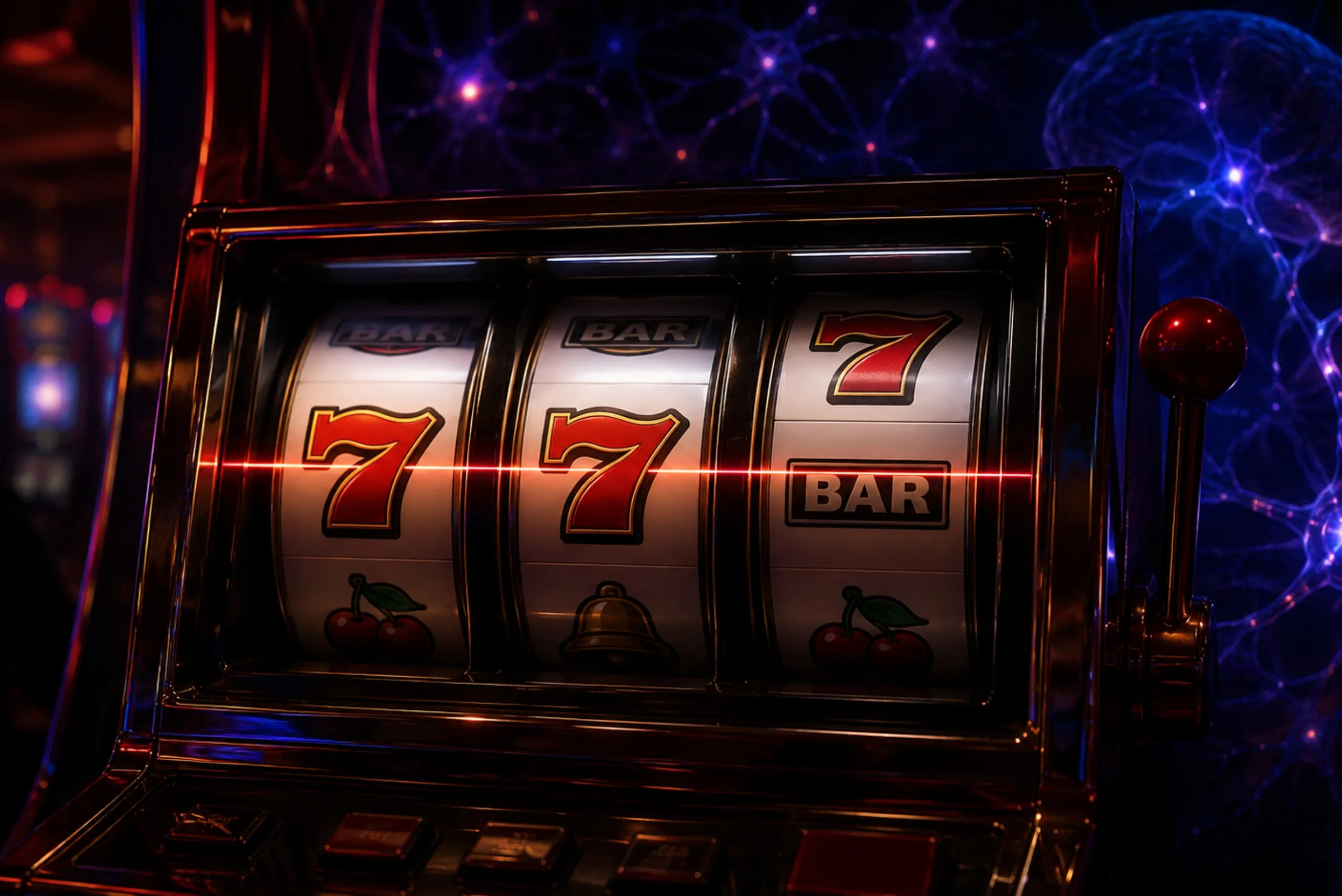
Pull a slot machine lever and watch two cherries line up on the payline while a third lands one position above it, and something strange happens in your brain. You lost. You know you lost. And yet the experience does not register the way an ordinary loss does. Compared to “full-misses,” near-misses were experienced as less pleasant, but increased desire to play. That contradiction — a worse-feeling outcome that makes you want to keep playing more than an outcome that feels neutral — is not an accident of psychology. It is, in a precise and patentable sense, a feature.
The Brain’s Confused Response to Almost-Winning
Near-Misses Look Like Wins to the Reward System
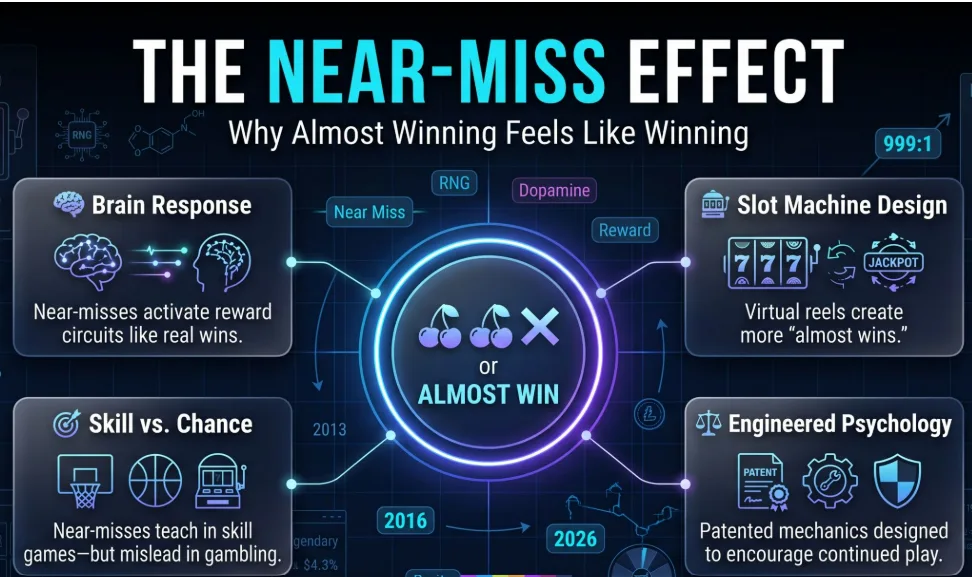
One prominent hypothesis is that the experience of almost-winning — a so-called “near-miss” — can invigorate gambling activity, and may accelerate the development of pathological gambling in vulnerable individuals. Near-miss events can produce similar psychological and physiological changes as winning outcomes. Neuroimaging studies have shown that near-miss outcomes involve reward brain circuits overlapping with the neural activity involved in monetary wins, by involving a circuit of areas — the ventral striatum and rostral anterior cingulate cortex — linked to reinforcement processing.
The Dopamine Signature
These observations suggest that near-misses convey a positive reward signal encoded by the dopaminergic circuits that support reward expectancy and reinforcement learning. Even without a monetary prize, the brain can release dopamine in response to a near win, reinforcing the desire to continue playing. According to behavioral studies, this effect can be even more stimulating than a clear loss.
Why Near-Misses Teach You in Skill Games — But Mislead You in Gambling
Real Feedback Versus Manufactured Feedback
In everyday life, near-misses are often valuable learning experiences. A basketball shot that rims out tells a player their aim was almost correct. A golfer who narrowly misses a putt gains information about the speed or slope of the green. Even in video games, failing a level by a few seconds or narrowly losing a race provides useful feedback that can be applied on the next attempt. In all of these situations, performance is influenced by skill, and practice genuinely increases the probability of future success.
Why the Slot Machine Lies to You
Slot machines operate under an entirely different principle. A near-miss — such as two jackpot symbols lining up while the third stops just above the payline — provides no information whatsoever about the likelihood of winning on the next spin.
Each spin is generated independently by a random number generator, meaning the machine has no memory of previous outcomes. An “almost win” does not indicate that the player is getting closer to a jackpot or that persistence will improve their chances. Gaming regulators require approved RNG systems specifically to ensure each game outcome is statistically independent and random, as detailed in the Nevada Gaming Control Board’s Technical Standards.
A Learning Mechanism Turned Against the Player
The problem is that the human brain evolved to treat near-success as a signal that improvement is possible. In skill-based activities, that instinct is adaptive because feedback helps refine future performance. In games of pure chance, however, the same learning mechanism becomes misleading.
Near-misses increase desire to play despite being experienced as less pleasant than a full miss, a finding documented in the foundational Cambridge near-miss study published in Neuron, which showed that near-misses can increase motivation to continue gambling even though they carry no predictive value — effectively encouraging players to interpret random, independent outcomes as signs of progress.
The Cambridge Experiment That Mapped It
Watching the Brain Get Fooled in Real Time
Using a simplified slot machine task, researchers measured behavioral and neural responses to gambling outcomes. By this formulation, on near-miss trials, as the slot machine reel approaches a standstill during the anticipation phase, the subject develops an expectation that they are about to win. The brain begins forming a prediction of a win before the outcome is final — and then has to abruptly cancel that prediction in the final instant.
A Reward Promised and Then Withdrawn
In the slot machine task, this positive prediction error is rapidly followed by a negative prediction error in the outcome phase, as the expected win is withheld. Dopamine cells show a pause in firing to omission of an expected reward. That whiplash — a surge of anticipatory reward followed by its sudden retraction — is precisely what keeps the motivational pull of a near-miss distinct from an ordinary, unremarkable loss.
Why This Matters More for Some Gamblers Than Others
The Effect Is Amplified in Pathological Gambling
In neuroimaging studies of slot-machine play, activation of the midbrain dopaminergic region in response to a near-miss was positively correlated with level of gambling severity in recreational gamblers, and the distribution of signals was most like winning outcomes. Pathological gamblers have amplified brain responses to near-misses, which likely contribute to their persistent gambling behavior.
A Distinction From Drug Addiction
In contrast to researchers’ hypothesis, a dopamine D2 receptor antagonist did not induce any reliable modulation of brain responses to near-misses, suggesting these results are not simply explained by dopamine receptor blockade — with implications for treatment and gambling regulation. The mechanism is more nuanced than a single neurotransmitter switch, which is part of why near-miss-driven gambling has proven so difficult to treat with medication alone.
The Engineering: Slot Machines Are Built to Produce This Exact Outcome
From Mechanical Reels to Virtual Reel Mapping
Modern slot machines do not generate near-misses by accident — they are mathematically engineered to produce them at a controlled, optimized frequency. While older mechanical slots had equal chances for each symbol position, modern machines use virtual reels with hundreds or thousands of stops mapped to the visible symbols. This technology allows manufacturers to weight certain symbols differently, making high-value jackpot symbols appear more frequently on the visible reels than their actual probability would suggest.
The Mathematics Behind the Illusion
High-value symbols like jackpot icons get fewer virtual positions assigned to them, making them genuinely rare. Low-value symbols get more virtual positions, so they appear frequently. The weighting also means high-pay symbols often land just above or below the payline more than pure chance would predict, creating “near miss” experiences that make it feel like you almost won. This is accomplished by clustering higher paying symbols above or below blank symbols on the slot machine virtual reels.
The Patent That Says the Quiet Part Out Loud
A Design Goal Written Into Patent Law
Universal Entertainment Corporation’s 1999 patent explicitly describes a system for mapping virtual reel stops to physical reel positions such that near-miss outcomes appear more frequently. The patent language is remarkably direct: the goal is to create “an exciting near-miss situation” to increase the chance that the player will continue to play.
Not a Conspiracy Theory — Disclosed Engineering
Near-miss frequency on modern slot machines is not determined by chance. It is a design parameter, tuned by engineers, protected by patents, and optimised through player behaviour data. The machine decides you lose, then selects a reel animation that makes the loss look close.
The Regulatory Line: Where Casinos Are Allowed to Go
A 1989 Ruling Drew an Unusual Distinction
A case brought before the Nevada Gaming Commission in 1988 resulted in a 1989 ruling that the proprietary computer algorithms used by one slot machine manufacturer to create a high number of near misses on the payline are “unacceptable,” whereas the use of virtual reel mapping to create near misses above and below the payline is acceptable.
A Loophole Regulators Accepted as Legal
According to a recognized authority on casino gambling, in answer to a reader’s question regarding the near miss: “What you are describing — winning combinations appearing more often than would occur randomly — is called ‘near-miss’ programming. Although I can’t speak to the legality of ‘near-miss’ programming for each and every gaming jurisdiction, I can state it has been ruled illegal in both New Jersey and Nevada.” Near-misses directly on the payline are prohibited; near-misses adjacent to the payline, achieved through virtual reel weighting, are not — a distinction with little psychological meaning to the player but significant legal meaning to the regulator.
The Loss Engineered to Feel Like Almost a Win
The near-miss effect sits at an unusual intersection of neuroscience, mathematics, and law. The brain’s reward circuitry cannot fully distinguish a near-miss from a win in the moment it happens, generating a dopamine signal that keeps the desire to continue playing alive even as the wallet empties. Near-miss strategies exemplify how gambling machines leverage psychology and technology to foster engagement. Through mechanisms like virtual reel mapping, teaser strips, and asymmetric reels, designers create captivating illusions of control and luck.
The same mental shortcut that helps a basketball player improve their jump shot is, inside a slot machine governed by an RNG with no memory of past spins, being exploited rather than rewarded. None of this is hidden — it is patented, regulated, and mathematically documented. What makes it effective is precisely that knowing how it works does not make the dopamine surge go away.
If you find that slot machines or other near-miss-driven games are affecting your ability to stop playing, this is a sensitive topic worth taking seriously, and speaking with a professional or a gambling support service can help you find the right resources.
FAQs
What is the near-miss effect in gambling?
The near-miss effect stimulates reward-related parts of the brain such as the ventral striatum, and can increase heart rate and dopamine transmission in the brain, with the stimuli causing the feeling that the gambler is close to a win. It causes players to interpret a loss that resembles a win as encouraging evidence that a real win is imminent.
Why do near-misses feel meaningful in skill-based games but not in gambling?
In skill-based activities like basketball or golf, a near-miss genuinely reflects how close your technique was to succeeding, and practice can improve future outcomes. In slot machines, each spin is generated independently by an RNG with no memory of prior spins, so a near-miss carries zero predictive information — a distinction enforced by Nevada’s gaming technical standards requiring statistically independent outcomes.
Why does a near-miss feel almost as good as winning?
Neuroimaging studies have shown that near-miss outcomes involve reward brain circuits overlapping with the neural activity involved in monetary wins. As the slot machine reel approaches a standstill during the anticipation phase, the subject develops an expectation that they are about to win — a prediction the brain forms before the final outcome is revealed, as documented in the original Cambridge study.
How do slot machines engineer near-misses?
Modern machines use virtual reels with hundreds or thousands of stops mapped to the visible symbols, allowing manufacturers to weight certain symbols differently and make jackpot symbols appear near the payline more often than their true probability would suggest. This technique, known as virtual reel mapping, lets designers separate what players see from the actual underlying odds.
Is engineering near-misses into slot machines legal?
It depends on placement. A 1989 Nevada Gaming Commission ruling found that algorithms creating a high number of near misses directly on the payline are unacceptable, while using virtual reel mapping to create near misses above and below the payline is acceptable. The latter remains standard industry practice today.
Are near-misses more powerful for problem gamblers?
Yes. Pathological gamblers have amplified brain responses to near-misses, which likely contribute to their persistent gambling behavior, and activation of the midbrain dopaminergic region in response to a near-miss was positively correlated with level of gambling severity.
Is there actual patented technology behind near-miss design?
Yes. Universal Entertainment Corporation’s 1999 patent explicitly describes a system for mapping virtual reel stops to physical reel positions such that near-miss outcomes appear more frequently, with patent language stating the goal is to create “an exciting near-miss situation” to increase the chance that the player will continue to play.