

Baseball’s Oldest Sin, Baseball’s Strictest Punishment
No professional sport in America has a more fraught, more consequential, or more thoroughly documented relationship with gambling than Major League Baseball. The rules governing betting on the game were not invented in a boardroom — they were forged in the wreckage of the 1919 Black Sox scandal, when eight Chicago White Sox players accepted money from gamblers to throw the World Series against the Cincinnati Reds. That catastrophe produced MLB’s foundational gambling prohibition, posted on the wall of every clubhouse in the country for over a century: bet on baseball, and you are gone.
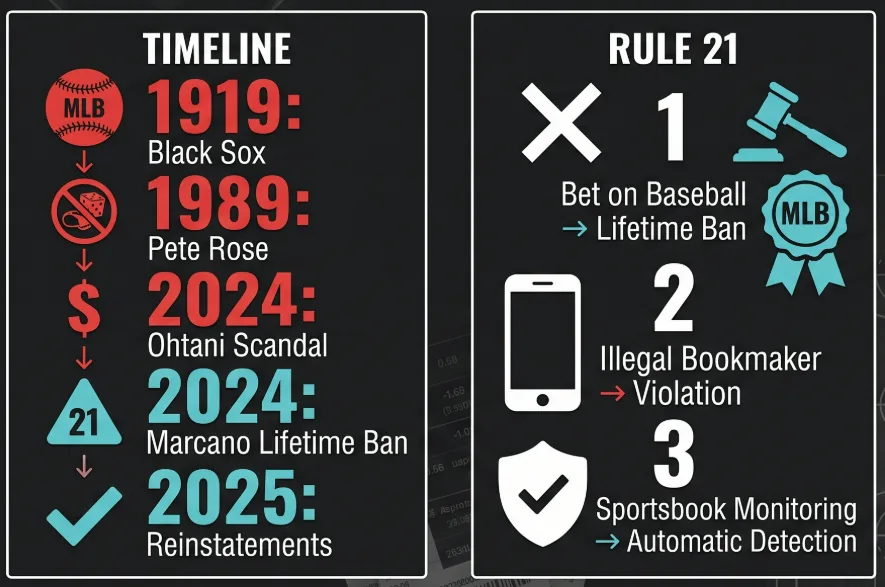
Two pieces of text form the backbone of baseball’s gambling policy: Rule 21(d) of MLB’s own rules and bylaws, and the Basic Agreement negotiated between the owners and the MLB Players Association. MLB Rule 21 has long guided the code of ethics regarding gambling, and it’s behind the lifetime suspensions of uniformed baseball personnel from Shoeless Joe Jackson to Pete Rose. From the Black Sox to a $17 million theft scandal involving baseball’s biggest modern star, the timeline of MLB gambling scandals is one of betrayal, denial, and consequences that have defined the sport’s identity for more than a century.
Understanding MLB Rule 21: What the Policy Actually Prohibits
No Betting on Baseball, at Any Level
According to the Collective Bargaining Agreement, players can’t bet on baseball. They cannot bet on MLB games, minor league games, youth games, high school games, college games, or international games. If it involves baseball at all, they cannot bet on it. That also includes fantasy baseball or any daily fantasy baseball game that includes a cash prize.
The Illegal Bookmaker Prohibition
Players and personnel are also absolutely prohibited from placing bets with illegal bookmakers regardless of the sport involved. Rule 21 states that players and team employees are prohibited from placing wagers, even legal bets, on baseball and from wagering with illegal or offshore bookmakers. However, players may legally bet on non-baseball sports through legal sportsbooks in states where betting is permitted — a distinction that has become increasingly significant as legalized sports betting has spread across the country since 2018.
1919: The Scandal That Created the Rules
Eight members of the Chicago White Sox were accused of intentionally losing the 1919 World Series against the Cincinnati Reds in exchange for payment from a gambling syndicate, possibly led by organized crime figure Arnold Rothstein. In response to the scandal, the National Baseball Commission was dissolved and Judge Kenesaw Mountain Landis was appointed to be the first commissioner of baseball, given absolute control over the sport to restore its integrity. Despite acquittals in a public trial in 1921, Landis permanently banned all eight implicated players from professional baseball.
The 2025 Reinstatement
The eight men’s bans stood for more than a hundred years — until MLB Commissioner Rob Manfred’s landmark May 2025 ruling removed all deceased individuals from the permanently ineligible list, opening the door to Hall of Fame consideration for players including Shoeless Joe Jackson. The ruling did not overturn the historical findings of the scandal or declare any player innocent. What it did was establish that permanent ineligibility ends upon death — a policy decision that reverberates directly through every gambling scandal that came after 1919.
1989: Pete Rose and the Lifetime Ban That Defined an Era
On August 23, 1989, as punishment for betting on baseball, Cincinnati Reds manager Pete Rose accepted a settlement that included a lifetime ban from the game. Rose was not just a manager — he was baseball’s all-time hits leader, a 17-time All-Star, and one of the most recognizable figures in the sport’s history. The scandal did not emerge from nowhere.
The Investigation
Major League Baseball began investigating Pete Rose in 1988, the year before it launched the full-blown, publicly announced probe that resulted in his banishment. MLB suspected in 1988, months before the public became aware of any investigation, that Rose was betting on baseball and was hundreds of thousands of dollars in debt. Lawyer John Dowd, who led MLB’s investigation, issued a 225-page report to Commissioner Bart Giamatti on May 9 about his findings. The report included phone records and testimonies primarily from bookmaker Ron Peters and Rose’s former friends, claiming Rose placed bets on baseball, including on the Reds.
The Confession and Its Consequences
In 2004, after years of repeated denials, Rose published a book in which he finally confessed to gambling on the Reds, though he added that he had always bet on the Reds to win. In 1991, the Baseball Hall of Fame formally voted to ban those on the permanently ineligible list from induction. Rose petitioned for reinstatement multiple times without success — until the same May 2025 MLB policy change that reinstated the Black Sox players also restored his eligibility for Hall of Fame consideration, though Rose had died in September 2024 at 83, never having received the reinstatement he spent decades pursuing.
2024: The Ohtani Scandal That Upended Baseball’s Opening Day
Baseball superstar Shohei Ohtani said he didn’t know that his now-fired interpreter, Ippei Mizuhara, was involved in alleged gambling and theft until a couple of days before he addressed the public. Ohtani said he was saddened and shocked at hearing the allegations, and stated that he has never bet on sports. The scandal broke during the Dodgers’ 2024 season opener in Seoul, South Korea — a moment designed to showcase baseball’s global reach that instead became the sport’s most disruptive gambling story in decades.
The Theft
Ippei Mizuhara was sentenced to 57 months in federal prison for illegally and without authorization transferring nearly $17 million from Ohtani’s bank account to pay off his own substantial gambling debts incurred with an illegal bookmaking operation. Mizuhara pleaded guilty in June 2024 to one count of bank fraud and one count of subscribing to a false tax return.
How Mizuhara Did It
Mizuhara changed the security protocols on Ohtani’s bank account so bank employees would call him rather than Ohtani, and impersonated Ohtani in calls with bank employees at least 24 times. Ohtani was cleared of any involvement. Critically, this case also illustrated the reach of Rule 21(d)(3) — Mizuhara’s violation was not betting on baseball, but using an illegal bookmaker, which the rule prohibits for all MLB personnel regardless of the sport being wagered on.
How MLB Enforces Rule 21 Today
Integrity Monitoring and Sportsbook Partnerships
Modern technology has fundamentally changed how Major League Baseball detects gambling violations. Rather than relying on whistleblowers or lengthy investigations alone, MLB now works with licensed sportsbooks and independent integrity monitoring services to identify suspicious betting activity. Legal sportsbook operators are required under their agreements with the league to report betting accounts that may belong to MLB players, coaches, umpires, or other league personnel — and those reports are cross-checked against MLB rosters and personnel records, allowing the league to investigate potential Rule 21 violations quickly.
Mandatory Player Education
Each Spring Training, all Major League and Minor League players must attend in-person sessions that specify the requirements of MLB Rule 21 and MLB’s Sports Betting Policy, as well as other best practices. MLB hosts a wide array of English- and Spanish-language awareness programs that reach players as they begin their professional baseball careers, as they near the Major Leagues, and as they begin each new season. Ironically, the expansion of legalized sports betting has made Rule 21 easier — not harder — to enforce.
Unlike illegal bookmakers, licensed sportsbooks maintain detailed digital records and cooperate with professional sports leagues, creating an audit trail that allows suspicious betting activity to be detected far more efficiently than in previous decades.
2024: Tucupita Marcano and the First Lifetime Ban in a Century
How the Investigation Began
The enforcement system described above is precisely what ended Tucupita Marcano’s career. The 2024 case demonstrates how that system works in practice: MLB’s investigation began after a licensed sportsbook notified the league of betting activity linked to accounts associated with current professional baseball players. Investigators then compared account information, betting histories, and transaction records before determining that Marcano had placed hundreds of wagers on baseball, including games involving the Pittsburgh Pirates while he was a member of the organization.
The Ruling
MLB permanently banned Tucupita Marcano after determining that the infielder placed 387 baseball bets totaling more than $150,000, including wagers on games involving the Pittsburgh Pirates when he was with the team last season. He became the first active player in a century banned for life because of gambling. Marcano’s ban was accompanied by one-year suspensions for four other players: Oakland Athletics reliever Michael Kelly and minor-league players Jay Groome, José Rodríguez, and Andrew Saalfrank, each of whom bet on baseball games through a legal sportsbook — and were caught because of it.
The full MLB discipline announcement made clear that the league found no evidence any games had been compromised. Under Rule 21, that is irrelevant — betting on a game in which a player has a duty to perform carries automatic permanent ineligibility, regardless of whether any outcome was affected.
The Fundamental Contradiction Baseball Has Never Resolved
A Sport That Profits From What It Prohibits
These longstanding restrictions have come into conflict with recent changes in state laws and in the broader culture, as well as with MLB and other pro sports’ embrace of revenue related to legalized gambling. Before the Supreme Court affirmed states’ rights to legalize betting in 2018, bettors had to place sports wagers with illegal bookies or websites. Since 2018, that’s changed, with TV coverage and advertising urging fans to place bets on their phones, on computers, or at newly legal betting parlors across the nation.
The Sportsbook at the Gate
In Phoenix, for example, there’s a sportsbook in the plaza outside the main entrance to Chase Field, where the Diamondbacks play 81 regular season games. Players walk past legal betting venues on the way into the ballpark — then face permanent banishment for doing what the advertisements outside the gate are encouraging fans to do. The league profits from gambling partnerships while enforcing some of the harshest anti-gambling rules in professional sports. That contradiction has not gone unnoticed by players or their union, and it is widely expected to be a central topic in future collective bargaining discussions.
A Century of Scandals, One Unchanging Rule
From the 1919 Black Sox to Tucupita Marcano’s lifetime ban in 2024, the throughline of MLB gambling scandals is remarkably consistent: the rule has not changed, the punishment has not softened, and the temptation has not disappeared. What has changed is the accessibility of betting, the sophistication of the monitoring systems that catch violations, and the commercial landscape in which those violations now occur.
The 2025 reinstatement of deceased players — from the Black Sox to Pete Rose — did not soften that rule for living players. The Rule 21 prohibition that was posted in clubhouses after the 1919 scandal remains in place today. As long as it does, gambling scandals will continue to define — and threaten — baseball’s most fundamental promise: that every game is real.
FAQs
What is MLB Rule 21 and what does it prohibit?
MLB Rule 21 is the foundational gambling policy posted in every clubhouse in professional baseball. Rule 21 states that players and team employees are prohibited from placing wagers, even legal bets, on baseball and from wagering with illegal or offshore bookmakers. Players may legally bet on non-baseball sports through legal sportsbooks in states where such betting is lawful, provided they do not use illegal bookmakers or offshore betting sites.
Why was Pete Rose banned from baseball?
The Dowd Report issued to Commissioner Bart Giamatti in May 1989 included phone records and testimonies claiming Rose placed bets on baseball, including on the Reds while managing them. On August 23, 1989, as punishment for betting on baseball, Rose accepted a settlement that included a lifetime ban from the game. He denied the allegations for years before publicly admitting the truth in 2004. Rose was posthumously reinstated in May 2025 following MLB’s policy change making all deceased members of the permanently ineligible list eligible for Hall of Fame consideration.
Was Shohei Ohtani punished in the Mizuhara gambling scandal?
No. Ohtani stated clearly that he has never bet on sports, and when he was finally able to talk to his representatives, they found out Mizuhara had been lying the whole time. MLB’s investigation confirmed Ohtani had no knowledge of or involvement in Mizuhara’s gambling activities. Ohtani was the victim of the theft, not a participant in the gambling scheme.
What punishment does betting on baseball carry under Rule 21?
Rule 21(d)(1) states that any player, umpire, or Club or League official or employee who bets any sum on a baseball game in which they have no duty to perform shall be declared ineligible for one year. Rule 21(d)(2) states that anyone who bets on a game in which they have a duty to perform shall be declared permanently ineligible. The prohibition applies equally to players, coaches, umpires, and front office personnel under the full text of Rule 21.
How does MLB catch players who violate its gambling rules?
MLB’s enforcement system relies on partnerships with licensed sportsbooks that are required to report accounts belonging to MLB personnel, cross-referenced against league rosters and personnel records. The Marcano case is the clearest example of this system in action: a legal sportsbook flagged the activity, triggering an investigation that ultimately led to a lifetime ban. Ironically, the expansion of legalized betting has made enforcement more effective, not less, because licensed sportsbooks maintain detailed digital records and cooperate with the league in ways that illegal bookmakers never would.
Who was Tucupita Marcano and why was he banned for life?
MLB permanently banned Tucupita Marcano after determining that the infielder placed 387 baseball bets totaling more than $150,000, including wagers on games involving the Pittsburgh Pirates when he was with the team. He became the first active player in a century banned for life because of gambling. Under Rule 21, the fact that no games were compromised is irrelevant — betting on a game in which a player has a duty to perform triggers automatic permanent ineligibility, the same rule that cost Pete Rose his career in baseball management.
Can MLB players legally bet on sports?
Yes, but with strict limitations. Players cannot bet on baseball at any level — MLB games, minor league games, youth games, high school games, college games, or international games, and that also includes fantasy baseball or any daily fantasy baseball game that includes a cash prize. Players may bet on non-baseball sports through legal sportsbooks in states where betting is lawfully permitted, provided they do not use illegal bookmakers or offshore sites — which are prohibited under Rule 21(d)(3) regardless of the sport involved.