

First Blood in League of Legends is the earliest signal the game gives you — and most bettors ignore it completely. In 2026, with the LCK, LEC, LCS, and LPL running at full intensity, the teams drawing First Blood are winning games at rates that the market consistently fails to price correctly. If you’re betting LoL without factoring in early-game kill trends, you’re reading only half the story.
Smart Bet Insider was built for bettors who want the full picture. With deep patch-by-patch analysis, team-by-team early-game profiling, and First Blood win-rate data across every major region, Smart Bet Insider turns overlooked statistics into actionable value picks. The 2026 season is already delivering patterns worth betting — and this guide breaks down exactly what to look for.
Why First Blood Data Matters More in 2026
Riot Games’ ongoing jungle and early-game reforms heading into 2026 have made the first five minutes of professional play more decisive than ever. Changes to drake spawn timers, jungle camp experience, and support item tuning have collectively pushed team compositions toward early aggression. The teams that thrive in this environment aren’t just winning lane — they’re converting First Blood into structural advantages that snowball through the mid-game before opponents can stabilize.
Across the four major regions in 2025’s final split, teams that secured First Blood closed out victories at an average rate above 58% — a figure that climbs significantly when you filter for teams with an aggressive jungler and a kill-pressure bot lane. That correlation isn’t random; it reflects deliberate draft and macro decisions. When you understand which teams are built to draw First Blood and which are built to absorb pressure and scale, you unlock a betting edge that most casual players never develop.
Why First Blood Correlation Is Often Misunderstood
Most betting analysis in League of Legends treats First Blood as a simple binary signal: the team that gets the first kill is slightly more likely to win the game. While this is statistically true in aggregate datasets, it hides the deeper structural reality that First Blood is not a direct win condition — it is an input, not an outcome. Research on early-game indicators in professional LoL shows that while First Blood correlates with match victory, its predictive power is significantly weaker than objectives like towers or sustained gold leads over time.
The Difference Between First Blood Teams and Early-Game Teams
The key mistake bettors make is failing to distinguish between First Blood teams and early-game teams. Some teams are built to secure isolated early kills through aggressive jungle pathing, lane priority setups, or coordinated level-2 skirmishes — these teams often inflate First Blood statistics but fail to consistently convert that advantage into map control or meaningful gold leads. Other teams rarely prioritize First Blood at all, instead opting for controlled scaling and objective trading, demonstrating far stronger conversion efficiency by turning even or losing early games into winning mid-game states through superior macro structure.
Why Raw First Blood % Can Be Misleading
This creates a critical betting blind spot: raw First Blood percentages ignore what happens after the kill. A team that secures First Blood but fails to convert it into gold, plates, dragons, or tempo often has a much lower real win impact than the stat suggests. Academic analyses of early-game performance consistently show that gold and objective differentials at 10–15 minutes are far stronger predictors of match outcomes than isolated kill events. In practical terms, First Blood should be treated as a trigger event — its true value depends entirely on whether the team can convert tempo into structured advantages through objective chaining. This distinction is what separates surface-level betting models from genuinely predictive LoL analysis — and it is exactly the framework Smart Bet Insider applies to every pre-match breakdown.
Reading Regional First Blood Styles
The LPL remains the most First Blood-aggressive major region in the world. Chinese teams play with relentless early pressure, often designing entire draft phases around securing invade paths and early skirmish advantages. LPL matches in 2026 feature the highest average kills-per-minute of any region, meaning First Blood leads tend to compound faster and translate more reliably into match wins than in slower, macro-focused leagues.
The LCK operates on the opposite end of the spectrum. Korean teams are historically disciplined in the early game, frequently trading First Blood in favor of objective control and vision superiority. In LCK matches, First Blood is a weaker win predictor than in the LPL, but it becomes highly significant when an LCK team that rarely concedes early kills suddenly gives one up — often signaling draft or preparation failures that cascade through the game. Track regional standings and match history on Gol.gg and Oracle’s Elixir to build a clear picture of these tendencies before placing any bet.
Key Factors Behind First Blood Trends
Jungle champion priority is the single biggest driver of First Blood patterns in 2026. Junglers on high-mobility, combat-oriented picks — such as early-pathing assassins or dueling bruisers — generate First Blood at dramatically higher rates than farm-heavy, objective-focused alternatives. Before betting any LoL match, checking the draft to confirm whether a team’s jungler is on a kill-threat pick versus a farming pick is a one-minute research step that can reframe the entire line.
Support matchups are the second critical variable. Aggressive roaming supports that leave lane early to create jungle-side pressure generate First Blood opportunities across multiple areas of the map simultaneously. When a kill-threat jungler is paired with a roaming support on the same team, First Blood probability spikes significantly. Smart Bet Insider tracks these champion pairing trends across all major regions, surfacing the draft combinations that produce early-kill edges before the market moves.
The Dragon Rush Effect: How Objectives Amplify First Blood Value
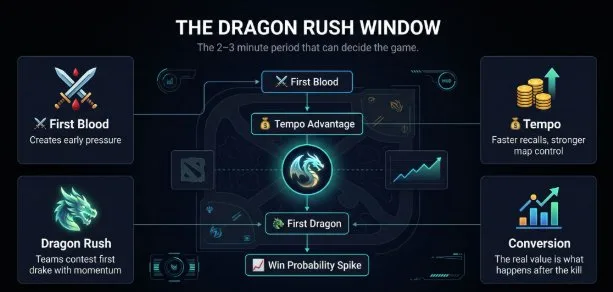
One of the most underreported betting angles in 2026 LoL is the relationship between First Blood and first dragon control. Riot’s current patch cycle has elevated elemental drake value to the point where teams that secure First Blood frequently use the tempo advantage to immediately contest the opening drake spawn. When a team converts First Blood into first dragon in the same game, their win rate across all major regions jumps to well above 65% — a compound edge that sportsbooks routinely undervalue in live and pre-match dragon-related prop markets.
This is what sharp bettors call the “Dragon Rush Window” — the two-to-three minute stretch after First Blood where the kill-leading team either converts their advantage into an objective or bleeds it back into a reset. Teams with disciplined macro systems, particularly from the LCK and top LPL rosters, execute this conversion at elite rates. Identifying which teams consistently turn First Blood into first dragon gives you a predictive edge not just on First Blood markets, but on first-objective props and early-game spread bets as well. Research on momentum and performance in competitive gaming supports the idea that early leads compound psychologically as well as structurally — making that Dragon Rush Window even more decisive than the raw numbers suggest.
Smart Bet Insider: Built for LoL Bettors Who Go Deeper
Most LoL betting content stops at head-to-head records and recent form. Smart Bet Insider goes further, delivering pre-match breakdowns that include First Blood rate by champion pairing, early-objective conversion data, patch-adjusted win probabilities, and draft-aware value picks for every major regional match. The analysis is built by people who watch every game — not algorithms recycling box scores.
Members receive confidence-tiered picks across match winner, First Blood, first tower, first dragon, and game duration markets for LCK, LPL, LEC, LCS, and international events. If the 2026 season has taught sharp bettors anything, it’s that early-game data is where the market is weakest — and that’s exactly where Smart Bet Insider focuses. Follow Smart Bet Insider today and start backing every bet with the intelligence the market hasn’t caught up to yet.
Follow the First Kill, Find the Edge
League of Legends in 2026 is being decided earlier than ever, and the bettors who understand First Blood trends — and the limits of what those trends actually tell you — are operating in a market where sportsbooks are consistently behind the curve. Draft context, regional styles, jungle matchups, objective conversion rates, and the Dragon Rush Window all combine to make early-game data the most undervalued input in professional LoL betting today.
Smart Bet Insider is the resource that connects all of those signals into clear, confident, patch-aware picks across every major region. From LCK morning slates to LPL primetime clashes, the analysis goes deeper than anything the market has already priced in. Follow Smart Bet Insider now and make the first kill count every time you bet League of Legends in 2026.
FAQs
1. What is First Blood in League of Legends betting?
First Blood is a prop market where you bet on which team’s player will record the first kill of the game. It’s available on most major esports sportsbooks for LCK, LPL, LEC, and LCS matches, and often offers better value than straight match-winner markets because it’s harder for bookmakers to price accurately.
2. How reliable is First Blood as a win predictor in LoL?
It’s reliable in aggregate, but context is everything. As Oracle’s Elixir data consistently shows, gold differentials and objective leads at 10–15 minutes are stronger win predictors than First Blood alone. The key is identifying whether a team is built to convert that first kill into structural advantages — not just to secure the kill itself.
3. Which sportsbooks offer First Blood markets for League of Legends?
Betway Esports, GG.bet, and Unikrn are among the most consistent providers of LoL prop markets including First Blood, first tower, and first dragon. Coverage is strongest during LCK and LPL regular season play and all international events.
4. Does patch meta affect First Blood rates?
Significantly. Patches that buff aggressive jungle champions or roaming supports increase First Blood frequency across all regions. Patches that strengthen scaling ADCs or late-game mages tend to push drafts toward passive early games and lower First Blood rates. Smart Bet Insider updates its models after every major patch to reflect these shifts before odds adjust.
5. How do I research First Blood trends before betting?
Start with team profiles on Gol.gg or Oracle’s Elixir for First Blood rates by team and patch. Then cross-reference the day’s draft — jungler and support picks are the two roles most responsible for early kill creation. Smart Bet Insider combines both layers of analysis into ready-to-use pre-match breakdowns.
6. Is live betting on First Blood available for LoL matches?
First Blood markets close at game start, so live betting applies more to subsequent early-game props — first tower, first dragon, first Rift Herald. These in-play markets are heavily influenced by which team drew First Blood, making pre-match First Blood research useful even for live betting strategies.
7. What bankroll approach works best for LoL prop betting?
Prop markets like First Blood carry higher variance than match-winner bets, so conservative staking is essential. A 1–2% flat stake per bet is recommended, with slightly larger positions reserved for high-confidence picks flagged by structured models. Never chase losses on prop markets — variance in single-game outcomes is high even when the edge is real.