
The Prediction Market Every Serious Bettor Should Understand
Kalshi is the first and longest-standing federally regulated prediction market in the United States — and in 2026 it has grown into one of the most consequential platforms in the US sports wagering landscape. It is not a sportsbook. It is a CFTC-regulated Designated Contract Market where users trade yes/no event contracts on sports, politics, economics, culture, and more. That distinction shapes everything about how Kalshi works, what it costs, and who benefits most from using it.
Smart Bet Insider covers the full prediction market landscape alongside traditional sportsbooks — helping members understand not just how to sign up but how each platform’s structure affects their long-term edge. This review covers Kalshi’s fee structure, market depth, state availability, app experience, and the honest answer to whether it belongs in your betting rotation in 2026.
How Kalshi Works: The Exchange Mechanic Explained
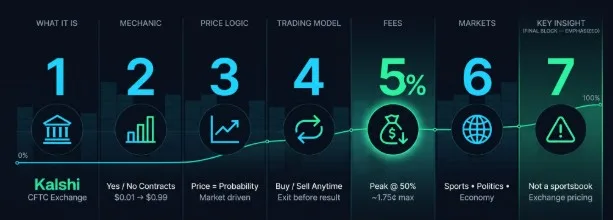
Kalshi markets are built around binary yes/no event contracts that pay $1 if the defined outcome occurs and $0 if it does not. Contract prices range from $0.01 to $0.99, reflecting the market’s collective probability estimate at any given moment — a contract priced at $0.65 implies a 65% market consensus that the event will occur. Unlike a sportsbook where the house sets and holds the odds, Kalshi is a live order book where prices are set by supply and demand between real traders.
This means you are not betting against a house with a built-in margin — you are trading against other market participants at continuously updated prices. You can buy a yes contract, buy a no contract, and exit either position before resolution by selling your contracts back into the market at whatever the current price is. Kalshi’s educational resources at learn.robinhood.com explain the price discovery mechanic clearly for new users. The ability to exit a position before resolution is one of the most practically useful features Kalshi offers — and one that has no equivalent in traditional fixed-odds sportsbook wagering.
Kalshi’s Fee Structure: What You Actually Pay
Kalshi’s fee structure is more nuanced than a flat commission and worth understanding before trading at any meaningful size. Taker fees apply when you place a market order that fills immediately against existing resting orders. The formula is: fee = 0.07 × contracts × price × (1 – price), rounded up to the nearest cent. In practical terms, fees are highest when a contract is priced near $0.50 — reflecting maximum market uncertainty — and decline toward zero as a contract approaches either extreme.
At exactly $0.50, you pay approximately 1.75 cents per contract. At $0.25 or $0.75, roughly 1.3 cents. At $0.10 or $0.90, approximately 0.6 cents. Maker fees apply to limit orders that rest in the book and follow a similar formula at 0.0175 × contracts × price × (1 – price). For a $100 trade, Kalshi’s fee is capped at $1.74 — making the effective rate under 2% on any single transaction. Debit card deposits and withdrawals carry a 2% processing fee; ACH bank transfers are fee-free. PayPal, Venmo, and Cash App are also supported as deposit methods.
Kalshi Prices Are Not Pure Probability: Why the “True Market” Framing Is Misleading
Most Kalshi reviews describe the platform as a clean, frictionless reflection of “true probability” — as if exchange pricing automatically converges to statistical truth. That framing is misleading. In practice, prediction markets are only conditionally efficient, and Kalshi behaves more like a segmented liquidity system than a perfectly informational one.
What Academic Research Actually Shows
Academic work by Wolfers and Zitzewitz on prediction market efficiency demonstrates that while prediction markets can be highly informative, they exhibit systematic deviations from true probabilities depending on liquidity, trader composition, and contract structure. Prices are not uniformly accurate across probability ranges or domains — and Kalshi is not exempt from this finding.
Kalshi Is a Segmented Liquidity System
Kalshi is not a single homogenous pricing environment. Sports markets, political markets, and macroeconomic contracts attract different participant bases, and those differences directly affect price formation. In lower-liquidity or retail-dominated contracts, prices tend to anchor around the 50% midpoint — where uncertainty is highest but informational conviction is weakest. This creates a structural distortion: the area most likely to attract disagreement is also the area most prone to noisy or biased aggregation.
Kalshi prices are therefore better understood as liquidity-weighted consensus estimates, shaped by who is trading, how much capital is present, and how actively contracts are being updated — not neutral, fully efficient probability signals. The CFTC itself emphasizes this distinction in how it interprets derivatives-based information markets, where prices are considered “informative but not definitive” representations of expectations rather than guaranteed truth signals.
The Practical Takeaway for Bettors
Edge on Kalshi still depends on understanding where the market is structurally noisy — not assuming all prices are equally efficient. A contract in a deeply liquid political market with high trader conviction prices very differently than a sports prop in a thin order book dominated by retail participants. Treating both as equally reliable probability signals is one of the most common and costly mistakes informed traders make on the platform.
The Mid-Probability Fee Problem: Kalshi’s Hidden Trading Cost
Understanding Kalshi’s fee formula reveals a structural dynamic that most review content never surfaces — and one that compounds the segmented liquidity problem described above. What sharp traders call the “Mid-Probability Fee Problem” is the reality that contracts priced near 50% — where genuine information asymmetry and edge most commonly exist — carry the highest fee burden. A contract priced at $0.50 costs nearly three times as much to trade as one priced at $0.10 or $0.90.
This matters practically because it affects edge calculation on near-50% markets. A bettor who believes a contract is mispriced at 50% when it should be 55% is working with a 5-cent per-contract edge — but paying approximately 1.75 cents per contract in taker fees, leaving a net edge of roughly 3.25 cents. Given that mid-probability markets are also the most prone to noisy price formation due to low informational conviction, the combination of higher fees and lower pricing efficiency makes near-50% contracts the most demanding trade type on the platform. Bettors who use limit orders — resting in the book as makers — pay lower fees and occasionally receive execution at better prices, which is the optimal strategy for informed, patient traders with genuine probability estimates.
Market Depth: What Kalshi Covers in 2026
Kalshi’s market breadth has expanded significantly since its 2025 sports launch. Sports coverage spans football, basketball, baseball, hockey, soccer, tennis, golf, esports, and MMA, alongside niche competitions including rugby, chess, and lacrosse. Beyond sports, Kalshi offers political markets covering elections, Supreme Court rulings, and international events; economic markets on S&P levels, inflation data, and interest rate decisions; tech and science markets spanning AI, energy, and medicine; and culture markets on entertainment and pop culture outcomes.
The range of non-sports markets is where Kalshi genuinely outperforms every alternative in the US regulated space — no licensed sportsbook offers tradable contracts on Fed rate decisions, hurricane formation, or IPO timing. For bettors whose edge extends beyond sports outcomes, this breadth creates a genuinely differentiated value proposition. The honest caveat is liquidity: smaller niche markets on Kalshi can have wider spreads and fewer active counterparties, meaning limit orders are essential for managing execution cost in thin order books. Major sports and political markets are deep and liquid; obscure niche contracts are not.
Smart Bet Insider: Where Kalshi Fits in Your Betting Rotation
Kalshi is not a replacement for a regulated sportsbook — it is a complement. For markets where both Kalshi and a regulated book like DraftKings or FanDuel offer comparable coverage, comparing implied prices before trading is the minimum due diligence. Kalshi’s exchange pricing occasionally offers better value than sportsbook moneylines on the same outcome — and occasionally worse, depending on where public money has moved each line. Using Oddschecker to benchmark Kalshi’s implied probability against sportsbook odds on the same event takes thirty seconds and is worth doing every time.
Smart Bet Insider covers Kalshi’s prediction market value picks alongside traditional sportsbook analysis — identifying where exchange pricing creates edge that fixed-odds markets don’t offer, and where the Mid-Probability Fee Problem erodes expected value that looks attractive on the surface. For bettors in states without licensed sportsbooks, Kalshi is the highest-quality regulated alternative available. For bettors who already have sportsbook accounts, Kalshi belongs in the rotation. Follow Smart Bet Insider today and approach every Kalshi market with the analytical framework that turns contract trading into consistent edge.
The Honest Verdict on Kalshi in 2026
Kalshi is a genuinely differentiated platform — and not just because it is the only CFTC-regulated prediction market with the breadth it offers. The exchange mechanic, the ability to exit positions early, the absence of account restrictions for winning traders, and the market depth across sports, politics, and economics collectively make it a platform that belongs in any serious bettor’s rotation. The Mid-Probability Fee Problem is real and worth managing — but it does not undermine the platform’s core value for informed, patient traders.
The verdict: Kalshi is worth using in 2026. Use it alongside regulated sportsbooks, compare prices before every trade, favor limit orders on near-50% markets, and deploy it where its exchange structure creates advantages that fixed-odds betting cannot replicate. Follow Smart Bet Insider now and trade every Kalshi market with the analytical edge the platform’s structure demands.
FAQs
1. Is Kalshi legal and safe to use?
Yes — Kalshi holds a CFTC Designated Contract Market license issued in November 2020, making it the first and longest-standing federally regulated prediction market in the US. It is fully legal at the federal level. State-level litigation over sports event contracts has resulted in restrictions in Nevada and active legal challenges in several other states — political and economic markets are broadly unaffected across the country.
2. What sports markets does Kalshi offer?
Kalshi covers NFL, NBA, MLB, NHL, soccer, tennis, golf, MMA, esports, and several niche sports. Markets include game outcomes, player props (points, assists, rebounds), futures, and tournament winners. Sports event contracts are unavailable or restricted in several states including Nevada and Ohio as of May 2026 — check Kalshi’s current state availability before trading.
3. How does Kalshi’s fee structure work?
Taker fees follow the formula: 0.07 × contracts × price × (1 – price). Fees peak near 1.75 cents per contract at $0.50 pricing and decline toward zero as contracts approach $0.00 or $1.00. Maker fees are lower, following the same formula at 0.0175 × contracts × price × (1 – price). ACH deposits are free; debit card transactions carry a 2% processing fee.
4. What is the Mid-Probability Fee Problem?
The Mid-Probability Fee Problem is the reality that Kalshi’s highest-cost trades — near 50% probability contracts — are also where genuine edge most commonly exists for informed traders. At $0.50 pricing, taker fees run approximately 1.75 cents per contract, meaningfully compressing net expected value on close-probability markets. Using limit orders as a maker reduces this fee burden significantly.
5. How does Kalshi compare to a traditional sportsbook?
The core structural difference is that Kalshi is an exchange — prices are set by trader supply and demand rather than a house margin. Winning accounts face no restrictions or limits. You can exit positions before resolution. Fees are based on trading activity, not user losses. Sportsbooks offer wider market variety, larger promotional offers, and are available in more states with established regulatory frameworks.
6. Can I exit a Kalshi trade before the event resolves?
Yes — this is one of Kalshi’s most valuable features. You can sell your contracts back into the market at any time before resolution at the current market price. This allows you to lock in profits when your position has moved in your favor or cut losses before a contract resolves against you — a flexibility that traditional fixed-odds sportsbook bets do not offer.
7. Is Kalshi worth using if I already have sportsbook accounts?
Yes — Kalshi and regulated sportsbooks serve different but complementary functions. Kalshi offers exchange-priced sports contracts with no account restrictions for winners, plus non-sports markets unavailable anywhere else. Comparing Kalshi’s implied probability to sportsbook odds before trading ensures you always access the better-priced market. Smart Bet Insider covers both sides of this comparison in its weekly picks.