
The Most Eventful Period in Kalshi’s History
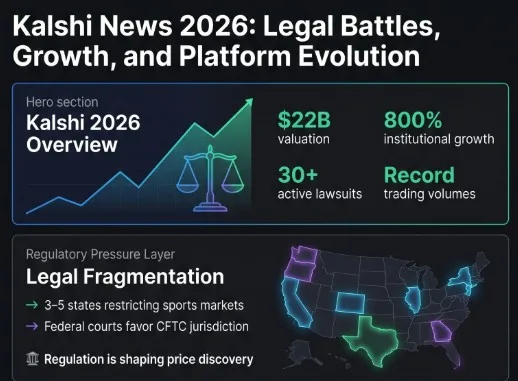
Kalshi has had more significant news in the first five months of 2026 than in any comparable period since its founding. A $22 billion Series F valuation, a landmark Third Circuit court ruling on federal preemption, over 30 active lawsuits with state gaming regulators, a congressional bill targeting the platform, record trading volumes, and institutional adoption surging 800% — the Kalshi news cycle in 2026 is not background noise. It is the story of a platform moving from startup to structural pillar of the US financial market, under legal pressure and commercial acceleration simultaneously.
Smart Bet Insider tracks the Kalshi legal, regulatory, and platform landscape continuously, covering what every development means for users, traders, and bettors operating on or monitoring the platform. This guide covers the most significant Kalshi news from 2026 — the court rulings, the funding round, the platform updates, and what all of it means for the market’s future.
Regulatory Fragmentation as Market Structure: Why the Legal Battle Is Reshaping Price Discovery
A common limitation in most Kalshi coverage is the assumption that its legal environment is simply a backdrop of isolated lawsuits and state-by-state disputes. In reality, the 2026 litigation wave has produced something more structurally important: regulatory fragmentation is now directly shaping market structure and, by extension, price formation itself.
A Patchwork of Jurisdictional Micro-Markets
Different jurisdictions are producing materially different operating conditions. Some states — Nevada and Ohio — have moved toward blocking or restricting sports-related event contracts, while others remain subject to ongoing injunctions shaped by federal appellate precedent. The CFTC has taken an increasingly active role defending federal jurisdiction over event contracts, reinforcing a split between state-level gaming enforcement and federal derivatives oversight. Federal preemption doctrine, as applied by circuits like the Third Circuit, has strengthened the federal case in some jurisdictions — while other courts continue to resist that interpretation.
The result is not a uniform national market with legal noise layered on top — it is a patchwork of jurisdictional micro-markets. Each ruling effectively determines whether specific contracts exist, who can legally participate, and how liquidity forms within that jurisdictional boundary. This introduces a deeper structural implication: regulation is no longer external to pricing on Kalshi. It is actively defining the boundaries of tradable information.
Legal Geography Maps Onto Probability Geography
Kalshi is increasingly better understood not as a single cohesive national prediction market, but as a federated system of fragmented pricing environments where legal geography directly maps onto probability geography. Every injunction, ruling, or enforcement action is simultaneously a change in the architecture of price discovery itself — not just a legal development to monitor, but a market-structure variable that alters which participants can trade, what liquidity is available, and how accurately any given contract can aggregate information.
This reframing matters practically for users and traders. A Kalshi sports contract trading in an unrestricted state draws from the full national liquidity pool. The same contract in a state with active enforcement action faces reduced participation, thinner order books, and a probability estimate that may reflect legal geography as much as genuine event probability. Understanding where you sit in the jurisdictional patchwork is not just a compliance question — it is an information quality question.
The Third Circuit Ruling: Kalshi’s Biggest Legal Win
The most consequential Kalshi legal development of 2026 came on April 7, when the US Court of Appeals for the Third Circuit upheld a district court ruling that blocked the New Jersey Division of Gaming Enforcement from enforcing state sports-betting laws against Kalshi while litigation proceeds. The Third Circuit found that Kalshi operates as a federally regulated exchange, classifying its event contracts as derivatives or swaps under the Commodity Exchange Act — placing the platform under exclusive CFTC jurisdiction rather than state gambling oversight.
The ruling is significant not just for New Jersey but for the broader jurisdictional war between Kalshi and state gaming regulators. The Third Circuit is one of the most influential federal appellate courts in the country, and its analysis of the federal preemption question carries persuasive weight across other circuits currently adjudicating similar disputes. Early rulings in Tennessee also favored Kalshi’s preemption argument. Courts in Nevada, Ohio, and Maryland have been more skeptical — creating the multi-circuit split that legal analysts widely expect will eventually push this question to the US Supreme Court.
The Legal Landscape: 30+ Active Lawsuits and a Congressional Bill
As of late April 2026, more than 30 lawsuits are pending between prediction markets and state or tribal government entities across state and federal courts nationwide. Ohio’s Casino Control Commission has proposed a $5 million fine against Kalshi for alleged unlicensed gambling, while the CFTC is challenging multiple states over jurisdiction, asserting federal authority over event contracts. The DOJ has signaled support for prediction markets, giving Kalshi an institutional ally in the dispute.
Congress has also stepped in with the March 23, 2026 “Prediction Markets Are Gambling Act,” which would restrict sports and casino-style contracts on federally regulated platforms amid rising scrutiny. At the same time, CFTC Chairman Michael Selig has emphasized ongoing rulemaking to clarify how event contracts are classified, a process that will shape the long-term legal framework regardless of individual court outcomes.
Platform Updates: What Has Changed for Users in 2026
Kalshi has made several 2026 operational updates affecting retail users, including a new “detect, investigate, enforce” surveillance system with public disciplinary disclosures following CFTC warnings on insider trading. It also expanded funding options with PayPal, Venmo, and Cash App, and now pays 3.75–4% APY on idle balances. Alongside block trading and prime broker integrations, these changes signal a shift toward more institutional-grade infrastructure.
What the News Cycle Means for Kalshi Users
The 2026 Kalshi news cycle creates a split dynamic: strong federal backing supports long-term viability, while lawsuits, state actions, and a congressional bill create ongoing uncertainty around sports contracts specifically.
What sharp traders call the “Legal Uncertainty Premium” is the small risk discount applied to sports event contracts in contested states, not to Kalshi as a whole. Political and economic markets are largely unaffected, but sports contracts may face occasional access disruption depending on legal outcomes.
More News to Come
Kalshi’s 2026 is not close to over. The multi-circuit litigation will continue generating significant rulings. The CFTC rulemaking process will produce clarity — or controversy — around event contract classification. The congressional bill will advance or stall. The $22 billion institutional infrastructure buildout will reshape how the platform operates for retail users. Every development matters for anyone using Kalshi as a betting or trading venue.
Smart Bet Insider tracks every Kalshi legal, regulatory, and platform development in real time — making sure members always know which markets are accessible, which contracts carry Legal Uncertainty Premium, and where platform changes affect trading strategy. Follow Smart Bet Insider now and stay ahead of every Kalshi news development in 2026.
FAQs
What was the Third Circuit’s ruling on Kalshi in April 2026?
The US Court of Appeals for the Third Circuit ruled on April 7, 2026 that New Jersey cannot enforce state sports-betting laws against Kalshi while federal litigation is pending. The court found Kalshi’s event contracts are likely swaps under the Commodity Exchange Act, subject to exclusive CFTC jurisdiction rather than state gambling regulation. The ruling allows Kalshi to continue operating while the underlying preemption question is fully litigated.
How many states are suing or taking enforcement action against Kalshi?
As of late April 2026, more than 30 lawsuits are pending between prediction markets and state or tribal entities. States with active enforcement actions against Kalshi include Nevada, Ohio, Maryland, New Jersey (currently enjoined), and several others. The CFTC is taking the counteroffensive side, pursuing legal action against Illinois, Wisconsin, New York, Connecticut, and Arizona to assert federal preemption of state gambling laws over event contracts.
What is the “Prediction Markets Are Gambling Act”?
A bipartisan bill introduced in Congress on March 23, 2026 that would ban sports and casino-style event contracts on federally regulated prediction market platforms like Kalshi. The bill reflects growing congressional concern about the expansion of prediction market trading. It has not passed — but its existence signals that congressional regulation of the space is a real medium-term possibility regardless of how the federal-state court battles resolve.
What did Kalshi’s $22 billion Series F include?
Kalshi raised $1 billion in a Series F round led by Coatue on May 7, 2026, at a $22 billion valuation — double its $11 billion Series E valuation from five months earlier. A $200 million extension followed, led by Baillie Gifford and Layer Global. The round reflects institutional adoption with trading volume up 800%, annualized revenue crossing $1.5 billion, and a record $14 billion in April 2026 monthly trading volume.
Are Kalshi sports markets available in all US states?
No — sports event trading is restricted or under active legal dispute in several states as of May 2026, including Nevada and Ohio. Non-sports markets (political, economic, cultural) are broadly available across the country. Users should check Kalshi’s current state availability page before placing sports contracts, as access can change as litigation progresses.
What new platform features has Kalshi introduced in 2026?
Key 2026 updates include the addition of PayPal, Venmo, and Cash App as deposit methods; block trading capabilities for institutional participants; enhanced risk management tools and prime broker integrations; and a surveillance and enforcement infrastructure overhaul with public disclosure of disciplinary actions. Kalshi continues to pay 3.75–4% APY on idle cash balances.
What is the Legal Uncertainty Premium on Kalshi sports markets?
The Legal Uncertainty Premium is the risk discount that should be applied to Kalshi sports contract markets specifically — reflecting the real but limited possibility of access interruption in states with active enforcement actions. Political, economic, and cultural markets carry no equivalent risk. For users placing significant positions in sports contracts, factoring the legal uncertainty into state-specific market selection is a prudent practice that Smart Bet Insider’s coverage specifically addresses.