
The Fee That Most Users Never Calculate Correctly
Kalshi is the most widely used CFTC-regulated prediction market in the US — and its fee structure is one of the most misunderstood aspects of trading on the platform. The headline figure of 1.75% is regularly cited in competitor coverage as if it applies uniformly to every trade. It doesn’t. Kalshi’s fees are dynamic, probability-based, and meaningfully different depending on where in the market you trade, how you place your orders, and what category of contract you’re dealing with.
Smart Bet Insider covers prediction market costs and edge across the full platform landscape. Understanding exactly what Kalshi charges per trade is not just an academic exercise — it directly affects whether a position with apparent value actually generates positive expected returns after fees. This guide breaks down the complete Kalshi fee structure in plain terms, with worked examples that show what you actually pay across the price range.
The “Effective Fee vs Display Fee” Gap: Why the Headline Formula Understates Real Trading Costs
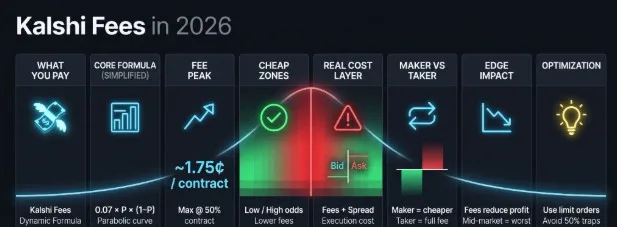
Most Kalshi fee explanations stop at the surface-level equation — 0.07 × p × (1 − p) — and present it as the full cost of trading. But this framing is incomplete in a way that materially distorts how traders should evaluate profitability. The formula describes a per-contract execution fee, not the actual economic cost of entering and exiting a position in a live market environment.
Three Hidden Cost Layers Beyond the Display Fee
In practice, traders are not paying a single isolated fee. They are interacting with a market microstructure governed by spreads, liquidity depth, and execution timing. The effective fee per position is almost always higher than the displayed taker fee — especially in active or fast-moving markets — because real trading involves at least three additional cost layers: round-trip execution (entry and exit both incur fees), spread capture between bid and ask prices, and partial fills or adverse selection in maker orders.
CFTC regulatory guidance on derivatives markets consistently emphasizes that transaction costs extend beyond explicit exchange fees, particularly in order-driven markets where liquidity conditions affect execution quality. Research in market microstructure similarly shows that implicit costs like slippage and spread often exceed explicit fees in high-frequency or actively contested environments.
What This Means in Dollar Terms
On Kalshi specifically, the headline fee can understate real costs by a factor of 1.5x to 3x in actively traded contracts, where spread capture and execution inefficiency dominate. A trade that appears to cost $0.0175 per contract may realistically cost significantly more once entry, exit, and execution dynamics are fully accounted for.
Framing Kalshi purely as a pricing formula problem misses this entirely. It is not just a fee schedule — it is a market microstructure system where execution quality determines true cost, not just the printed equation. This is why limit orders are not merely a fee discount: they are the primary tool for controlling the spread component of effective cost, by placing your order inside the current bid-ask rather than crossing it.
The Core Formula: How Kalshi Calculates Every Trade Fee
Kalshi uses a single probability-weighted formula for taker fees across all markets: fee = 0.07 × price × (1 – price) per contract, where price is the contract’s current implied probability expressed as a decimal between 0.01 and 0.99. The result is a parabolic fee curve that peaks at contracts priced at $0.50 and declines symmetrically toward zero as contracts approach either extreme.
At exactly $0.50, the formula produces 0.07 × 0.50 × 0.50 = $0.0175 per contract — the maximum taker fee. At $0.20 or $0.80, it produces approximately $0.0112. At $0.10 or $0.90, approximately $0.0063. At $0.05 or $0.95, the fee drops to around $0.0033 per contract. This is the taker fee — the rate you pay when you place a market order that fills immediately against existing orders on the book. Maker fees, charged on limit orders that rest in the book, are approximately 25% of the taker rate at the same price point — making limit orders dramatically cheaper for patient, informed traders.
The Fee-to-Edge Ratio: The Number That Actually Matters
Most coverage of Kalshi fees presents the numbers in isolation. The number that actually determines whether a trade is worth placing is the “Fee-to-Edge Ratio” — the proportion of your expected edge consumed by total effective trading costs, not just the display fee. As the effective fee gap section above makes clear, the round-trip taker fee is the floor of your real cost — not the ceiling.
A bettor who believes a $0.50 contract should be priced at $0.55 has a $0.05 per-contract edge. After paying $0.0175 in taker fees per side — $0.035 round-trip on the display fee alone — the net edge is approximately $0.015 per contract before spread and execution costs. Once a realistic spread and adverse selection cost is added, that net edge can compress to near zero on a thin order book. Research on prediction market microstructure consistently shows that near-50% contracts attract the most trading activity but also the least reliable pricing, combining high display fees with higher implicit costs. The fee-to-edge calculation must account for effective total cost — not just the formula — before any market order is placed.
Non-Trading Fees: Deposits, Withdrawals, and Idle Cash
Beyond trading fees, Kalshi applies costs at the account funding level that are worth factoring into total cost calculations. ACH bank transfers for both deposits and withdrawals carry no fee. Debit card transactions — both deposits and withdrawals — carry a $2 flat fee per transaction. PayPal, Venmo, and Cash App are supported deposit methods, with terms aligned to Kalshi’s standard processing conditions.
One offsetting factor that most fee guides omit: Kalshi pays 3.75–4% APY on idle cash balances held in your account. For a trader holding $10,000 in their account, that generates approximately $375–400 annually — meaningfully offsetting trading fees for lower-volume users. Smart Bet Insider recommends ACH funding as the default method to eliminate transaction fees entirely, and factoring the idle cash APY into total cost calculations for anyone maintaining a consistent account balance across multiple trading sessions.
Smart Bet Insider: Fee-Aware Trading on Kalshi
Kalshi’s fee structure rewards the same discipline that profitable sports betting demands: patience, genuine probability estimates, and execution through the most cost-efficient available channel. Using limit orders where possible, focusing on contracts where your estimated edge meaningfully exceeds the Fee-to-Edge Ratio, and using ACH funding to eliminate deposit and withdrawal friction are the three fee-management habits that compound into real performance differences over a full trading season.
Smart Bet Insider’s Kalshi market analysis is built with fee costs baked in — every value identification includes a fee-adjusted expected value calculation so members see net edge, not gross. Follow Smart Bet Insider today and trade every Kalshi contract with a complete, accurate picture of what you’re actually paying and what edge is actually left after costs.
Conclusion: Fees Are the Difference Between Edge and Expense
Kalshi’s fee structure is transparent, calculable, and entirely manageable — for traders who understand it. The parabolic formula rewards confidence and punishes uncertainty trading, meaning the most actively contested markets are also the most expensive to trade. The taker/maker distinction offers a 75% fee reduction that most users leave uncaptured by defaulting to market orders. And the Fee-to-Edge Ratio is the number that determines whether apparent value on any contract actually survives contact with real trading costs.
Smart Bet Insider builds all of this into its Kalshi market coverage — delivering fee-adjusted value picks that reflect what you actually earn, not what the contract spread implies before costs. Follow Smart Bet Insider now and trade every Kalshi position knowing exactly what you’re paying and what’s left on the other side of the fee.
FAQs
1. What is Kalshi’s taker fee formula?
The taker fee formula is: fee = 0.07 × price × (1 – price) per contract, where price is the contract’s implied probability as a decimal. The maximum fee is $0.0175 per contract at $0.50 pricing. Fees decline symmetrically as contracts move toward $0.00 or $1.00. The formula applies across all standard market categories.
2. What is the difference between taker and maker fees on Kalshi?
Taker fees apply when your order fills immediately against existing book orders — you pay the full 0.07 × price × (1 – price) rate. Maker fees apply when your limit order rests in the book and is filled by someone else — approximately 25% of the taker rate at the same price point. At $0.50 pricing, takers pay $0.0175 per contract and makers pay approximately $0.0044.
3. How much does Kalshi charge on a $100 trade?
It depends on the contract price. At $0.50, 100 contracts at $0.50 each equals $50 in contract value — taker fees run approximately $1.75. At $0.10, 100 contracts equals $10 in value — taker fees run approximately $0.63. The fee as a percentage of capital risked is highest at $0.50 and lowest at extreme price points.
4. What is the Fee-to-Edge Ratio and why does it matter?
The Fee-to-Edge Ratio is the proportion of your estimated edge consumed by taker fees. On a $0.50 contract where you estimate true probability at 54%, your $0.04 gross edge faces a $0.035 round-trip taker fee, leaving approximately $0.005 net expected value per contract. Calculating this before placing any trade determines whether a position is genuinely profitable or fee-negative after costs.
5. Are there fees on deposits and withdrawals at Kalshi?
ACH bank transfers carry no fees for deposits or withdrawals. Debit card transactions carry a $2 flat fee per transaction. PayPal, Venmo, and Cash App are also supported. Kalshi pays 3.75–4% APY on idle cash balances, which partially offsets trading fees for users maintaining consistent account balances.
6. How does Kalshi’s fee compare to Polymarket?
Kalshi’s taker fee coefficient is 0.07 versus Polymarket’s 0.0625 for equivalent markets — making Kalshi slightly more expensive at the same price points. At $0.50 pricing, Kalshi charges $1.75 per 100 contracts versus approximately $1.56 for Polymarket. The gap narrows at extreme prices. For US-regulated trading, Polymarket’s regulated venue charges a flat 0.30% taker fee with a 0.20% maker rebate.
7. How can I minimize Kalshi fees?
Use limit orders wherever possible — maker fees are approximately 75% cheaper than taker fees at the same price point. Use ACH funding to eliminate deposit and withdrawal fees. Focus trading on contracts where your estimated edge meaningfully exceeds the Fee-to-Edge threshold after taker costs. Avoid chasing near-50% markets where fee drag and noisy pricing combine to compress net expected value. Smart Bet Insider’s analysis identifies which Kalshi markets clear these thresholds each week.