
Every Betting Line Is a Lie — Here’s How to Read the Truth
When you look at a point spread priced at -110 on both sides, you are not looking at what the sportsbook thinks will happen. You are looking at what the sportsbook thinks will happen, plus their cut. Every betting line includes vig — also called juice — which is the built-in commission sportsbooks charge to guarantee profit regardless of the outcome. Understanding how much vig is baked into a line and what the true odds would be without it is essential for any bettor serious about finding value.
Stripping the vig is the process of reverse-engineering a betting line to find what it would look like in a fair, commission-free market. It does not guarantee winners. What it does is give you an honest baseline — the actual probability the market has assigned to each outcome — so you can compare that against your own assessment and decide whether a bet is worth placing.
What the Vig Actually Is
The Hidden Tax on Every Bet
The vig is essentially a fee that sportsbooks include in their lines — a fee that guarantees they profit long-term regardless of the outcomes of individual bets. A common example of this is when you log onto a sportsbook and see odds of -110 on both sides of a line. This means each bettor must place a $110 wager to win $100.
How the Math Works Against You
Imagine one bettor places $110 on the Celtics and another bettor wagers $110 on the Suns. Obviously, one bettor will win and one will lose. The sportsbook will pay $100 profit to the winner and collect $110 from the losing bettor — earning $10 profit. When that dynamic plays out across millions of bets, the sportsbook’s long-term edge is structural, not luck. The vig is applied to virtually every wager, and that seemingly small fee adds up over the long run, making it difficult for sports bettors to break even, much less profit.
Step One: Convert the Odds to Implied Probability
The Formula for Favorites (Negative Odds)
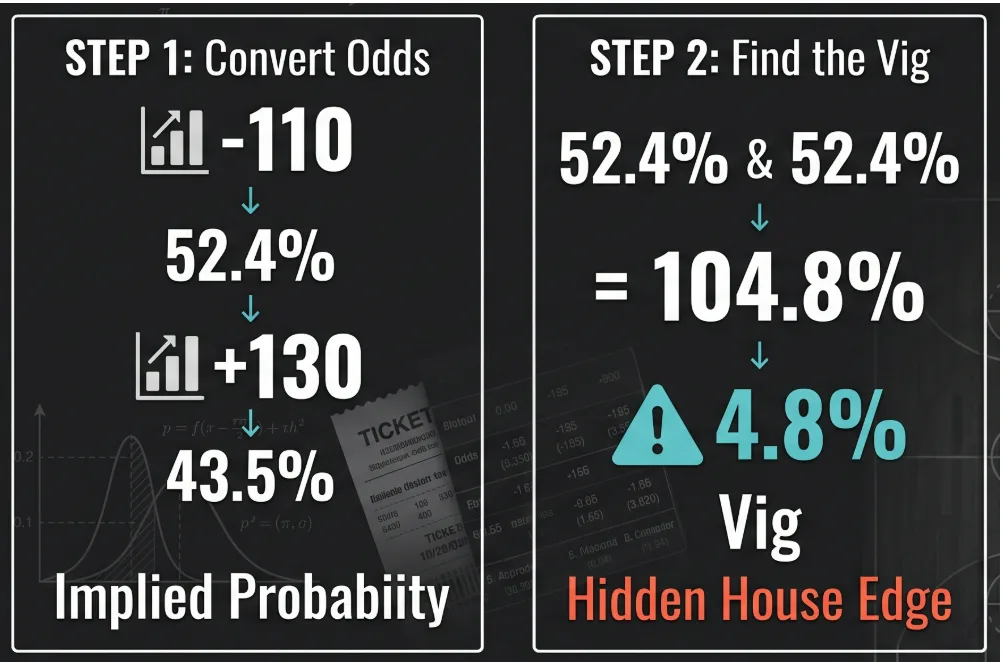
Before you can strip the vig, you need to convert the American odds on each side into an implied probability. For American odds, the formula for negative odds is: Implied % = |odds| / (|odds| + 100). So -120 becomes 120/220 = 54.55%. For a line of -110, the math is 110 divided by 210, which equals 52.4%.
The Formula for Underdogs (Positive Odds)
For positive odds, the formula flips: divide 100 by the odds number plus 100. A team listed at +130 carries an implied probability of about 43.5%. The math: 100 divided by (130 + 100) equals 100 divided by 230, which equals 0.435, or 43.5%. Run this calculation on both sides of any bet and you have your starting point. Prediction markets express probabilities differently: instead of American odds, platforms like Kalshi use contract prices, as explained in our breakdown of how Kalshi odds work.
Step Two: Identify the Vig
Finding the Overround
Once you have both implied probabilities, add them together. On a standard NFL spread, both sides are priced at -110. Run the formula on each side: 110 divided by 210 equals 52.4%. Add both sides together: 52.4% plus 52.4% equals 104.8%. That total is over 100%, which is mathematically impossible for a two-outcome event. That extra 4.8% is the sportsbook’s margin.
What the Number Tells You
Calculating vig requires three steps: convert each side’s odds to implied probability, add them together, then subtract 100%. The amount over 100% is the vig. Notice that vig is not always distributed equally between both sides. A moneyline with a heavy favorite will often load more of the vig on the underdog side, which is why naively splitting the overround in half produces inaccurate results.
Step Three: Normalize to Find the True Probability
The Proportional Method — The Industry Standard
The normalization technique is the most widely used approach for removing the vig from betting odds — also known as the proportional or multiplicative method. After converting each outcome into its implied probability, the method simply divides each probability by the combined total so they sum to 100%. Its popularity stems from its simplicity, transparency, and strong performance in two-outcome markets such as point spreads, moneylines, and totals.
The Normalization Formula
To remove the vig, divide each side’s implied probability by the total combined implied probability. Fair Odds = Implied Probability / Total Implied Probability of All Odds. So: 52.4% / 104.8% = 50%. Do this for both sides and the two results will sum to exactly 100% — that is the true, no-vig probability the market is assigning to each outcome.
A Worked Example
Using the Packers at -200 and the Vikings at +170: the Packers convert to 66.7% and the Vikings convert to 37%, for a total of 103.7%. Removing the juice is not as simple as dividing 3.7% by two and subtracting from each side, but it’s fairly straightforward — divide each implied probability by the total to normalize them back to 100%. The result is the market’s honest assessment: what the line would look like if the sportsbook charged nothing.
There Is More Than One Way to Remove the Vig
Alternative De-Vigging Methods
While proportional normalization is the standard choice, it is not the only accepted method. More advanced approaches attempt to account for biases that can exist in sportsbook pricing, particularly in markets with three or more outcomes or where longshots are systematically overpriced. The Shin method, developed by economist Hyun Song Shin, assumes that some bettors possess insider information and adjusts probabilities accordingly, making it popular in academic research and soccer betting markets.
When the Differences Matter
Other approaches — including the power (logarithmic) method and Margin Proportional to Odds (MPTO) — redistribute the sportsbook’s margin differently to better reflect observed betting behavior, and can produce more accurate fair probabilities when favorites and underdogs are priced asymmetrically. For casual bettors, however, the differences between methods are usually small. Unless you are building predictive models or analyzing high-volume markets, the proportional method remains the most practical balance of accuracy and simplicity for everyday expected value calculations.
Why the Vig Varies — and Why It Matters
Spreads vs. Props vs. Futures
The standard -110/-110 spread market carries about 4.8% vig. Moneylines typically have 3-5% vig on major sports. Props and futures often carry significantly higher juice, sometimes exceeding 10% depending on the market and sportsbook. The size of the vig is also a signal — sportsbooks tend to charge higher margins on markets where they are less confident in their line, which is useful information in itself.
Parlays Compound the Problem
Sportsbooks typically make a little over 4% ROI on standard bets. However, they actually make over 9% profits on every bet placed due to the growing popularity of parlays. If you create a three-leg parlay with a 5% vig for each leg, the total vig adds up to 15%. Stripping the vig on each leg of a parlay individually reveals how quickly the house edge multiplies — and why straight bets offer far better long-term value for the serious bettor.
What to Do With the True Probability
Finding Positive Expected Value
A positive expected value (+EV) bet means the odds offered by the sportsbook are better than the true probability of the outcome. Over time, +EV bettors profit because math is on their side. Once you have the no-vig probability, you have the honest baseline. If your research or model suggests a team has a 55% chance to win and the no-vig line says 52%, you have found a potential edge — and the size of that gap tells you how large the edge is.
Comparing Books and Shopping Lines
Find sharp lines by comparing no-vig odds across books to see which one has the sharpest lines for a specific market. Measure your edge by comparing your estimated probability against the no-vig probability to see whether you actually have an edge. If the no-vig line says 52% and you think it’s 53%, you barely have an edge. Over hundreds of bets, even a two- or three-percent edge compounds into meaningful long-term profit.
The Vig Is Not the Enemy — Ignorance of It Is
Every line on every sportsbook is a probability estimate with a commission baked in. Bettors who do not strip the vig are comparing their opinion against a distorted number and will consistently underestimate or overestimate the value of the bets they place. Removing the vig provides a behind-the-scenes viewpoint for sports bettors. If you don’t remove the vig, you won’t know what the sportsbook actually thinks is going to happen in the game.
The math is straightforward. Convert each side to implied probability, add them together, subtract 100% to find the vig, then divide each probability by the total to normalize. The result is the true market price — and the only honest starting point for any bet you are considering. For a deeper comparison of de-vigging approaches, the full breakdown of methods is available here.
FAQs
What is the vig in sports betting?
Vig, short for vigorish, is the margin a sportsbook builds into its odds so that it profits on both sides of a bet. It is also commonly called the juice or the cut. Rather than simply offering fair odds on two outcomes, a sportsbook prices both sides slightly below true probability — and that gap between what they pay out and what they take in is the vig.
How do I calculate implied probability from American odds?
For negative odds, the formula is: Implied % = |odds| / (|odds| + 100). For positive odds, the formula is: Implied % = 100 / (odds + 100). Run this on both sides of any bet, add the results together, and anything over 100% is the vig.
How do I remove the vig from a betting line?
To remove the vig, divide each side’s implied probability by the total combined implied probability of both outcomes. For example, at -110/-110, each side implies 52.4%, for a total of 104.8%. Dividing each side by 104.8% gives you 50% — the true no-vig probability. This is the proportional method, the industry standard for two-outcome markets.
Are there other ways to remove the vig?
Yes. While the proportional method is the most widely used, alternatives such as the Shin method and the power method redistribute the margin differently and can be more accurate in markets with three or more outcomes or where longshots are systematically overpriced. For everyday spread, moneyline, and totals betting, the proportional method provides a reliable and practical estimate.
Why does vig vary between bet types?
The standard spread market carries about 4.8% vig. Moneylines typically carry 3-5% vig on major sports. Props and futures often carry significantly higher juice, sometimes exceeding 10% depending on the market and sportsbook. Higher vig on a specific market often reflects lower sportsbook confidence in that line — a signal worth paying attention to.
What is a no-vig line and why does it matter?
True odds represent what the market would price if sportsbooks charged no commission. They reflect the actual probability the book has assigned to each outcome without the margin markup. Market odds include vig, so comparing your estimated probability to market implied probability does not give you a clean read on value. Removing the vig first gives you the honest baseline.
How do I use true probability to find value?
To profit, you need to find lines where your own probability estimate beats the implied probability by enough to overcome the built-in margin. Always add up the implied probabilities on both sides of a line. If the total is above 100%, the difference is the sportsbook’s vig — and a total of 105% means you are fighting a 5% house edge before the game even starts.