

A Different Kind of Odds
If you’ve come to Kalshi from traditional sports betting, the odds format will look unfamiliar. There are no American odds, no decimal odds, no juice-adjusted spreads. Instead, every market shows a price between $0.01 and $0.99 — and that price is the odds. Understanding how to read those prices, what they imply about probability, and how they differ structurally from sportsbook odds is the foundational knowledge every Kalshi user needs before placing their first trade.
Smart Bet Insider covers the full prediction market landscape alongside traditional sports betting — helping members understand not just where to bet but how each platform’s pricing mechanics affect the value of every trade. Kalshi’s price format is genuinely simple once the core concept clicks, and this guide walks through everything you need to know to read Kalshi odds fluently in 2026.
Why Kalshi Prices Are Calibrated Estimates, Not Literal Probabilities
While Kalshi prices are commonly interpreted as direct probabilities, academic research suggests they are better understood as calibrated estimates with structured, context-dependent error. The mapping from price to probability is not invariant across markets — it varies significantly across domains, time horizons, and trader composition.
Systematic Deviations From True Probability
Foundational work on prediction market efficiency shows that while prices are often informative, they are subject to systematic deviations driven by liquidity conditions and participant heterogeneity. Political and long-horizon contracts frequently exhibit compression toward the 50% region — reflecting uncertainty clustering and the dominance of mixed-information trading rather than sharp conviction. This means near-50% Kalshi prices carry less informational precision than prices at the extremes, where trader conviction and liquidity tend to be more asymmetric.
Thin Market Distortion and Liquidity Imbalance
Trade size effects and liquidity imbalances can distort marginal prices, particularly in thin markets where a small number of participants can move the mid-price without representing a broad consensus shift. A displayed price of $0.65 does not necessarily correspond to a stable 65% real-world probability — it reflects the aggregated, liquidity-weighted beliefs of active traders under specific market conditions at that moment. Complementary research on prediction market microstructure further highlights how order book dynamics and strategic trading behavior introduce deviations between observed prices and underlying latent probabilities.
The Practical Reading Framework
The key implication is that Kalshi prices should be read as noisy, context-sensitive probability estimates rather than literal truth values. Their accuracy is contingent on liquidity depth, domain structure, and participant composition — and interpretation requires adjusting for these factors rather than treating all prices as equally reliable across all market conditions. A high-volume sports contract with thousands of active traders warrants more probability confidence than a thinly traded political niche market, even if both display a price of $0.65.
The Core Concept: Price Equals Probability
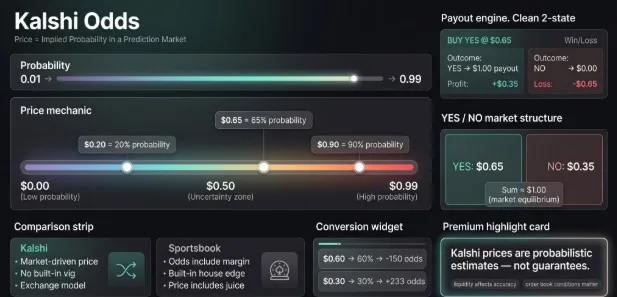
On Kalshi, every event contract is structured as a yes/no question. A contract priced at $0.65 means the market collectively estimates a 65% probability that the event occurs. A contract priced at $0.20 means 20% probability. A contract priced at $0.90 means 90% probability. The price is the probability, expressed in cents per dollar of potential payout.
When a contract resolves “Yes,” it pays $1.00 per contract held. When it resolves “No,” it pays $0.00. If you buy a yes contract at $0.65 and the event occurs, you collect $1.00 — a profit of $0.35 per contract. If the event doesn’t occur, you lose your $0.65 stake. That arithmetic is the entire pricing model. Kalshi’s own educational resources describe this as the foundational mechanic: every contract is a $1 bet on a binary outcome at a price that reflects collective market probability.
Yes and No Contracts: Two Sides of the Same Market
Every Kalshi market offers both a yes contract and a no contract, and understanding their relationship is essential for reading prices correctly. If the yes contract is priced at $0.65, the no contract is priced at approximately $0.35 — the two sides must sum to roughly $1.00, reflecting the fact that one of the two outcomes must occur. In practice, the yes and no prices sum to slightly more than $1.00 due to the bid-ask spread, which is where Kalshi’s market friction is embedded rather than in a built-in margin on a single line.
This is a fundamental structural difference from traditional sportsbooks. At a sportsbook, both sides of a bet are priced at -110 (or similar), meaning the total implied probability across both outcomes adds to approximately 105% — the excess being the sportsbook’s take. On Kalshi, the “vig” is not embedded in the listed price. It exists in the spread between where you can buy and where you can sell, and in the explicit taker fees charged on each trade. The CFTC’s framework for exchange-traded event contracts governs this structure — Kalshi is regulated as a financial exchange, not a gambling operator, which shapes how pricing transparency works.
Converting Kalshi Prices to Familiar Odds Formats
For bettors who think in traditional odds formats, converting Kalshi prices is straightforward. A Kalshi yes contract priced at $0.65 implies 65% probability — equivalent to approximately -186 in American odds (where the formula is -100 / (p / (1-p)) for favorites) or 1.54 in decimal odds. A contract priced at $0.30 implies 30% probability — equivalent to approximately +233 in American odds or 3.33 in decimal odds.
The key difference is that Kalshi prices already include the market’s probability estimate without an embedded bookmaker margin. A sportsbook moneyline of -200 implies approximately 66.7% probability after removing the vig — but a Kalshi contract at $0.65 implies exactly 65% because the price is set by trader supply and demand rather than a house line. This means Kalshi prices are a cleaner probability signal than sportsbook odds in most cases — though research on prediction market microstructure consistently shows that this efficiency is conditional on liquidity, trader composition, and contract specificity rather than universal across all markets.
Smart Bet Insider: Reading Kalshi Prices With Full Context
Reading Kalshi prices fluently means understanding the displayed price as a probability estimate, the order book as the true execution environment, the yes/no relationship as the market’s internal arbitrage constraint, and price movements as information signals weighted by volume and liquidity. Those four layers together give you the full picture of what a Kalshi market is actually saying — rather than just the headline number.
Smart Bet Insider’s prediction market analysis is built around exactly this kind of multi-layer price reading — comparing Kalshi implied probabilities to Polymarket pricing, traditional sportsbook lines, and Metaculus calibration estimates to identify where genuine mispricing exists. Follow Smart Bet Insider today and read every Kalshi market with the analytical depth the platform’s pricing mechanics demand.
Simple Format, Deep Information
Kalshi’s price format is deceptively simple — a single number between $0.01 and $0.99 that directly expresses market probability. But reading that price correctly requires understanding the order book behind it, the yes/no relationship that constrains it, the fee structure that affects your real execution cost, and the liquidity context that determines how much informational weight it deserves. The Displayed vs Executable Price Gap, volume-weighted signal interpretation, and cross-platform comparison are the tools that turn a displayed price into a genuinely useful probability estimate.
Smart Bet Insider delivers that full analytical context alongside every Kalshi market it covers — making sure every prediction market trade is grounded in what the price is actually saying, not just what it appears to say at first glance. Follow Smart Bet Insider now and read every Kalshi price with the precision the platform’s mechanics reward.
FAQs
What does a Kalshi price of $0.60 mean?
A Kalshi yes contract priced at $0.60 means the market collectively estimates a 60% probability that the event occurs. If you buy one contract at $0.60 and the event resolves “Yes,” you collect $1.00 — a $0.40 profit. If it resolves “No,” you lose your $0.60 stake. The price is the probability, and the payout structure is always $1.00 for a correct outcome.
How do yes and no contracts relate to each other on Kalshi?
Yes and no contracts are two sides of the same binary outcome. If the yes contract is priced at $0.60, the no contract is priced at approximately $0.40 — the two sides sum to roughly $1.00 because one outcome must occur. The slight excess above $1.00 in practice reflects the bid-ask spread rather than a built-in bookmaker margin.
Is a Kalshi price the same as an American odds equivalent?
Not directly — you need to convert. A $0.60 Kalshi price implies 60% probability, which converts to approximately -150 in American odds. A $0.30 price implies 30% probability, equivalent to approximately +233. The key advantage of Kalshi’s format is that it expresses probability directly without embedded bookmaker margin, making it a cleaner probability signal than traditional sportsbook odds.
What is the Displayed vs Executable Price Gap?
The Displayed vs Executable Price Gap is the difference between the headline price shown on a Kalshi market and the price at which your trade actually executes against the order book. On liquid markets the gap is typically one to two cents. On thin markets it can be five cents or more. Using limit orders rather than market orders is the standard practice for controlling execution price on Kalshi.
How do I know if a Kalshi price movement is meaningful?
Volume context is essential. A large price move with significant trading volume behind it typically reflects genuine new information. A small move with low volume may reflect a single trader or thin-book noise. Always check trading volume alongside price on Kalshi before treating a price movement as a meaningful signal about the underlying event probability.
How does Kalshi pricing differ from a sportsbook?
Sportsbooks embed a margin into both sides of a bet — both outcomes are priced above true probability, with the excess being the house’s take. Kalshi prices are set by trader supply and demand in a live order book with no embedded house margin. The platform’s revenue comes from explicit taker fees on each transaction rather than built-in odds inflation. This makes Kalshi prices a more transparent probability signal, though efficiency still depends on liquidity and trader composition.
Can I use Kalshi prices to inform sportsbook bets?
Yes — comparing Kalshi implied probabilities to sportsbook lines on the same event is a useful cross-reference for identifying mispricings. If a Kalshi market implies 58% probability on an outcome that a sportsbook is pricing at the equivalent of 52%, that discrepancy is worth investigating. Smart Bet Insider’s analysis routinely cross-references Kalshi, Polymarket, and traditional sportsbook lines to surface these pricing gaps before they close.