

Golf betting games are the small wagers a group layers onto a regular round, settled among the players rather than through a sportsbook. The right one depends on your group: how many of you there are, how far apart your handicaps sit, and whether you want one bet for the whole round or fresh action on every hole. Stakes usually run a few dollars, and the point is keeping a back nine interesting after someone blows up on the front.
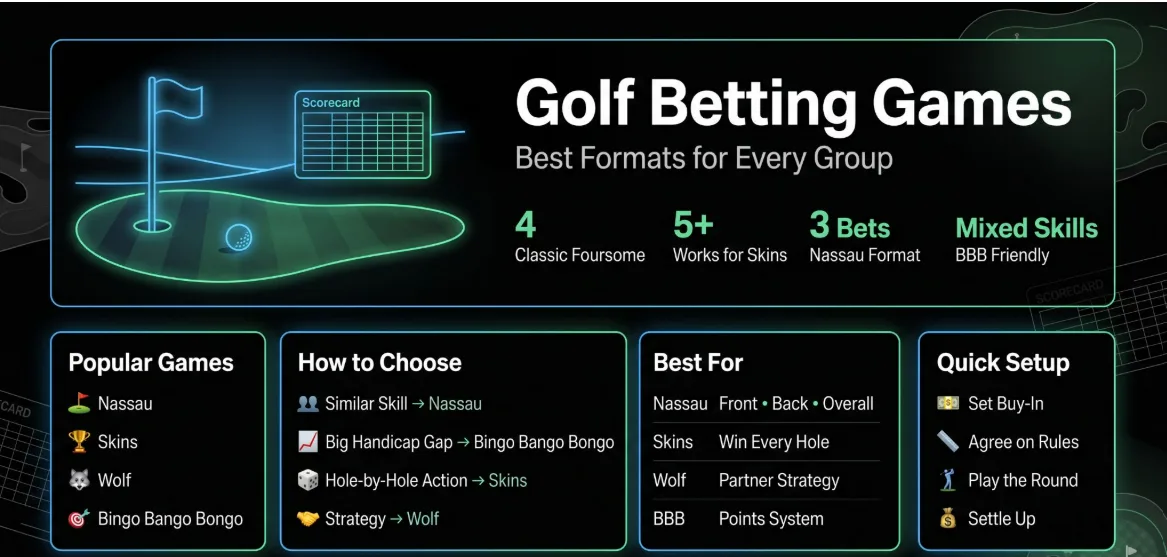
Picking the format matters more than the dollar amount. A foursome of similar skill can run a straight Nassau, while a wide handicap spread needs a points game that levels the field. Smart Bet Insider covers how these formats work and how to set them up cleanly. The sections below walk through the best games by situation, the exact steps to start each one, and how the money settles at the end.
Nassau: The Standard Bet for a Foursome
Nassau is the most common golf wager because it splits one round into three separate bets: the front nine, the back nine, and the overall 18. A “$5 Nassau” means $5 on each, so a player risks $15 across the round. Losing the front nine still leaves two bets to chase, which keeps everyone playing to the last hole.
Setting it up takes one decision on the first tee. Agree on the dollar amount per leg, whether that is $5-5-5 or a heavier $5-5-10 on the overall, and confirm you are playing match play by holes won rather than total strokes. Run handicap strokes if the skills differ, using net scores to keep it fair.
The press is the one add-on worth knowing. A team that falls two holes down can call a press, which opens a new bet for the remaining holes at the original stake. Many groups make presses automatic at two down, so the action compounds without anyone having to ask.
Skins: Hole-by-Hole Drama for Any Size Group
Skins assigns a value to each hole, and the lowest score on that hole wins the skin outright. A tie carries the skin to the next hole, so the pot builds when nobody wins clean. Three straight ties turn a $5 hole into a $20 one, and a single birdie can take the whole stack.
The setup scales to almost any group. Set the per-hole value, decide whether ties carry over or simply wash, and choose gross or net scoring based on the handicap spread. Five or more players works fine, since only the low score each hole matters.
Skins rewards one great hole rather than a steady round, which suits a group with mixed consistency. A high-handicapper who makes one net birdie can win a carried-over pot that a steadier player never touches.
Wolf: Strategy for Three or Four Players
Wolf rotates a captain, the “wolf,” through the group hole by hole, and the wolf picks a partner after watching tee shots. Set a playing order on the first tee, and the wolf tees off last each hole so they see every drive before deciding. A good drive from an early player tempts the wolf to partner up right away.
The strategy lives in the timing. The wolf must choose a partner immediately after that player’s tee shot or lose the option, so a great drive forces a quick call. The wolf can also go “lone wolf” against all three others, which doubles the points on that hole.
Scoring runs on points rather than per-hole cash, tallied at the end and multiplied by an agreed value. Lone-wolf wins pay the most, which rewards the player willing to take on the group alone. Three or four players is the sweet spot.
Bingo Bango Bongo: The Format for Mixed Handicaps
Bingo Bango Bongo levels a group with wide skill gaps because it rewards order of play, not raw score. Each hole offers three points: first ball on the green (bingo), closest to the pin once everyone is on (bango), and first ball in the hole (bongo). A 25-handicap can win points a scratch player never sniffs.
The setup is mostly about honor and order. Agree on a value per point, and enforce that the player farthest from the hole always plays first, since the points depend on it. Track all three points per hole and total them at the end.
The format keeps a beginner in the game all day. Winning closest-to-the-pin or first-on does not require a low score, only a well-timed shot, which is why mixed groups reach for it over a straight stroke bet.
How to Settle Up and Keep It Legal
Settling is simple math once the round ends. Total each player’s wins and losses across every game you ran, then net the figures so only the final differences change hands. Running a Nassau, a skins game, and a side Wolf at once is where pen and paper gets messy, and a scoring app handles the net cleanly.
Stakes and legality are worth a quick word. Casual social betting among friends is legal in most U.S. states under social-gambling exemptions, though larger organized pools enter a gray area in some places. Keep the buy-ins small, agree on every rule before the first tee, and the round stays friendly. Smart Bet Insider breaks down the formats and the math so your group settles without an argument.
Frequently Asked Questions
What is the most popular golf betting game?
Nassau is the most popular golf betting game and has been the standard for over a century. It splits a single round into three separate bets, the front nine, the back nine, and the overall 18, so a bad nine does not end your day. A “$5 Nassau” puts $5 on each leg, for $15 total at risk.
What is the best golf betting game for mixed skill levels?
Bingo Bango Bongo is the best format for a group with wide handicap differences. It awards points for first on the green, closest to the pin, and first in the hole, none of which requires a low score. Skins and Stableford with handicap strokes also keep weaker players competitive.
How does a press work in golf betting?
A press is a new side bet a trailing team starts when it falls two holes down in a match. It runs alongside the original bet for the remaining holes at the same stake, giving the losing side a chance to recover. Many groups make presses automatic at two down, which can stack several bets at once.
How many players do you need for Wolf?
Wolf works with three or four players, and a foursome is ideal. One player per hole becomes the wolf and chooses whether to partner up after seeing tee shots or play alone against the others. The captain role rotates with each hole, so everyone takes a turn.
Is it legal to bet on golf games with your group?
Casual betting among friends on the course is legal in most U.S. states under social-gambling exemptions. The money stays within the group rather than going to a bookmaker, which is what keeps it social rather than commercial. Larger organized pools and auctions can fall into a legal gray area, so keep stakes modest and local.