

The Market Is Shrinking — Know Where You Stand
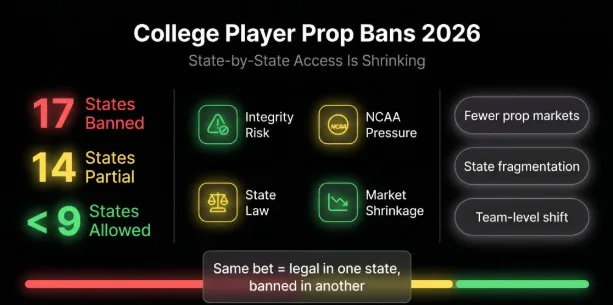
College player prop betting is one of the fastest-changing regulatory landscapes in US sports wagering right now. What was a wide-open market two years ago has become a fragmented state-by-state patchwork, with 17 states now fully or partially restricting individual college athlete prop bets as of 2026 — and more legislation actively moving through state houses. If you’re betting college football or basketball props without knowing your state’s current rules, you may already be placing bets that are no longer legally available on licensed platforms.
Smart Bet Insider tracks the college prop regulatory landscape continuously — covering not just where bets are currently legal but where restrictions are headed and how to adjust your strategy accordingly. This guide maps the current state-by-state picture, explains what’s driving the legislative momentum, and identifies how smart bettors are adapting as the market contracts around them.
Why College Player Props Are Being Banned
The legislative push against college player props is driven by two overlapping concerns: game integrity and athlete welfare. Unlike professional leagues with robust integrity departments, union representation, and multimillion-dollar contracts, college athletes are 18-to-23-year-old students with no financial insulation from bettors seeking to exploit them. NCAA President Charlie Baker has repeatedly called on state gambling commissions to ban college player props since 2023, arguing that individual performance props lower the manipulation threshold compared to game-outcome betting — a single missed shot, an early substitution, or a deliberate foul is all that’s needed to influence a prop outcome.
The January 2026 point-shaving indictments — involving 26 defendants across 17 college teams in one of the largest integrity scandals in US college sports history — gave those arguments significant legislative momentum. NCAA surveys indicate that 67% of Division I athletes report receiving unwanted gambling-related messages on social media, with some athletes reporting direct approaches from bettors seeking inside information about injuries or playing time. The integrity argument is not theoretical — it is documented, ongoing, and directly shaping legislation in multiple states simultaneously.
The Prop Status Volatility Index: Why Static State Lists Are Already Outdated
Static Lists Miss the Real Trend
Most state-by-state breakdowns of college player prop legality quickly become outdated because they treat regulation as static rather than directional. In reality, the college prop landscape is highly volatile, with multiple states shifting positions within a single legislative cycle. Since 2024, at least four jurisdictions — including Louisiana, Maryland, Ohio, and Vermont — have moved from allowing college player props to implementing full bans, reflecting a broader regulatory tightening trend driven by integrity concerns raised by the NCAA.
The Prop Status Volatility Index
A more accurate framework than a snapshot list is the Prop Status Volatility Index — a forward-looking model that tracks not just where states are today, but how quickly and in what direction they are moving. Instead of relying on static tables, this index evaluates three dynamic factors: recent legislative change (states that have altered prop rules in the last 24 months), active bill momentum (states with introduced or committee-stage restrictions), and enforcement intensity (regulatory signals such as partial bans or sportsbook-specific limitations).
States Most Likely to Shift Next
Under this framework, states like Kentucky and Minnesota rank as high-probability “next movers” — Kentucky’s gaming commission has already issued emergency regulations on college same-game parlays, while Minnesota’s proposed bill extends beyond standard prop restrictions into broader in-game betting limitations. Meanwhile, states that recently rejected NCAA-backed restrictions — such as Missouri — represent short-term stability but not long-term certainty, as regulators continue to revisit the issue in response to integrity scandals and ongoing federal pressure via the SCORE Act.
The Current State-by-State Picture
As of 2026, the college player prop landscape across the 39 states with legal sports betting breaks into three broad tiers — but as the Prop Status Volatility Index makes clear, these tiers are directional, not fixed. The first tier — full bans — includes Louisiana, Maryland, Ohio, and Vermont, all of which have banned individual college athlete props since 2024, alongside a growing list of states enacting restrictions in 2026. The second tier — partial restrictions — includes states like New Jersey and Oregon, which have implemented various limits on the types or combinations of college props available without a full prohibition. The third tier — unrestricted — now covers fewer than nine states that allow college player props without any restrictions, down significantly from the market’s early years.
According to data from BetMGM cited across industry reporting, only nine states allow college player props without restrictions, 14 allow them in some form, and 17 ban them outright. Pending legislation in Kentucky and Minnesota could shift that balance further before the 2026-27 college football season begins — both rank as high-volatility movers under the Prop Status Volatility Index framework. The patchwork nature of current restrictions means bettor experience varies dramatically by state even when using the same national sportsbook platform.
The Prop Ban Patchwork Problem: How a Single Market Fractures
The state-by-state approach to college prop regulation has created what sharp bettors and industry observers call the “Prop Ban Patchwork” — a fragmented regulatory environment where identical bets are legal in one state, restricted in another, and completely prohibited in a third, all on the same sportsbook platform accessed from different locations. For bettors who travel, live near state lines, or hold accounts registered in different states, this creates a constant navigation challenge that the early legal sports betting market never had to account for.
The Prop Ban Patchwork also creates uneven integrity outcomes. As LSU executive associate athletic director Steve Lautz noted in 2026, while Louisiana has moved to ban these bets, many other states still allow them — meaning athletes from Louisiana schools remain exposed to prop-related pressure from bettors operating in unrestricted states. A federal solution through the SCORE Act has been proposed but failed to advance in Congress, leaving the patchwork intact and likely expanding further through state-level action in 2026 and 2027.
How Bettors Should Adjust Their Strategy
The shrinking college prop market creates real strategy implications for bettors who have relied on individual player performance markets for value in college football and basketball. The first adjustment is awareness: verifying your state’s current rules before building any college-focused betting strategy is no longer optional. A state that allowed full college prop access in 2024 may have implemented restrictions since then, and sportsbook apps do not always surface these restrictions transparently before you attempt to place a bet.
The second adjustment is market diversification. Bettors who have concentrated heavily in college player props should build familiarity with alternative college betting markets — team totals, first-half spreads, and game-level props — that remain available across all regulated states regardless of prop restrictions. These markets are less affected by the current legislative wave and offer their own exploitable pricing patterns, particularly in the early-season and conference play periods where public attention is concentrated on a smaller number of high-profile matchups. Smart Bet Insider’s college betting coverage includes both player prop analysis where legally available and game-level value picks that hold up across the full range of state restriction environments.
Smart Bet Insider: Navigating the Prop Ban Landscape
College betting strategy in 2026 requires knowing not just which bets offer value but which bets are still available in your state — and that regulatory picture is changing month by month. Smart Bet Insider tracks college prop legislation across every regulated state, alerting members when new restrictions take effect and identifying the alternative markets that deliver the best available value when player props are off the table. The analysis doesn’t stop at legality — it covers efficiency gaps in the markets that survive, which is where the real edge lives.
From the unrestricted states where full college prop access remains available to restricted markets where game-level value picks require a different analytical framework, Smart Bet Insider’s college betting content is built for the regulatory reality of 2026. Follow Smart Bet Insider today and make sure your college betting strategy is calibrated for the market that actually exists — not the one that existed two years ago.
The College Prop Market Will Keep Shrinking
The trajectory of college player prop regulation in 2026 is clear: more states will restrict or ban these markets before the year is out, the NCAA will continue pushing for a national standard, and the patchwork will become increasingly difficult to navigate without active tracking of where restrictions apply. Bettors who have relied heavily on college player props need a strategy that accounts for a regulated market where those bets are available in fewer than a quarter of legal betting states.
Smart Bet Insider tracks every legislative development, flags new restrictions as they take effect, and delivers college betting value picks calibrated for whatever market your state actually allows. Follow Smart Bet Insider now and stay ahead of every college prop restriction before it affects your betting strategy.
FAQs
1. How many states have banned college player props in 2026?
As of 2026, 17 states fully or partially restrict college player prop bets, with 12 banning them altogether. Louisiana, Maryland, Ohio, and Vermont enacted full bans since 2024. Kentucky and Minnesota have active legislation that could expand that list before the 2026-27 college football season. Only nine states currently allow college player props without any restrictions.
2. Why are states banning college player props specifically?
The primary drivers are game integrity and athlete welfare. Individual player props require only minimal performance manipulation — a single missed shot or early substitution — making them easier to exploit than game-outcome markets. The January 2026 point-shaving indictments involving 26 defendants across 17 college teams accelerated legislative action. NCAA President Charlie Baker has formally urged all state gambling commissions to eliminate college player props.
3. Can I still bet college player props if my state has banned them?
No — licensed sportsbooks use geolocation technology to enforce state-specific restrictions. If your state has banned college player props, they will not appear on your regulated sportsbook app regardless of which platform you use. Offshore sportsbooks operating outside state licensing frameworks are not subject to these restrictions, but bettor legal risk should be evaluated independently.
4. Which states still allow college player props without restrictions?
Fewer than nine states currently allow unrestricted college player props. The list is contracting — any state that launched sports betting before 2022 without prop restrictions may have added them since. Checking your sportsbook’s market availability or your state’s gaming commission website is the most reliable way to verify current access in your specific state.
5. Will there be a federal ban on college player props?
A federal solution through the SCORE Act has been proposed but has not advanced in Congress. The most likely near-term outcome is a continued expansion of the state-by-state patchwork, with more states choosing to restrict college props as they update their betting frameworks. A national ban remains possible but is not imminent based on current Congressional appetite for federal sports betting regulation.
6. How does the college prop ban affect my March Madness or CFB betting?
In states with full bans, individual player markets — points, rebounds, passing yards, receiving props — are unavailable. Game-level props, team totals, first-half spreads, and matchup-level markets remain available and provide significant alternative betting depth. Smart Bet Insider’s March Madness and college football coverage includes full game-level analysis calibrated for the restrictions in place across all regulated states.
7. Are same-game parlays with college player legs also banned?
In most states with college player prop bans, same-game parlays that include individual college player performance legs are also prohibited. Kentucky’s gaming commission has issued emergency regulations specifically targeting same-game parlays involving individual college player metrics. If college player props are unavailable in your state, SGP legs tied to those markets are typically unavailable as well.