
From World Series Fixes to FBI Stings: Why Gambling and Sport Have Never Made Peace
Professional and collegiate athletes may feel confident that their own knowledge of sports gives them a decided advantage over the average person in wagering on a contest. The desire of some for high living, particularly in cases where they’re in financial trouble or in college yet to earn income commensurate with their status, along with compulsive gambling issues and plain old greed — these are among the factors that have created scandals involving the intersection of sports and gambling.
What follows is a ranked timeline of the biggest betting scandals in sports history, measured by their impact on the sport involved, the scale of the corruption, and the lasting changes they forced upon professional athletics.
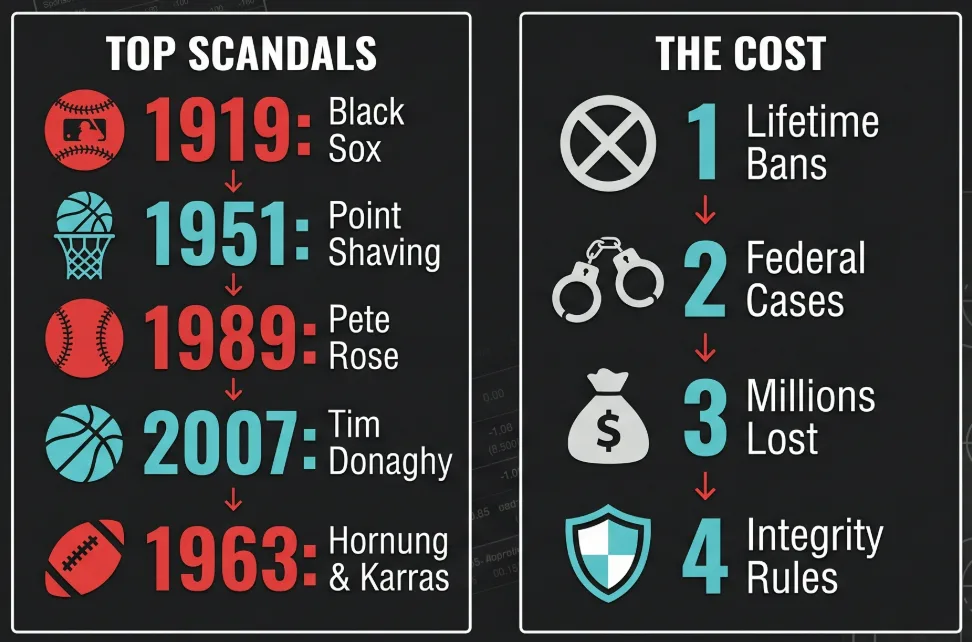
1. The 1919 Black Sox Scandal — Baseball
The Fix That Created the Commissioner’s Office
The Black Sox scandal has become arguably the best-known example combining sports and gambling: In tainting baseball, it altered the image of far and away the nation’s most popular sport at the time, involving corruption on the sport’s highest stage — the World Series. Eight members of the Chicago White Sox accepted money from gamblers to lose the 1919 World Series against the Cincinnati Reds.
The Consequences
In response to the scandal, the National Baseball Commission was dissolved and Judge Kenesaw Mountain Landis was appointed to be the first commissioner of baseball, given absolute control over the sport to restore its integrity. Despite acquittals in a public trial in 1921, Landis permanently banned all eight implicated players from professional baseball. In May 2025, MLB Commissioner Rob Manfred removed all deceased members of the permanently ineligible list, opening the door to Hall of Fame consideration for Shoeless Joe Jackson and his co-conspirators — without declaring them innocent.
2. The 1951 College Basketball Point-Shaving Scandal — NCAA
The Scandal That Nearly Killed College Basketball
The 1951 college basketball point-shaving scandal encompassed a conspiracy among gamblers and players from multiple universities to fix game outcomes by manipulating point spreads, primarily through bribes totaling approximately $50,000 to influence 86 contests. Thirty-five active and former players faced accusations, targeting stars from the City College of New York — which had won both the NCAA and NIT tournaments in 1950 — just months prior.
Point Shaving, Not Losing
Players were not being paid to lose — they were being paid to win by less than the betting spread. The CCNY players admitted to losing three games deliberately during the 1950-1951 season, each receiving $1,000 or more per game. The scandal effectively ended New York’s status as the nation’s premier venue for showcasing college basketball, and as college basketball faded in New York, professional basketball began to take its place as Madison Square Garden’s top draw.
3. Pete Rose — Major League Baseball
The All-Time Hits Leader’s Secret Life
Pete Rose was banned from the sport on August 24, 1989, due to allegations of betting on baseball games while serving as player-manager for the Cincinnati Reds. This decision followed a six-month investigation led by attorney John M. Dowd, which confirmed that Rose had placed bets on games, including those involving his own team.
Thirty-Five Years of Denial
In 2004, after years of repeated denials, Rose finally confessed to gambling on the Reds, though he added that he had always bet on the Reds to win. In 1991, the Baseball Hall of Fame formally voted to ban those on the permanently ineligible list from induction. Rose petitioned for reinstatement multiple times without success — until the May 2025 MLB policy change posthumously restored his Hall of Fame eligibility, though he had died in September 2024 at 83.
4. Tim Donaghy — The NBA Referee Scandal
An Official Who Bet on His Own Games
Tim Donaghy worked in the NBA for 13 seasons from 1994 to 2007 until he was caught in a gambling scandal, after FBI allegations that he bet on games he officiated and made calls that affected the point spread in those games. No betting scandal before or since has struck quite as deep — because Donaghy was not a player manipulating outcomes from the court, but a referee capable of directly influencing calls in real time.
The Statistical Evidence
Sports gambling expert R.J. Bell discovered that during the two seasons investigated by the NBA, the teams involved scored more points than expected by Las Vegas sports books 57 percent of the time, compared to only 44 percent in the previous two seasons. According to Bell, the odds of such a discrepancy were 1 in 1,000. Donaghy was sentenced to 15 months in federal prison on July 29, 2008.
5. Paul Hornung and Alex Karras — The NFL’s First Scandal
Two Stars, One Commissioner’s Decision
In April 1963, the NFL suspended Paul Hornung, the Packers halfback, for wagering on football — and the league’s best defensive player, Lions tackle Alex Karras, suffered the same fate. The simultaneous suspension of the NFL’s reigning MVP and its best defensive lineman sent shockwaves through a league still establishing itself as America’s dominant professional sport.
Hall of Fame Delayed, Not Denied
Karras had made at least six significant bets of $50 and $100 on NFL games since 1958. Hornung bet up to $500 on games. Neither bet against his own team, and neither made much money. Hornung was not voted into the Pro Football Hall of Fame until 1986, his 15th time on the ballot. Karras had to wait 45 years for his election in 2020. Their case established the foundational precedent for every NFL gambling suspension that followed.
6. The Shohei Ohtani–Ippei Mizuhara Scandal — MLB
A $17 Million Theft on Opening Day
Ippei Mizuhara was sentenced to 57 months in federal prison for illegally transferring nearly $17 million from the bank account of MLB star Shohei Ohtani to pay off his own substantial gambling debts incurred with an illegal bookmaking operation. The scandal broke during the Dodgers’ 2024 season opener in Seoul — a moment designed to celebrate baseball’s global ambitions that instead became one of the sport’s most chaotic news days in memory.
Why It Matters Beyond the Headlines
Rule 21(d)(3) prohibits anyone involved in baseball from betting illegally on any sport. Mizuhara bet millions of dollars on non-baseball sporting events with a bookie in California, a state where gambling is illegal. Had he bet the same amount legally in Arizona, Mizuhara probably wouldn’t have been caught. Ohtani stated he was saddened and shocked that someone he trusted had done this, and made clear he has never bet on sports.
7. The 2025 NBA Gambling Scandal — Billups, Rozier, and the FBI
Operation Nothing But Bet
Portland Trail Blazers head coach Chauncey Billups, Miami Heat guard Terry Rozier, and former NBA player Damon Jones were arrested as part of a wide-ranging gambling investigation. More than 30 defendants were charged, marking the NBA’s second significant gambling scandal in two years, following Jontay Porter’s lifetime ban in 2024.
Organized Crime and Rigged Poker Tables
Billups was charged in a separate case with helping to rig poker games to defraud unknowing players, using fraudulent card shufflers and X-ray tables. That scheme also involved the Bonanno, Gambino, Lucchese, and Genovese organized crime families in New York. FBI Director Kash Patel described the operation as “a criminal enterprise that envelops both the NBA and La Cosa Nostra.” Both Billups and Rozier were placed on immediate leave; the cases The Pattern That Never Ends
From the 1919 World Series fix to FBI arrests in 2025, the through-line of sports gambling scandals is consistent: the games that audiences trust to be real have always attracted people willing to compromise that trust for money.
The underground betting market that has existed in the U.S. since sports have existed continues to thrive, with unlicensed bookmakers offering credit and attracting high-profile clientele who might be hoping for more anonymity. As legal sports betting expands and prop markets grow more granular, the incentive for insiders to exploit information only grows. The scandals on this list are not historical curiosities — they are a pattern. And if that pattern holds, the next entry is already being written.
FAQs
What is the biggest sports betting scandal in history?
While sports gambling is far more accessible today, the Black Sox scandal remains arguably the worst of them all. Eight Chicago White Sox players agreed to throw the World Series to help gamblers, and the scandal forever ruined the legacy of star outfielder Shoeless Joe Jackson, who was blocked from the Baseball Hall of Fame despite his denial of illicit participation. The scandal also produced the office of the Commissioner of Baseball — a structural reform that reshaped how professional sport governs itself to this day.
What is point shaving and how did it work in the 1951 college basketball scandal?
Point shaving involves a player deliberately performing below their ability to ensure their team does not win by more than the betting spread — without necessarily losing the game. The 1951 college basketball point-shaving scandal encompassed a conspiracy among gamblers and players from multiple universities to fix game outcomes by manipulating point spreads, primarily through bribes totaling approximately $50,000 to influence 86 contests across 23 cities in 17 states.
Was Tim Donaghy proven to have fixed NBA games?
The FBI informed the NBA that Donaghy had placed bets on NBA games, including games he had officiated, and had disclosed confidential NBA information — including player injuries and the names of referees assigned to specific games — to individuals for use in betting. Whether Donaghy manipulated calls directly remains disputed, but the statistical analysis of his games showed outcomes that were statistically nearly impossible without outside influence.
What happened with the Calciopoli scandal in Italian football?
Transcripts of wiretapped conversations between Juventus’s General Manager Luciano Moggi and various officials revealed an elaborate scheme to affect match outcomes by influencing referee assignments — having favourable referees assigned to Juventus games and directly pressuring referees to make decisions beneficial to the club. Juventus was stripped of its 2004-05 and 2005-06 championships and relegated to Serie B, while AC Milan, Fiorentina, and Lazio received point deductions. More details on FIFA’s integrity framework can be found at inside.fifa.com/legal/integrity.
Was Shohei Ohtani involved in the gambling scandal involving his interpreter?
No. Ohtani stated he was saddened and shocked that someone he trusted had done this, and that he has never bet on sports. MLB’s investigation confirmed Ohtani had no knowledge of or involvement in Mizuhara’s gambling activities. Ohtani was the victim of the theft — not a participant — and faced no discipline from the league.
What were the charges against Chauncey Billups and Terry Rozier in 2025?
Rozier was part of an investigation into bettors using non-public information, such as when a player would miss a game or exit it early, to place bets. Billups was charged in a separate case with helping to rig poker games that were backed by organized crime. Both were placed on immediate leave by the NBA following their October 2025 arrests, and both men have denied wrongdoing through their legal representatives.
How does the Hansie Cronje scandal compare to others on this list?
Cronje was banned from cricket for life in October 2000 for accepting money from unlicensed bookmakers for providing information and fixing matches. What distinguished his case was stature — he was captain of one of cricket’s most respected teams and a genuine national hero in post-apartheid South Africa. The ICC’s anti-corruption framework was substantially strengthened in the aftermath, producing the integrity monitoring infrastructure that governs international cricket today.