
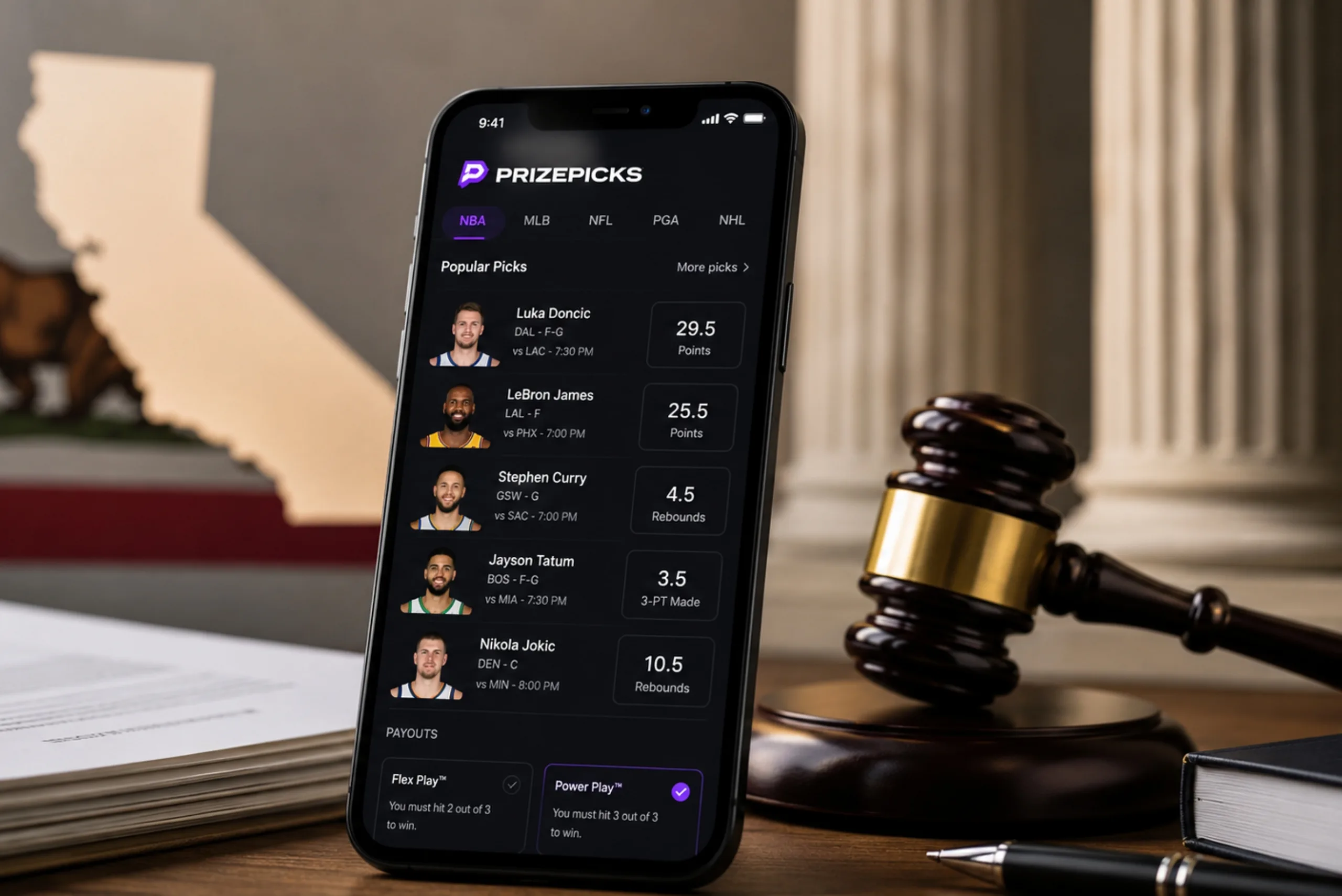
Yes, You Can Play — But the Legal Ground Is Shifting
PrizePicks is currently accessible to California players, and the platform has operated in the state for years. But “accessible” and “clearly legal” aren’t quite the same thing here — California’s Attorney General has directly challenged whether daily fantasy sports platforms like PrizePicks are legal at all, and PrizePicks has already changed how it operates in the state in response.
Here’s exactly where things stand, what changed in 2025, and what California players should understand before entering a contest. For ongoing coverage of DFS and prediction market legality across states, Smart Bet Insider tracks these disputes as they develop.
The Basic Legal Framework: Skill vs. Chance
California’s approach to daily fantasy sports hinges on a specific legal distinction that predates PrizePicks entirely.
How California’s Gambling Law Is Structured
California’s Penal Code, particularly Sections 330 and 337, governs gambling by broadly banning games based on chance while leaving out those based on skill — sports betting falls under this chance-based prohibition, but skill-based DFS doesn’t necessarily fit the same category. That distinction has historically been the legal basis DFS operators point to when arguing their contests are permitted in a state where traditional sports betting remains illegal.
No Explicit Law Either Way
California has not passed a law that specifically legalizes or prohibits daily fantasy sports, which leaves platforms like PrizePicks in a genuine gray area — not governed by traditional gambling law, but also not formally approved through dedicated DFS legislation. That ambiguity is what’s allowed PrizePicks and several competitors to operate in California for years without a clear regulatory framework specifically built for their product.
California DFS Legal Timeline (2015–2026)
California’s daily fantasy sports landscape has evolved through years of legal uncertainty rather than a single law or court decision. Unlike many states that enacted statutes specifically authorizing and regulating DFS contests, California never passed dedicated legislation governing the industry. Instead, operators such as PrizePicks continued offering contests while relying on the longstanding argument that fantasy sports are contests of skill rather than prohibited gambling — a legal position that remained largely untested until recent regulatory developments brought the issue into sharper focus.
| Year | Major Development |
| 2015–2024 | DFS operators continue serving California despite the absence of DFS-specific legislation. |
| February 2024 | PrizePicks submits a legal memorandum arguing that its contests are skill-based and lawful under existing California law. |
| July 2025 | California Attorney General Rob Bonta issues a formal legal opinion concluding that paid DFS contests violate existing state gambling laws. |
| Mid-2025 | PrizePicks transitions California users from its traditional Pick’em contests to the peer-to-peer Arena format. |
| 2026 | Litigation, regulatory debate, and product changes continue while major DFS platforms remain accessible to California players. |
This timeline highlights why California is often described as one of the country’s most legally complex DFS markets. The Attorney General’s 2025 opinion marked a significant turning point, but it did not create a new law or automatically prohibit operators from offering contests. Instead, the California Department of Justice explained that the opinion interprets existing statutes as they apply to paid fantasy sports contests, rather than establishing new ones.
Questions about how those statutes should ultimately be enforced remain the subject of ongoing litigation, industry responses, and potential future legislative action. For that reason, California players can still access certain DFS products today, even as the broader legal debate continues to unfold. The Department of Justice’s press release and the full formal opinion remain the most authoritative explanation of the state’s current legal position, and are worth reading directly if you want the source material rather than secondhand summaries.
What Changed in July 2025
This is the development that’s actually reshaped how PrizePicks operates in California, and it’s the most important recent update to understand.
The Attorney General’s Opinion
In July 2025, California Attorney General Rob Bonta issued a formal opinion arguing that paid DFS contests violate existing gambling law, including sports-wagering restrictions. That opinion directly challenged the “game of skill” argument DFS operators had relied on, and it applied to the traditional pick’em format PrizePicks had used in the state up to that point.
Why Tribal Gaming Interests Are Involved
California’s tribal communities, backed by the California Nations Indian Gaming Association, pushed for exactly this kind of ruling, arguing that any real-money betting based on game stats should require a gambling license like the ones tribal casinos hold. That pressure reflects a broader tension in California gaming: tribes see DFS platforms competing directly with their regulated casino business without carrying the same licensing burden.
How PrizePicks Responded: The Shift to Arena
Rather than exit California, PrizePicks changed its contest format specifically to try to stay on the right side of Bonta’s opinion.
Peer-to-Peer Instead of Against-the-House
Following the Attorney General’s opinion, PrizePicks moved California users to its Arena peer-to-peer contest format, with competitor Underdog making a similar shift to its Champions format. In peer-to-peer contests, entries are matched against other players rather than against the house, and the platform earns a fee rather than setting odds or acting as the counterparty — a structural difference PrizePicks and Underdog are betting will hold up legally where the traditional format might not.
The Attorney General Isn’t Convinced
Bonta’s opinion reportedly disagrees with that distinction, arguing that all formats — including peer-to-peer — are illegal under California’s existing gambling law. PrizePicks and its competitors are effectively betting that courts will see the peer-to-peer structure differently than the Attorney General does, but that disagreement remains legally unresolved as of mid-2026.
Active Litigation You Should Know About
The dispute over DFS legality in California isn’t just a regulatory opinion sitting on a shelf — it’s actively being litigated.
Class Action Lawsuits
PrizePicks and DraftKings are both currently subjects of class-action lawsuits in California that challenge the legality of fantasy contests in the state. Underdog is facing a separate class action of its own, and with California accounting for over 10% of some operators’ total revenue, the financial stakes of these cases are significant for the companies involved.
Operators Are Pushing Back Publicly
DraftKings has stated it “respectfully disagrees” with the Attorney General’s interpretation, arguing that its peer-to-peer fantasy contests are legal and noting the company has operated in California for over 13 years without a legal challenge of this kind. That public disagreement signals operators intend to keep contesting the issue rather than quietly exit the state, at least for now.
Can You Actually Play PrizePicks in California Right Now?
Despite the unresolved legal dispute, the practical answer for most players is still yes — for now.
All Major DFS Platforms Remain Accessible
All four major DFS operators currently accept California players, though what each platform offers varies following the shift to peer-to-peer formats. PrizePicks specifically remains available through its Arena contests, alongside competitors like Underdog Fantasy, Boom Fantasy, ThriveFantasy, and ParlayPlay, which continue to operate in the state as well.
The Market Hasn’t Shut Down, But Nothing Is Fully Settled
DFS platforms may still be accessible in California, but the legal status is genuinely disputed — DraftKings and FanDuel continue to be closely watched, PrizePicks and Underdog have adjusted their contest formats, and the underlying legal question remains unresolved. That means the current access California players have isn’t necessarily permanent, and it could change depending on how the pending litigation and regulatory pressure ultimately play out.
What This Means If You’re a California Player
Given the ongoing dispute, it’s worth understanding what you’re actually opting into if you play PrizePicks in California right now.
You’re Playing in an Unsettled Legal Environment
Unlike states with clear DFS legislation, California players are participating in a market where the state’s top law enforcement official has already argued the activity may be illegal. That doesn’t mean you’re personally at legal risk for playing — enforcement actions in these disputes have historically targeted operators, not individual users — but it does mean the platform’s availability isn’t guaranteed to remain stable.
Format Changes May Continue
Since PrizePicks has already changed its contest structure once in response to regulatory pressure, further changes remain possible if the litigation or the Attorney General’s position develops further. Smart Bet Insider tracks these format and availability changes across DFS platforms, since a shift like the Arena transition can happen with relatively little advance notice to players.
Smart Bet Insider’s Take
PrizePicks is currently playable in California, but calling it unambiguously “legal” oversimplifies a genuinely contested legal situation. The Attorney General’s July 2025 opinion, the shift to peer-to-peer Arena contests, and the active class-action lawsuits all point to an environment that could look different a year from now than it does today.
Smart Bet Insider tracks the legal status of DFS and prediction market platforms across states, including California’s ongoing dispute, so you’re not caught off guard by a sudden format change or availability shift. Check there periodically if you’re a regular California player.
FAQs
Is PrizePicks currently legal to play in California?
PrizePicks is currently accessible to California players, but its legal status is disputed — California’s Attorney General issued a 2025 opinion arguing DFS contests, including PrizePicks’, violate state gambling law.
Why did PrizePicks change its contest format in California?
Following the Attorney General’s July 2025 opinion targeting traditional pick’em contests, PrizePicks shifted California users to its Arena peer-to-peer format, betting that the structural difference would hold up better legally.
Does California have a specific law regulating daily fantasy sports?
No. California has never passed a law explicitly legalizing or banning DFS, leaving platforms like PrizePicks in a legal gray area based on the state’s broader distinction between games of skill and games of chance.
Is PrizePicks facing any lawsuits in California?
Yes. PrizePicks and DraftKings are both named in class-action lawsuits in California challenging the legality of their fantasy contests, and Underdog Fantasy faces a separate class action as well.
Why are California tribes involved in this dispute?
California’s tribal gaming interests, backed by the California Nations Indian Gaming Association, have pushed regulators to classify DFS as gambling, arguing it competes with the state’s regulated tribal casino industry without equivalent licensing.
Can I get in legal trouble for playing PrizePicks in California?
Enforcement actions in disputes like this have historically targeted operators rather than individual players, but the underlying legality of the activity in California remains unresolved as of mid-2026.
Where can I track PrizePicks’ legal status in California and other states?
Smart Bet Insider tracks DFS and prediction market legal developments across states, including ongoing disputes like California’s, so you can stay current on availability and format changes.