

A Video Game That Became an Unregulated Casino
In 2013, Valve Corporation added a small cosmetic feature to Counter-Strike: Global Offensive — weapon skins that changed the visual appearance of in-game guns without affecting how they played. Valve added skin drops to CS:GO in the hopes that players would trade them, form communities, and populate the Steam Marketplace. This innovation was a success for them; however, it spiraled out of control quickly. What started as a cosmetic flourish became, within a few years, one of the largest unregulated gambling economies in the world — built entirely on virtual items with no in-game function whatsoever.
In the year 2023 alone, it was estimated that Valve earned US$1 billion from the sale of weapons case keys and commission from user-to-user trades in the Steam marketplace. Understanding how a video game cosmetics system became a multibillion-dollar gambling apparatus — and why regulators are only now catching up to it — requires understanding the mechanics Valve built, the third-party industry that grew around them, and the legal fight still unfolding more than a decade later.
How the Mechanics Actually Work
The Case and Key System
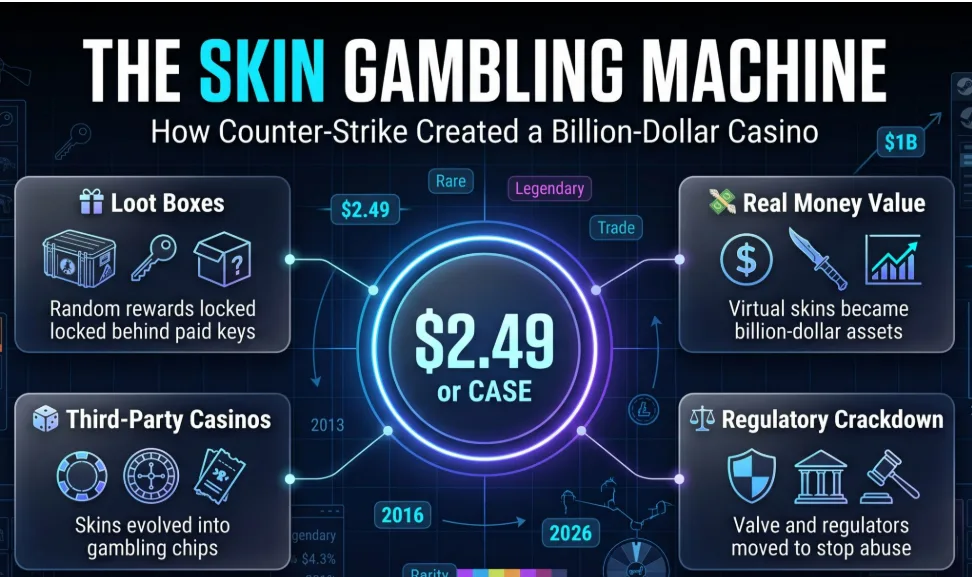
Skins are a form of virtual currency, with some items like special cosmetic knives worth thousands of United States dollars. This virtual currency is further impacted by the game giving out “weapon cases” that contain an unknown randomized skin, which can only be opened by purchasing a key in the in-game store for $2.49. The most common skins that can be obtained have a value far less than the cost of the key, so the player would effectively lose money if they bought a key and found a common skin.
Built for Repetition by Design
The mechanics were built elegantly: the box itself fell for free after the match, fueling excitement, but the lock on it required a paid key for $2.49. Valve created an ideal consumption cycle — a free drop provokes curiosity, and curiosity is converted into a direct purchase. Loot boxes have been compared to slot-machine-style mechanics because they share a variable-ratio reinforcement structure known to encourage repeated behavior. The randomness is the core feature. The loop is engineered to encourage repetition even when the expected return is negative.
Why Skins Are Different From Ordinary Cosmetics
Real Liquidity Makes the Difference
What separates Counter-Strike’s skins from the cosmetics in most other games is that they can be converted into real money. Valve controls rarity through case drop rates, and players can trade freely on Steam or off-platform. That liquidity is the difference-maker. CS2 skins can be traded, sold, and gambled, while other games’ cosmetics stay locked to the account.
A Market Worth Billions
The value of Counter-Strike’s skins rose significantly in recent years, attracting speculators and investors who viewed these virtual items as potentially lucrative digital assets. In March 2025, it was reported that the market for Counter-Strike skins had surpassed $4.3 billion. The randomly selected virtual items have no in-game functionality but can be sold online for money, with one item reportedly being sold for more than $1 million.
The Third-Party Gambling Explosion of 2015-2016
Skins Become Casino Chips
Once skins had real liquid value, an entire ecosystem of unregulated gambling sites sprang up around them. Third-party sites cropped up, exploiting Valve’s marketplace limitations and allowing players to trade their skins for cash. These sites became full-fledged gambling sites, allowing users to bet skins on professional CS:GO games or play games of chance.
A Market the Size of Nevada’s Casinos
Eilers and Narus estimated that $2.3 billion in skins was used to bet on esports in 2015, $5 billion in 2016, and projected that over $20 billion in skins would be gambled by 2020 if the market was left unchecked. Of the $5 billion in skins during 2016, only $2 billion were used for esport betting, while the rest was used on traditional games of chance. By 2016, the skin gambling industry was worth an estimated $5 billion, with virtual items being utilized for gambling on websites such as CSGO Lounge, CSGO Lotto, and CSGO Wild, which had no regulations or age limits.
Why Valve Couldn’t Simply Eliminate Skin Gambling
Trading Was Never Built for Gambling
A common question is why Valve did not simply disable skin trading once third-party gambling websites began using Counter-Strike items as casino chips. The answer is that skin trading itself was not illegal, nor was it created for gambling. When Valve introduced weapon skins in 2013, they were designed to encourage player trading, community engagement, and participation in the Steam Marketplace. The underlying trading infrastructure — including the Steam Trading API — had numerous lawful uses, from player-to-player exchanges to marketplace transactions and inventory management. Valve’s own developer documentation frames Steam trading as a system meant to facilitate secure exchanges between users, not to enable gambling.
A Billion-Dollar Legitimate Economy Stood in the Way
By the time skin gambling exploded in 2015 and 2016, millions of players had accumulated valuable inventories, and a thriving legitimate marketplace had developed around them. Disabling trading altogether would not have targeted only gambling websites — it would also have wiped out a legitimate digital economy worth billions of dollars, affecting collectors, traders, esports fans, and ordinary players who had purchased or earned cosmetic items over many years. This is the structural bind Valve faced throughout the controversy: the same trading system that powered gambling sites also powered the entire legitimate skins economy that gave Counter-Strike’s cosmetics any value in the first place.
Valve’s Response and Its Limits
A Narrower Approach: Targeting Misuse, Not the Marketplace
Instead of eliminating trading, Valve chose a narrower approach. Valve’s Erik Johnson stated in a July 13, 2016 letter that they would demand the third-party sites that use Steam functionality to aid in gambling cease their use of Steam in that manner, stating Valve has no business relationships with these sites and would pursue legal action if they continued to violate their service terms. As a result, Valve had to send ultimatums to 20 large resources, demanding their closure.
Closing the Anonymous Currency Loophole
In October 2019, Valve dealt another blow to the “gray” schemes by banning the resale of loot box keys on the Steam trading platform. From that moment on, the purchased key was firmly linked to the account. The scheme — buy the keys, leak them to roulette, transfer them to real money through skins — had worked flawlessly until then. These measures reflected Valve’s broader strategy of targeting platform misuse rather than dismantling the legitimate marketplace that existed independently of skin gambling.
The Legal Fights That Followed
The Early Lawsuits Collapsed on a Technicality
In June 2016, Valve was sued in the State of Connecticut over “illegal gambling” issues “knowingly” created by Valve and three trading sites. Over the course of several years, the claims were whittled down by the court until there were none left. The parents could not prove they had been deceived by Valve, said US District Judge James L. Robart, because they “never visited a Valve or Steam website, never used Steam, never played CS:GO, and never saw or read any representations from Valve about CS:GO, keys, or weapon cases.”
Europe Moved Faster Than the United States
Only European regulators were able to really bend the giant. The Belgian Gambling Commission was the first to recognize cases in CS:GO violated the law and threatened Valve with fines of up to €800,000. The Netherlands went even further: after checking ten top games, the local government recognized the loot boxes as gambling in four of them. Valve simply blocked the possibility of opening cases for players from these countries.
The Casino Hiding in Plain Sight
What makes the Counter-Strike skin economy remarkable is not just its scale — it is how invisibly it operates relative to its size. There is no casino floor, no slot machine, no sportsbook app on a phone’s home screen. There is a video game, a $2.49 key, and a spinning wheel that determines whether a teenager’s purchase was worth pennies or thousands of dollars.
The legal system spent the better part of a decade deciding whether that distinction mattered, and Valve spent that same decade walking a narrow line between preserving a legitimate billion-dollar marketplace and policing the gambling economy that grew up around it. With New York’s 2026 lawsuit and a parallel billion-dollar class action now active, it appears American regulators are finally arriving at the same conclusion European regulators reached years earlier: a casino disguised as a cosmetics system is still a casino.
FAQs
How did CS:GO skins become a gambling economy?
Valve’s weapon cases contain an unknown randomized skin that can only be opened by purchasing a key for $2.49, and most common skins obtained are worth far less than the cost of the key. Third-party sites exploited Valve’s marketplace to let players trade skins for cash, turning into full-fledged gambling sites where users could bet skins on professional matches or games of chance.
Why didn’t Valve just shut down skin trading to stop the gambling sites?
Skin trading predated and was independent of the gambling problem. The Steam Trading API was built to support legitimate player-to-player exchanges and marketplace transactions, and by the time gambling sites exploited it, millions of players had accumulated billions of dollars in legitimate inventory. Eliminating trading entirely would have destroyed that legitimate economy along with the gambling activity riding on top of it.
How big is the skin gambling and case-opening industry?
It was estimated that Valve earned US$1 billion from the sale of weapons case keys and commission from user-to-user trades in 2023 alone. The broader market for Counter-Strike skins had surpassed $4.3 billion as of March 2025.
What steps did Valve take to fight skin gambling?
Valve sent ultimatums to 20 large third-party gambling sites demanding their closure, and in October 2019 banned the resale of loot box keys on the Steam trading platform, firmly linking purchased keys to accounts to cut off the anonymous currency loop that fueled gambling sites. Valve has described these as targeted measures against platform misuse rather than a wholesale shutdown of trading.
Why did the early lawsuits against Valve fail in the United States?
The plaintiffs’ claims were dismissed because the parents could not prove they had been deceived by Valve — they “never visited a Valve or Steam website, never used Steam, never played CS:GO, and never saw or read any representations from Valve about CS:GO, keys, or weapon cases.” The case was dismissed with prejudice, ending that legal avenue for those plaintiffs.
What is New York’s 2026 lawsuit against Valve about?
New York Attorney General Letitia James sued Valve for illegally promoting gambling through Counter-Strike 2, Team Fortress 2, and Dota 2, alleging Valve enables gambling by charging users for the chance to win rare virtual items resembling a slot machine, with one item reportedly sold for more than $1 million.
How did European regulators respond differently than the United States?
The Belgian Gambling Commission recognized that cases in CS:GO violated gambling law and threatened Valve with fines of up to €800,000. The Netherlands went further, formally recognizing loot boxes as gambling in several games, forcing Valve to block case-opening for players in those countries. The United States took until 2026 to bring comparably serious regulatory action.