
A Common Misunderstanding, Repeated for Years
Ask most sports fans what happened in May 2018, and they will tell you the Supreme Court legalized sports betting. It is the phrase you hear in every sportsbook commercial, every news segment about a new state launch, every casual conversation about why you can now bet on football from your phone. It is also not quite true. The Court did not give any explicit endorsement of gambling. What the Court actually did was strike down a federal law on constitutional grounds entirely unrelated to whether sports betting is good or bad policy — and that distinction matters far more than the headlines ever conveyed.
The Law the Court Actually Struck Down
What PASPA Said
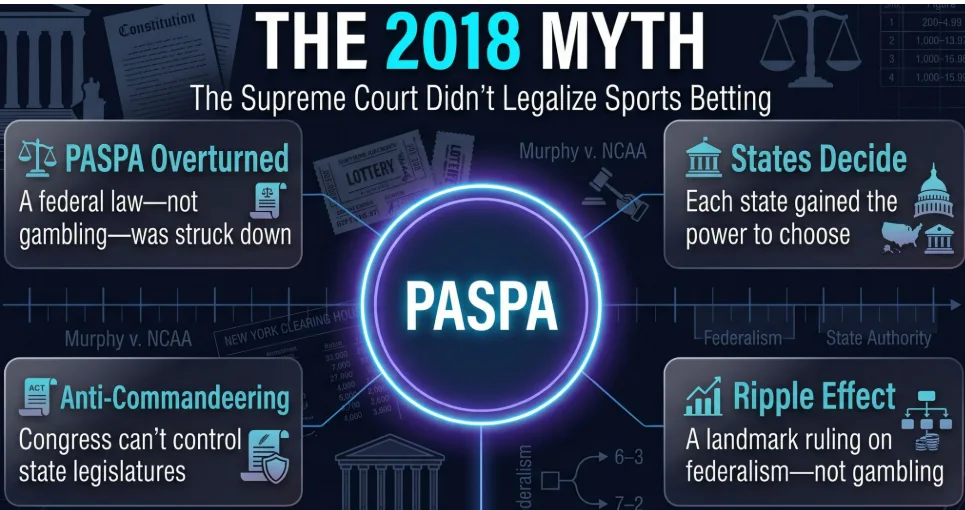
In 1992 Congress passed the Professional and Amateur Sports Protection Act (PASPA) to prohibit state-sanctioned sports gambling. PASPA did not make sports gambling a federal crime; rather, it prohibited states from sponsoring, operating, advertising, promoting, licensing, or authorizing sports gambling activities.
The Grandfather Clause That Started Everything
Exceptions for certain forms of sports gambling were made for four states — Nevada, Delaware, Montana, and Oregon — and New Jersey was given one year to enact a law permitting sports betting — an option the state declined to pursue at the time. That missed window is the reason New Jersey spent the next two decades fighting in court to undo a law it could have simply opted into.
The Road to Murphy v. NCAA: A 26-Year Legal Timeline
The Supreme Court’s 2018 decision did not emerge from a single lawsuit — it was the culmination of more than two decades of legislative decisions, failed court challenges, and changing public attitudes toward sports betting. Understanding this timeline makes clear that Murphy v. NCAA was the final chapter in a long constitutional dispute, not a sudden legalization of sports wagering.
| Year | Milestone |
| 1992 | PASPA was signed into law by President George H.W. Bush, taking effect in January 1993, and would sometimes be referred to as the Bradley Act after Senator Bill Bradley of New Jersey. See the Congressional Research Service overview of PASPA. |
| 1993 | Congress provided a one-year window of opportunity from the effective date of PASPA for states which operated licensed casino gaming for the previous ten-year period to pass laws permitting sports wagering — an exception clearly crafted with New Jersey in mind. New Jersey failed to take advantage of this opportunity. |
| 2011 | New Jersey Public Question 1, the Sports Betting Amendment, was approved by voters on November 8, 2011, amending the state constitution to allow the legislature to legalize betting on professional, college, and amateur sporting events. |
| 2012 | On August 7, 2012, the NCAA, NBA, NFL, NHL, and MLB sued Gov. Christie, seeking to enjoin his administration from implementing the Sports Wagering Act of 2012. The state’s U.S. District Court ruled in favor of the leagues, striking down the law, and the Third Circuit affirmed. |
| 2014 | New Jersey filed litigation again over the Sports Wagering Act of 2014, this time as a partial repeal of its own betting prohibitions rather than affirmative authorization. The district court again sided with the leagues, and the Third Circuit upheld the judgment, ruling that PASPA did not commandeer the state. |
| 2017 | Murphy v. National Collegiate Athletic Association, the updated case title reflecting the inauguration of New Jersey Gov. Phil Murphy, was argued on December 4, 2017, after the Supreme Court agreed to hear the case — then known as Christie v. NCAA before the change in governor renamed it. |
| May 2018 | On May 14, 2018, the U.S. Supreme Court ruled 6–3 that PASPA’s prohibition on state authorization of sports gambling was unconstitutional under the anti-commandeering doctrine of the Tenth Amendment. Read the full Supreme Court opinion in Murphy v. NCAA. |
| June 2018 | On June 11, 2018, Governor Murphy signed legislation that permitted sports betting at New Jersey casinos and racetracks. |
The Real Legal Question: Not Gambling, But Federalism
What New Jersey Actually Argued
New Jersey argued that PASPA was invalid because it violated anticommandeering doctrine by prohibiting the State from legalizing sports gambling. New Jersey was not arguing that sports betting should be legal as a matter of policy. It was arguing that Congress had no constitutional authority to forbid a state legislature from changing its own state law.
What Anti-Commandeering Actually Means
The Court explained that because PASPA “unequivocally dictates what a state legislature may and may not do” with respect to sports gambling, it impermissibly placed state legislatures “under the direct control of Congress.” This doctrine holds that Congress cannot “commandeer the legislative process of the States by directly compelling them to enact and enforce a federal regulatory program.”
How the Court Reasoned Its Way There
Alito’s Key Distinction
Regarding the distinction between Congress preventing the states from taking an action and Congress requiring the states to take an action, Alito wrote: “This distinction is empty. It was a matter of happenstance that the laws challenged in New York and Printz commanded ‘affirmative’ action as opposed to imposing a prohibition. The basic principle — that Congress cannot issue direct orders to state legislatures — applies in either event.”
Why Preemption Didn’t Save the Law
The leagues had a fallback argument: even if PASPA commandeered the states, it was still valid as an exercise of Congress’s power to preempt state law. The Court rejected the argument that PASPA represented a valid exercise of Congress’s power to preempt state law, reasoning that Congress can preempt state law only in the course of directly regulating private actors and not by directly issuing commands to state governments.
What the Court Explicitly Refused to Say
A Decision That Took No Position on Gambling Itself
The majority acknowledged that the legalization of sports gambling is a controversial subject that is best left to Congress. “The legalization of sports gambling requires an important policy choice, but the choice is not ours to make. Congress can regulate sports gambling directly, but if it elects not to do so, each state is free to act on its own,” Justice Alito wrote. “Our job is to interpret the law Congress has enacted and decide whether it is consistent with the Constitution. PASPA is not.”
Congress Could Still Ban It Tomorrow
This is the part most coverage omits entirely. The opinion allows for Congress to choose to ban or allow sports gambling altogether. However, Congress also has the option to bypass the issue and let the individual states decide for themselves. Congress simply has not exercised that option since the ruling — leaving the current state-by-state patchwork as a default, not a constitutional mandate.
The Vote and the Dissent
A Split Decision, Not Unanimous
On May 14, 2018, the Supreme Court reversed lower courts and sided with New Jersey in deciding that PASPA violated the anticommandeering principle by a 7–2 vote and declaring the entire law unconstitutional by a 6–3 vote.
Ginsburg’s Disagreement
Justice Ginsburg dissented, arguing severability should save the remaining provisions of the law. She remonstrated that the Court “ordinarily engages in a salvage” by “severing any problematic portions while leaving the remainder intact.” She argued that the majority made a critical “mistaken assumption that private sports-gambling schemes would become lawful” once the prohibition on state authorization fell. Ginsburg wrote that rather than wielding “an axe,” the Court could have used “a scalpel to trim the statute.”
The Practical Aftermath
States Moved Fast
Within a year of the Murphy decision, six states had legalized sports betting and most states were considering statutory or constitutional measures to legalize it. As of 2025, sports betting has been legalized in some form in 39 states and the District of Columbia.
A Ruling With Implications Far Beyond Gambling
The Murphy precedent might be used to challenge federal laws that arguably violate the Tenth Amendment and commandeer state authority in other areas, such as marijuana legalization, immigration policy, and gun rights. This is the part of the ruling’s legacy that rarely makes it into sportsbook advertising: Murphy v. NCAA is now cited far beyond gambling cases, in disputes about federal power versus state sovereignty across entirely unrelated policy areas.
A Federalism Case Wearing a Gambling Costume
The Supreme Court did not sit down in 2018 and decide that sports betting was good for America, harmless to athletic competition, or worth expanding nationwide. It decided a narrower and, in constitutional terms, more consequential question: can Congress order state legislatures not to change their own laws? The answer was no — and that answer happened to clear the path for sports betting because the law standing in the way was built entirely on commanding states rather than regulating private conduct directly. The forty-plus states that have since legalized sports betting did so by their own legislative choice, not because the Constitution required it.
FAQs
Did the Supreme Court legalize sports betting in 2018?
No. The Court overturned PASPA but did not give any explicit endorsement of gambling. Justice Alito wrote that “the legalization of sports gambling requires an important policy choice, but the choice is not ours to make.” The ruling simply removed a federal restriction that prevented states from making that choice for themselves.
What was PASPA and why was it struck down?
PASPA was a 1992 federal law that prohibited states from sponsoring, operating, advertising, promoting, licensing, or authorizing sports gambling activities. It was struck down because it unconstitutionally “commandeered” state legislatures by dictating what they could and could not do — a violation of the Tenth Amendment’s anti-commandeering doctrine, not a judgment about gambling policy.
Why did it take 26 years for PASPA to be overturned?
PASPA endured a number of legal challenges over its 26-year existence, the most significant being Murphy v. National Collegiate Athletic Association, which traces back to New Jersey’s missed 1993 exemption window, its 2011 constitutional amendment, two separate failed legislative attempts in 2012 and 2014, and finally a Supreme Court appeal that took until 2018 to resolve.
What is the anti-commandeering doctrine?
The anti-commandeering doctrine prohibits Congress from issuing direct orders to states because Article I does not enumerate that power, and the Tenth Amendment reserves all unenumerated powers to the states. Congress can “require or prohibit certain acts,” but it cannot directly “compel the States to require or prohibit those acts.”
Could Congress still ban sports betting nationally after this ruling?
Yes. The opinion allows for Congress to choose to ban or allow sports gambling altogether. Congress also has the option to bypass the issue and let the individual states decide for themselves. The ruling only removed a specific unconstitutional mechanism — it did not strip Congress of its power to regulate sports gambling directly through different legislation.
What was Justice Ginsburg’s dissent about?
Ginsburg argued that severability should have saved the remaining provisions of PASPA rather than striking down the entire law, and she argued the majority made a “mistaken assumption that private sports-gambling schemes would become lawful” once the prohibition on state authorization fell. Her dissent emphasized that removing a restriction on states is not the same as making an activity affirmatively legal.
Does Murphy v. NCAA matter outside of sports betting?
Yes, significantly. The Murphy precedent might be used to challenge federal laws that arguably violate the Tenth Amendment and commandeer state authority in other areas, such as marijuana legalization, immigration policy, and gun rights. Legal scholars consider it one of the more significant federalism rulings of the past decade, independent of its gambling industry consequences.