
Baseball’s Most Notorious Betrayal
The expectancy that grips the American nation with the beginning of baseball’s World Series each year was even more apparent on October 1, 1919, when the great Chicago White Sox, winners of the American League pennant, were to meet the Cincinnati Reds in the first World Series since World War I had ended. The White Sox were heavily favored — and yet, behind closed doors, a scheme had already been set in motion that would permanently alter the sport. What followed would become known as the Black Sox Scandal: the most brazen act of corruption in American sports history, a betrayal so complete it forced baseball to reinvent itself from the ground up.
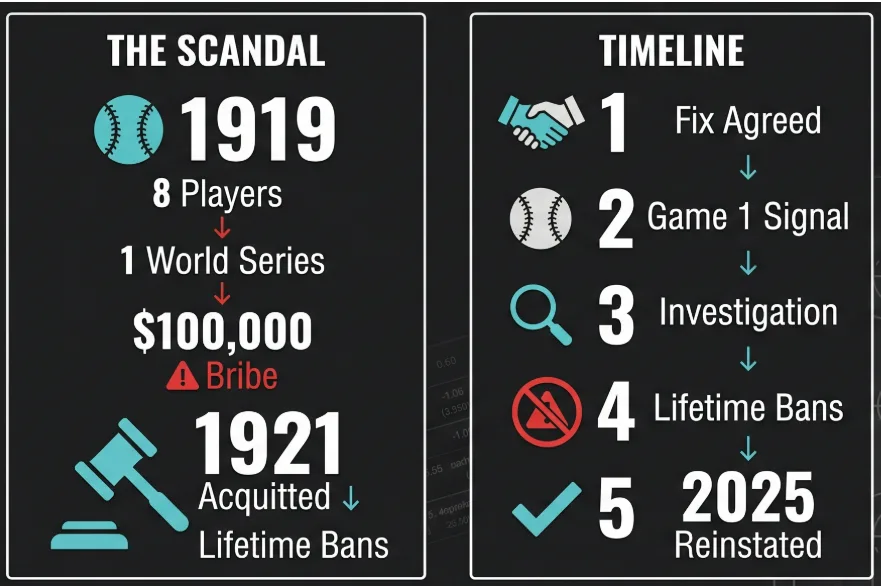
Eight members of the Chicago White Sox were accused of intentionally losing the 1919 World Series against the Cincinnati Reds in exchange for payment from a gambling syndicate, possibly led by organized crime figure Arnold Rothstein. The fix was not subtle. The consequences were not minor. And more than a century later — capped by a landmark 2025 MLB ruling that removed all eight players from the permanently ineligible list — the questions surrounding justice, punishment, and redemption have never been more alive.
Who Were the Eight Men, and How Did the Fix Begin?
The scheme to throw the game for money may have first materialized a few weeks before that year’s World Series, when White Sox first baseman C. Arnold “Chick” Gandil and a gambler named Joseph “Sport” Sullivan met to discuss the possibility of Sox players deliberately tanking in the championship. Gandil later claimed he was initially skeptical that it could work, but he eventually agreed that he and a few co-conspirators would throw the series in exchange for a hefty payout of around $100,000.
He soon enlisted White Sox pitchers Eddie Cicotte and Claude “Lefty” Williams, shortstop Charles “Swede” Risberg, and outfielder Oscar “Happy” Felsch into the scheme. Third baseman Buck Weaver was in on the early stages of the plot before pulling out, and utility infielder Fred McMullin was cut in after he overheard the players talking about the deal. Power hitter “Shoeless” Joe Jackson was also approached. The eight men who would eventually be indicted represented some of the most talented players on a roster capable of genuine championship play — which made the betrayal all the more stunning.
The Signal That Launched the Fix
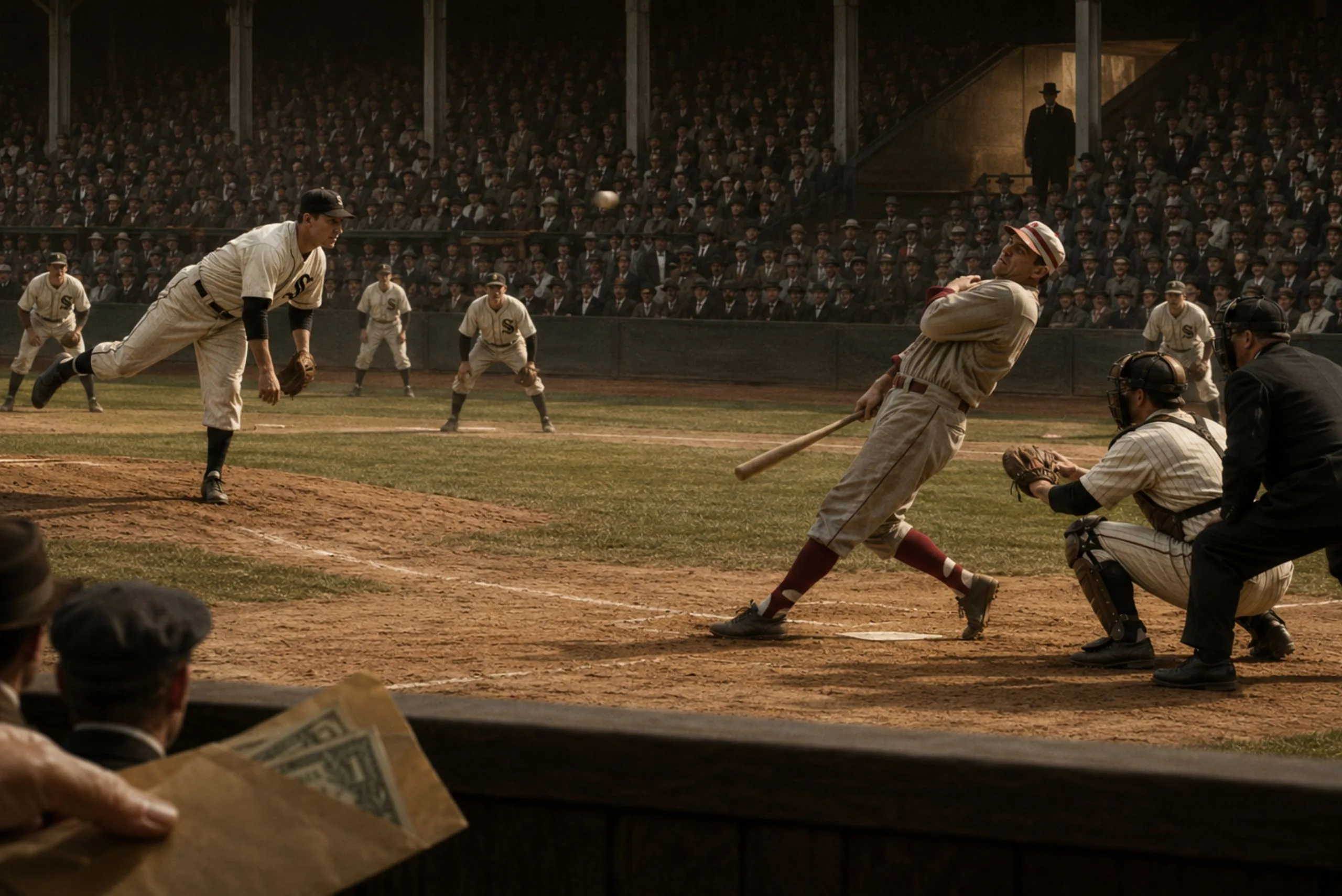
On October 1, 1919, all eyes were on the mound when Chicago White Sox pitcher Eddie Cicotte threw a pitch during Game 1 of the World Series. The ball hit Cincinnati Reds leadoff hitter Morrie Rath squarely in the back. Though the spectators didn’t know it at the time, the pitch was a signal to the gambling world: the fix was in. It was an extraordinarily brazen act — hiding a conspiracy-wide signal in plain sight before a national audience.
A wild pitch, a low throw, a dropped fly ball — the Chicago White Sox were not playing their usual brand of winning baseball in the 1919 World Series. Insider Billy Maharg later declared that Games One, Two, and Eight of the 1919 World Series had been rigged. Suspicions surfaced immediately among sportswriters, but no formal investigation followed — baseball’s leadership appeared content to let the matter fade quietly into the offseason.
How the Cover-Up Unraveled
Baseball’s leading figures appeared content to let the 1919 World Series go unexamined, and it largely did until August 31, 1920, when evidence surfaced that gamblers had rigged a regular season game between the Cubs and the Phillies. A grand jury convened to investigate, and speculation soon turned to the previous year’s World Series. The investigation that began with an inconsequential Cubs-Phillies game had detonated the biggest scandal in the sport’s history.
During a tearful mea culpa, pitcher Cicotte admitted involvement in the scandal, saying, “I don’t know why I did it…I needed the money. I had the wife and kids.” Shortly afterward, star hitter “Shoeless” Joe Jackson testified and admitted to having accepted $5,000 from his teammates. Over the next few days, Lefty Williams and Oscar Felsch also confessed their involvement. The confessions seemed to guarantee conviction — but the legal outcome would prove far more complicated.
The Trial, the Acquittals, and the Lifetime Bans
The indicted players stood trial in the summer of 1921 but on August 2 were acquitted on insufficient evidence — largely because key evidence, including the original confessions of the players, had disappeared from the grand jury files. The disappearance of those confessions remains one of the most suspicious episodes in the scandal’s long aftermath, and historians have never conclusively determined who removed them or why.
Despite the players suspected of participating in the scandal being acquitted following the 1921 trial, they were permanently banned from playing Major League Baseball. The decision was especially harsh toward Buck Weaver, who was banned even though he supposedly dropped out of the plot before it started. Joe Jackson, meanwhile, had admitted to accepting money, but later claimed he was an unwilling participant — and his series-best batting average of .375 suggests he took no active role in throwing the 1919 championship. The question of Jackson’s true culpability would remain one of baseball’s most enduring debates for the next hundred years.
2025 Update: MLB Reinstates the Black Sox Players
A Historic Policy Change
On May 13, 2025, MLB Commissioner Rob Manfred announced he would remove “Shoeless” Joe Jackson, Pete Rose, and other deceased players from the league’s permanently ineligible list. Manfred concluded that “permanent ineligibility ends upon passing of the individual,” reasoning that a person no longer living cannot represent a threat to the integrity of the game. The full announcement and policy decision can be read at MLB.com.
What the Reinstatement Actually Means
The ruling applied to 17 deceased individuals disciplined since the founding of the Commissioner’s Office, including all eight Black Sox players. Critically, the decision does not declare any of them innocent — Commissioner Manfred was clear that the ruling addressed only the duration of the punishment, not the underlying conduct. Following the announcement, the National Baseball Hall of Fame confirmed that Jackson and the other reinstated players may now be evaluated by the Classic Baseball Era Committee, with the next opportunity for consideration scheduled for December 2027. As with any Hall vote, it takes 75% for a candidate to be elected. The Hall of Fame’s full statement is available at baseballhall.org.
A Debate That Continues Today
The reinstatement has reignited debate among historians and fans alike. Jackson — considered one of baseball’s earliest superstars, with a .356 career batting average that remains one of the highest ever — had long been excluded from Hall of Fame consideration despite a groundswell of support. Supporters argue that more than a century of exclusion is sufficient punishment, particularly for players like Jackson and Weaver whose exact roles remain disputed. Others maintain that game-fixing represents baseball’s gravest offense and that Cooperstown should remain off-limits for anyone connected to intentionally losing games for money.
The Lasting Impact: How the Scandal Reshaped Baseball
In response to the scandal, the National Baseball Commission was dissolved and Judge Kenesaw Mountain Landis was appointed to be the first commissioner of baseball, given absolute control over the sport to restore its integrity. The creation of a commissioner’s office with near-absolute authority was a direct consequence of eight players and a gambling ring exposing just how vulnerable the sport was without centralized enforcement.
The Black Sox scandal came to mark the end of an era in American sports history and to signal the beginning of the modern epoch of spectator sports on a grand scale. The scandal helped to create stringent ethical rules governing athletes — the insistence on absolute professionalism paved the way for the transformation of professional sports into a major American industry. Superstitious baseball fans believe the “Curse of the Black Sox” followed the Chicago White Sox for decades, as the team would not reach the World Series again until 1959 or win the championship until 2005.
Baseball’s Original Sin, Finally Addressed
The 1919 Black Sox Scandal is not simply a story about eight men who took money. It is a story about institutional failure, gambling’s deep roots in professional sport, and what happens when a sport built on public trust decides it would rather look away than confront its own corruption. “The Black Sox Scandal has it all: corruption, betrayal, injustice, redemption” — all of the universal human elements that make the story compelling and dramatic.
The 2025 MLB reinstatement decision does not close the book on the Black Sox — it reopens it. With Jackson and his co-conspirators now eligible for Hall of Fame consideration through the Classic Baseball Era Committee’s December 2027 vote, the debate over justice, punishment, and baseball’s most infamous chapter will continue to shape the sport’s history for years to come.
FAQs
Who were the eight players banned in the Black Sox Scandal?
The eight Chicago Black Sox players indicted were Eddie Cicotte, Oscar “Happy” Felsch, Arnold “Chick” Gandil, “Shoeless Joe” Jackson, Fred McMullin, Charles “Swede” Risberg, George “Buck” Weaver, and Charles “Lefty” Williams. All eight were permanently banned from Major League Baseball despite being acquitted at trial in 1921 — and all eight were posthumously reinstated by Commissioner Rob Manfred in May 2025.
Were the Black Sox players reinstated in 2025?
Yes. On May 13, 2025, MLB Commissioner Rob Manfred announced that permanent ineligibility ends upon the death of the disciplined individual, dating back to the ruling by Commissioner Landis that originally banned the Black Sox. The full policy decision is available at MLB.com. The ruling does not overturn the historical findings of the scandal or declare the players innocent.
Was Shoeless Joe Jackson guilty?
Joe Jackson admitted to having accepted $5,000 from his teammates but later claimed he was an unwilling participant who tried to tip team owner Comiskey to the scheme. His series-best batting average of .375 suggests he took no active role in throwing the 1919 championship. His exact level of involvement remains one of baseball’s most debated questions, and his reinstatement has renewed calls for his enshrinement at Cooperstown.
Why were the players acquitted if they confessed?
The players were acquitted on insufficient evidence — largely because key evidence, including the original confessions of the players, had disappeared from the grand jury files. The confessions were probably stolen. Without the written confessions, the prosecution’s case collapsed, and the jury returned not-guilty verdicts after deliberating for just three hours.
Can the Black Sox players now be inducted into the Hall of Fame?
Yes — for the first time since their bans. The Classic Baseball Era Committee, which studies candidates whose impact occurred prior to 1980, will vote on eligible candidates when it meets again in December 2027. As with any Hall vote, it takes 75% for a candidate to be elected. Full details on the Hall of Fame’s process are available at baseballhall.org.
Why was Buck Weaver banned if he didn’t actively participate?
Buck Weaver refused to accept any money and played to the best of his ability in the Series, but was banned nevertheless because he knew of the conspiracy and did not report it to MLB authorities and team ownership. Commissioner Landis’s position — that knowledge without disclosure was sufficient grounds for a lifetime ban — stood for over a century before Manfred’s 2025 ruling posthumously lifted it.
What lasting changes did the scandal produce in baseball?
The scandal had a profound impact on the landscape of American sports, leading to the establishment of stricter ethical guidelines for athletes and marking the transition of professional sports into a major enterprise. Most directly, it produced the office of the Commissioner of Baseball — with Judge Kenesaw Mountain Landis granted sweeping authority over the sport — and established the precedent that a lifetime ban could be imposed regardless of a criminal court’s verdict. That very precedent was partially reversed by the May 2025 MLB policy decision, ensuring the scandal’s influence on baseball governance continues to evolve.