

College Basketball Has Never Fully Escaped Its Gambling Problem
College basketball and point-shaving corruption have been intertwined for nearly a century — and the pattern has never stopped repeating. From Mob-connected bookmakers prowling New York’s Madison Square Garden in the late 1940s to an FBI-unsealed federal indictment in January 2026 naming 39 players across 17 Division I programs, the game’s structural vulnerabilities to gambling manipulation have proven stubbornly resistant to every deterrence effort the NCAA and federal prosecutors have deployed.
What the sport’s administrators keep discovering — and keep being surprised by — is that the incentive structure never fundamentally changes. Smart Bet Insider tracks the full history of NCAA gambling integrity failures because the betting public deserves to understand what they’re wagering on. This guide covers every major point-shaving scandal in college basketball history, explains why the sport remains uniquely exposed to this form of corruption, and outlines what today’s bettors should know before placing money on college basketball lines.
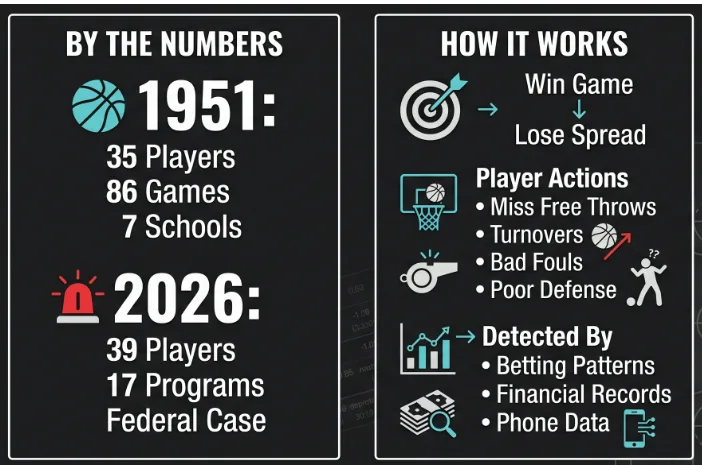
How a Player Can Shave Points Without Losing the Game
The Mechanics of Invisible Corruption
One reason point shaving has remained difficult to detect for decades is that the objective is not necessarily to lose the game. Instead, the goal is to influence the margin of victory so the final score lands on one side of the betting spread. A player can contribute to that outcome through actions that appear indistinguishable from ordinary mistakes, poor judgment, or bad luck during a game.
The Tactics Fixers Actually Use
A player might miss critical free throws late in the second half, commit avoidable turnovers during key possessions, or reduce defensive intensity just enough to allow an opponent to score additional baskets. Other tactics are even more subtle — deliberately picking up unnecessary fouls to limit their own playing time, slowing offensive possessions to suppress scoring opportunities, or voluntarily leaving a game citing a minor injury that cannot easily be disproven. None of these actions guarantee a loss, but collectively they can shift a game’s margin by several points, often enough to affect the betting outcome.
Why Detection Is So Hard
The challenge for coaches, officials, and sportsbooks is that every one of these behaviors also occurs naturally in legitimate competition. Players miss free throws, make careless passes, struggle defensively, and occasionally play through minor injuries. Academic research examining historical betting patterns has found that many outcomes which initially resemble point-shaving can also be explained by normal game dynamics, making detection far more difficult than most fans realize.
How Modern Investigations Actually Work
For that reason, modern investigations typically rely less on game film and more on unusual betting activity, communication records, financial transactions, and coordinated wagering patterns that suggest a player’s on-court decisions were not merely basketball mistakes. Academic research examining point-shaving incentives has found that detection is far more difficult than most fans realize. Recent federal investigations — including the 2026 probe reported by CBS News — were initiated after betting-monitoring systems detected abnormal wagering behavior, as detailed in Reuters’ reporting on the federal point-shaving investigation, rather than obvious evidence from the games themselves.
The 1951 Scandal: How Organized Crime Almost Killed the Sport
The Scale of the Fix
The story of point-shaving in college basketball effectively begins in the Catskills, where a two-bit gambler named Salvatore Sollazzo spent summers cultivating relationships with college players who worked as waiters and busboys at resort hotels. By the late 1940s, those relationships had turned into something far more corrupting. When New York District Attorney Frank Hogan’s office moved in 1951, what they uncovered was staggering: 35 players from seven colleges had accepted bribes to fix 86 games across 17 states between 1947 and 1950 — with $72,000 in total payments, worth over $900,000 today.
The Programs That Paid the Price
The scandal’s most devastating blow landed on City College of New York — the reigning 1950 NCAA and NIT co-champion, the only program ever to win both titles in a single season. CCNY players had been fixing games while simultaneously winning a national championship. The University of Kentucky was implicated as well, with stars Ralph Beard and Alex Groza banned from the NBA for life and the entire program suspended from competition for the 1952–53 season. LIU shut down its athletics department for seven years. The 1951 scandal remains the largest and most consequential episode of corruption in the history of American college sports.
Boston College, Henry Hill, and the Mob’s Return: 1978–79
How the Scheme Came Together
The next major chapter arrived nearly three decades later — and came to public attention only because a mobster turned informant to save his own life. Henry Hill, a Lucchese crime family associate later immortalized in Martin Scorsese’s Goodfellas, was arrested on drug trafficking charges in 1980 and told federal prosecutors about a parallel scheme: a point-shaving operation targeting the Boston College Eagles during the 1978–79 season. Hill had been recruited by Pittsburgh gambler Paul Mazzei, who used Hill’s mob connections to finance player payments and build a coast-to-coast bookmaking network capable of absorbing large bets without triggering suspicion.
Nine Games, One Schedule Card
The scheme targeted at least nine games and centered on BC center Rick Kuhn — a high school friend of gambler Tony Perla — who was paid $2,500 per game to ensure the Eagles failed to cover the point spread. The operation was crude in its execution: Hill later told investigators that Kuhn simply circled games on a pocket schedule. Kuhn was convicted and initially sentenced to ten years in federal prison. The NCAA, notably, imposed no institutional sanctions on Boston College itself — an early signal of the organization’s reactive rather than preventive approach to gambling corruption.
Tulane 1985 and Arizona State 1994: The Scandals That Changed Programs Forever
Tulane: The Program That Was Erased
Tulane’s 1985 scandal carried a consequence no other point-shaving case in history has matched: the university president eliminated the basketball program entirely. Five players, including future NBA center John “Hot Rod” Williams, were indicted on charges tied to the fixing of two games — against Southern Mississippi and Memphis State. The investigation also revealed that head coach Ned Fowler had been paying players throughout the season, prompting the resignations of Fowler, two assistants, and the school’s athletic director. Tulane’s program was eventually reinstated for the 1990–91 season, but the episode demonstrated what institutional accountability for point-shaving could look like when a university chose honesty over self-preservation.
Arizona State: When the Star Was the Fixer
The Arizona State scandal of 1993–94 introduced a different profile: not organized crime, but a player-led enterprise. Guard Stevin “Hedake” Smith — the Sun Devils’ leading scorer — was at the center of a scheme to deliberately underperform in four games, accepting payments from a gambling ring before pleading guilty to conspiracy charges and serving nearly a year in jail. The case illustrated what researchers would later call senior-year vulnerability: Smith was approached in his final college season, when the prospect of NBA earnings had faded and gambling payments felt most financially significant.
The Scandal That Never Really Ended
College basketball’s point-shaving problem is not a series of isolated incidents separated by decades of clean competition — it is a continuous pattern interrupted by periods of non-detection. The 1951 scandal, Boston College, Tulane, Arizona State, Northwestern, and the 2026 federal indictment all follow the same architecture: financially vulnerable players, a gambling market willing to absorb manipulated lines, and an NCAA enforcement apparatus that has consistently responded to corruption rather than prevented it.
For bettors, the practical takeaway is clear: college basketball lines — particularly in games involving smaller programs with limited NIL income — carry integrity risk that professional sports markets do not. Smart Bet Insider tracks betting integrity developments across every major college basketball market, covering not just the scandal record but what it means for the lines you’re evaluating today. Follow Smart Bet Insider for ongoing coverage of NCAA gambling integrity, point-spread analysis, and the legislative developments reshaping college sports betting across the country.
FAQs
What is point shaving in college basketball?
Point shaving is a form of match manipulation in which a player deliberately underperforms to ensure their team fails to cover the betting point spread. Unlike outright game-fixing, the team may still win; the manipulation targets the margin, not the result. Players miss shots, commit turnovers, or reduce defensive effort to keep the final score within a range that benefits gamblers who have wagered against the spread.
What was the biggest point-shaving scandal in college basketball history?
By scale, the 1951 scandal remains the largest in American sports history. It involved 35 players from seven colleges, 86 fixed games across 17 states, and $72,000 in bribes — worth over $900,000 in today’s money. The fallout included lifetime NBA bans, program suspensions, and a permanent shift away from Madison Square Garden as college basketball’s primary showcase venue.
What happened in the Boston College point-shaving scandal?
In 1978–79, Lucchese crime family associate Henry Hill helped orchestrate a scheme in which Boston College players were paid to ensure the Eagles failed to cover the point spread across a series of games. The scheme was only uncovered after Hill was arrested on drug trafficking charges in 1980 and cooperated with federal prosecutors. Player Rick Kuhn was convicted and sentenced to ten years in prison, later reduced. The scandal was later depicted in Hill’s memoir Wiseguy, which became the basis for the film Goodfellas.
Why did Tulane shut down its basketball program after the 1985 scandal?
Tulane’s president eliminated the basketball program entirely after five players were indicted for fixing two games and a separate investigation revealed that head coach Ned Fowler had been paying players throughout the season. The combination of player-level criminality and institutional coaching violations made the program’s continuation untenable. Tulane reinstated basketball for the 1990–91 season, making it the only major college basketball program ever voluntarily shut down over a gambling scandal.
What was the 2026 NCAA point-shaving indictment?
In January 2026, federal prosecutors in the Eastern District of Pennsylvania unsealed charges against 26 individuals connected to a scheme involving 39 college basketball players across 17 Division I programs and 29 fixed games during the 2023–24 and 2024–25 seasons. The operation began in the Chinese Basketball Association before being redirected to American college basketball, with players at smaller programs recruited through payments of $10,000 to $30,000 per fixed game. NCAA president Charlie Baker described it as a significant and rampant corruption of college athletics.
Why is college basketball particularly vulnerable to point shaving?
Basketball’s structure makes it uniquely susceptible to spread manipulation. Only five players are on the court at once, meaning a single cooperative player can influence a game’s margin from both ends of the floor without the manipulation being obvious to observers. Academic research has confirmed that players unlikely to pursue professional careers — particularly seniors and players at smaller programs — face the highest financial incentive to cooperate with fixers.
How has the expansion of legal sports betting affected NCAA point-shaving risk?
The 2018 repeal of PASPA and the subsequent legalization of sports betting in over 30 states has increased both the volume of money wagered on college basketball and the variety of available markets — including first-half totals and player props, which are easier to manipulate and harder to monitor than full-game outcomes. The 2026 federal indictment was the first large-scale evidence that this expanded betting environment had been actively exploited by a coordinated fixing operation. NCAA president Charlie Baker specifically called on states and regulators to eliminate collegiate prop bets in the wake of the indictment.