
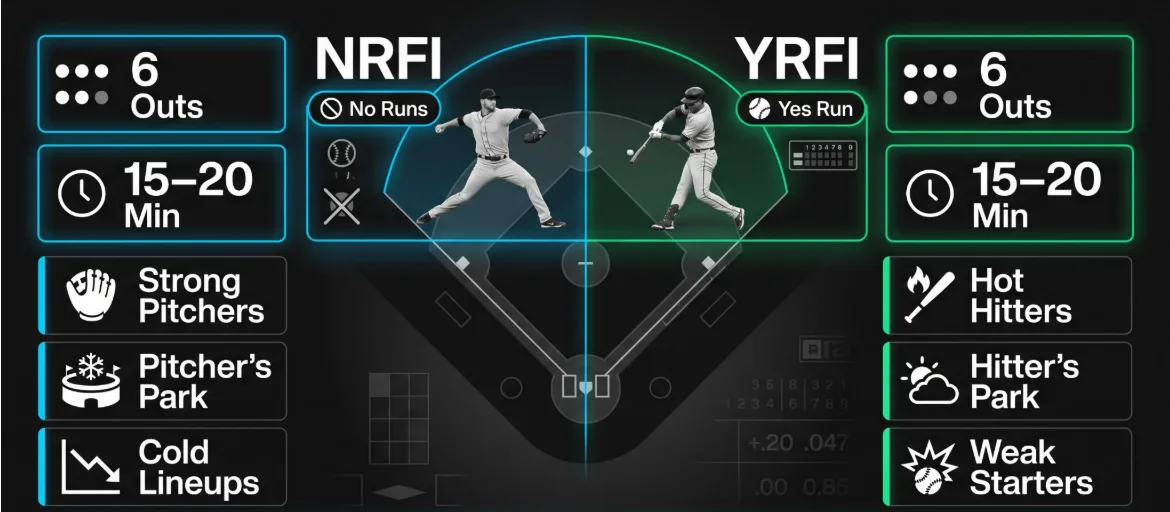
NRFI and YRFI are the two sides of the same first-inning bet, settled the moment the opening frame ends. NRFI, No Run First Inning, wins if neither team scores in the first. YRFI, Yes Run First Inning, wins the instant any run crosses the plate. One bet resolves in 15 to 20 minutes, which is why the market has grown on every major sportsbook since 2020.
The two sides are not priced evenly, and that gap is where the decision lives. NRFI is usually the favorite, YRFI usually pays plus money, and the public leans hard one way for reasons that have nothing to do with the math. Smart Bet Insider covers the prop markets and the pricing quirks inside them. The sections below explain each side, why the odds tilt the way they do, and when each bet is the smarter play.
What NRFI and YRFI Actually Mean
Both bets cover the same six outs, the top and bottom of the first inning. NRFI (No Runs First Inning) needs a clean, scoreless frame from both teams to cash. YRFI (Yes Runs First Inning) needs only a single run from either side, so one bloop-and-a-blast ends it in the visitor’s half before the home team even bats.
Sportsbooks list the bet as a first-inning total, usually over or under 0.5 runs. The under is NRFI, the over is YRFI, and both settle as soon as the inning closes. A postponed or suspended game before the inning completes typically voids the bet and refunds the stake.
The appeal is the fast, clean result. There is no bullpen, no pinch-hitter, no late-game variance to sweat, just the two starters against the top of each order. That simplicity is what turned a niche prop into a market on every board.
Why NRFI Is Usually the Favorite
Most first innings end scoreless, so the math starts on NRFI’s side. Roughly 52-55% of MLB first innings finish 0-0 in a typical season, which is why books hang NRFI at a price like -130 and YRFI at plus money like +110. The favorite reflects the base rate, not a read on tonight’s game.
The first inning also caps the offense’s best shot. Only the top three or four hitters are guaranteed to bat, so a lineup’s most dangerous bats get one swing before the order turns over. First-inning scoring explains only about a third of a team’s overall scoring variance, partly because those top hitters get a disproportionate share of first-inning plate appearances.
Park and weather move the baseline more than most bettors expect. MLB lists Coors Field at a 1.271 run factor, and a hot day with the wind blowing out lifts scoring further. A pitcher’s park like Oracle or Petco pushes the same matchup back toward NRFI.
When YRFI Is the Smarter Choice
YRFI earns its plus money in the spots NRFI bettors avoid. A starter carrying a first-inning ERA of 4.00 or higher against a top-heavy lineup is a real YRFI signal, especially when both starters are known slow starters. If both sides are vulnerable early, the chance of at least one run climbs fast.
Conditions stack the case. A hitter’s park with the wind blowing out, a warm night, or a bullpen game with an unfamiliar opener all raise first-inning scoring. Pull the first-inning team splits before committing, since a lineup that scores early all season is telling you something the season-long total hides.
The contrarian angle is the sharpest one. The public bets YRFI more often because it is the action bet, rooting for runs beats rooting against them, so books can shade YRFI prices in heavily bet games. When the crowd piles onto YRFI, the scoreless side sometimes offers the better number, and the reverse holds in a juiced Coors matchup.
How to Play the First-Inning Bet
The decision is never NRFI or YRFI by default, only which price beats the true probability. Estimate the odds of a scoreless first from the two starters, the top of each lineup, the park, and the weather, then compare that read against the line. A side is worth betting only when your number says the market is wrong.
Line shopping decides thin edges. The same game might show NRFI at -125 at one book and -140 at another, and YRFI swings just as much, so a 10 to 15 cent difference can flip a bet from value to dead money. Selectivity matters more than volume, since the juice on the favorite means a coin-flip approach loses over time.
Most bettors should treat this as a few plays a slate, not a bet on every game. Smart Bet Insider tracks first-inning matchups, park factors, and the line movement that signals where the public has tilted a price. Compare the number against your own read before you take either side, and keep stakes to a small share of your bankroll.
Frequently Asked Questions
What is the difference between NRFI and YRFI?
NRFI and YRFI are opposite sides of the same first-inning bet. NRFI, No Run First Inning, wins if neither team scores in the first inning, while YRFI, Yes Run First Inning, wins if either team scores. Sportsbooks list the bet as a first-inning total of over or under 0.5 runs.
Why is NRFI usually the favorite?
NRFI is usually favored because more than half of MLB first innings end scoreless in a typical season. Only the top three or four hitters are guaranteed to bat in the first, which caps how much an offense can do. As a result, NRFI often prices around -130 while YRFI pays plus money.
When should I bet YRFI instead of NRFI?
YRFI is the stronger side when a weak starter with a high first-inning ERA faces a strong top of the order. Hitter-friendly parks, warm weather with the wind blowing out, and bullpen games all raise first-inning scoring. YRFI also offers value when the public has bet NRFI heavily and shaded its price.
How do ballparks affect NRFI and YRFI bets?
Ballparks change the run environment before a pitch is thrown. Coors Field carries a run factor of about 1.27, meaning it produces roughly 27% more runs than a neutral park, which tilts games toward YRFI. Pitcher-friendly parks like Oracle Park and Petco Park suppress scoring and favor NRFI.
Are NRFI and YRFI bets worth it?
Neither bet is inherently worth it, because value depends entirely on whether the price beats the true probability. NRFI hits more often but requires laying juice, while YRFI hits less often and pays plus money. The edge comes from finding games the market has mispriced, then shopping for the best line.