
The biggest parlay ever won depends on what you measure, the size of the payout or the length of the odds. One Florida bettor turned $500,000 into $5.5 million on four legs. Another turned a single dollar into nearly $345,000 on twenty. Both are records, and the gap between them shows how parlays work: stack enough legs and a tiny stake can chase a life-changing number, but the chance of getting there collapses with every leg you add.
Those headline wins are real, rare, and worth understanding for the math underneath them rather than the dream on top. A parlay multiplies the odds of every leg, which multiplies both the payout and the house’s edge. Smart Bet Insider covers the mechanics behind the markets, including the ones that make for great stories and bad habits. The sections below walk through the record wins and the math that explains why they almost never happen.
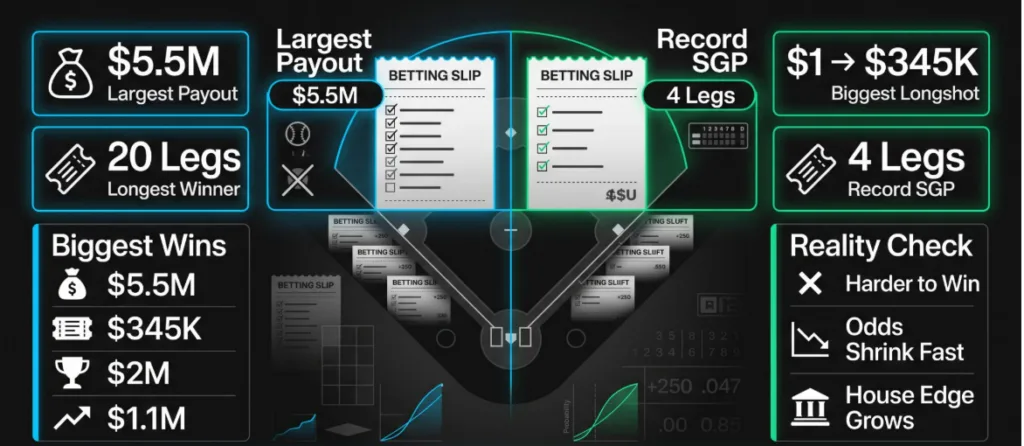
The Record Payout: $5.5 Million on Four Legs
The largest parlay payout reported by a U.S. sportsbook came down to a last-second field goal. In November 2023, a Florida bettor staked $500,000 on a four-leg same-game parlay at Hard Rock, needing the Texans to beat the Bengals, the game to clear 44.5 points, and Devin Singletary to top 51.5 rushing yards with a touchdown.
Every leg hit. Singletary ran for 150 yards and scored, the total cleared, and rookie Matt Ammendola drilled a 38-yard field goal on the final play for a 30-27 Houston upset. The $500,000 stake returned $5.5 million.
The size of the bet is what built the payout, not the length of the odds. A four-leg parlay is not an outrageous longshot, but a half-million-dollar stake turns a modest multiplier into a record check. This is the high-stakes path to a big number, and it takes deep pockets to walk it.
The Record Longshot: $1 Into $344,902
The opposite path starts with pocket change. In December 2025, a bettor in Pembroke Pines, Florida built a 20-leg college basketball parlay entirely out of under bets, staked one dollar, and won $344,902.81. The combined odds came to +34,490,180, the longest-odds payout in Hard Rock Bet history.
The ticket survived on margins. Florida Gulf Coast landed on exactly 76 points against a 76.5 under, and a Central Michigan total sat one basket from busting in the final minute. Twenty legs all had to clear, and they did.
This is the lottery-ticket path, and the number proves the appeal. A dollar chasing $345,000 is the dream every parlay builder is sold, multiplied across twenty independent outcomes that each had to break right.
Other Parlays That Made History
A $30 home-run parlay produced the most lopsided win on record. On April 24, 2026, a Hard Rock bettor backed six specific players to homer on the same night at odds of +6,576,031. Jazz Chisholm, Bryce Harper, and Shohei Ohtani were among the names, and when the last one cleared the fence on the West Coast, the $30 turned into nearly $2 million.
Mixing sports widened the odds on another famous ticket. In November 2021, a BetMGM customer put $50 on a 15-leg parlay spanning the NFL, NBA, NHL, college football, and golf, then cashed about $1.1 million eight days later when the final leg landed. Spreading legs across leagues pushed the combined price past +22,000.
The sharpest of these wins came from catching a live price mid-collapse. In December 2022, Marco Piemonte staked $31,000 on a five-leg NFL parlay that opened with the Vikings down 36-14 to the Colts, grabbing Minnesota’s live moneyline at +700. The Vikings completed the largest comeback in NFL history, the other four legs hit, and the ticket paid just over $2.88 million.
How Parlay Odds Multiply
The mechanics are simple arithmetic. Convert each leg’s odds to decimal form, multiply them together, and the result is the parlay price. Three legs at standard -110 odds run 1.91 times 1.91 times 1.91, which lands around +596, so $100 returns roughly $696.
The multiplication is why payouts balloon and why hitting gets so much harder. Three coin-flip legs have about a 12.5% chance to all win, even though the payout looks generous. Add legs and the win probability falls off a cliff, which is how a 20-leg ticket reaches odds of 34 million to one.
Breakeven is the number most bettors never run. A two-leg parlay at -110 each needs to win 27.4% of the time just to break even, and a three-leg needs 14.4%, because the juice on every leg compounds rather than averages out. Those thresholds climb out of reach long before a ticket reaches the leg counts that make headlines.
Why the House Loves a Parlay
Parlays are the most profitable product on a sportsbook’s menu, because the edge compounds with every leg. A straight bet carries a hold of roughly 4.5%, the standard juice baked into a -110 line. A parlay stacks that margin on each leg and multiplies it, pushing the effective hold to 15% or higher on a four-leg ticket.
State data makes the gap concrete. In New Jersey in September 2024, sportsbooks held 24.2% on parlays against 4.4% on everything else, and parlays drove the bulk of betting revenue despite a fraction of the money wagered. The books promote parlay builders so heavily for that reason.
The record wins do not contradict this. A sportsbook can write a $5.5 million check and still profit enormously on parlays overall, because for every ticket that hits, thousands miss. Smart Bet Insider tracks the markets and the math behind them so the numbers stay in view. Understand the hold before you chase the headline, and treat a longshot parlay as the lottery ticket it is.
Frequently Asked Questions
What is the biggest parlay ever won?
There is no single record, because the biggest parlay depends on the metric. The largest reported payout is $5.5 million, won on a $500,000 four-leg parlay at Hard Rock in 2023. The most extreme longshot is a $1 wager that returned $344,902 on a 20-leg college basketball parlay in 2025.
How is a parlay payout calculated?
A parlay payout is found by converting each leg’s odds to decimal form and multiplying them together. Three legs at -110 each work out to about +596, so a $100 bet returns roughly $696. The more legs you add, the larger the multiplier and the lower your chance of winning.
Why are parlays harder to win than straight bets?
Parlays require every leg to hit, so the win probability multiplies down with each addition. Three even-money legs have only about a 12.5% chance of all landing, and a six-leg parlay drops under 2%. That collapsing probability is the tradeoff for the larger potential payout.
Do sportsbooks make more money on parlays?
Yes, parlays are the most profitable bet type for sportsbooks because the house edge compounds across legs. A straight bet holds around 4.5%, while a four-leg parlay can hold 15% or more. In New Jersey in September 2024, parlays held 24.2% versus 4.4% on other bets.
What is a same-game parlay?
A same-game parlay combines multiple bets from a single game into one ticket, like a team’s moneyline plus a player’s rushing total. The legs are often correlated, meaning one outcome makes another more likely, so sportsbooks price them to account for that link. The record $5.5 million Texans payout was a four-leg same-game parlay.
Can you really turn a small bet into a huge parlay win?
It happens, but it is extremely rare and not a reliable strategy. A bettor turned $1 into nearly $345,000 on a 20-leg parlay in 2025, at odds of more than 34 million to one. For every winning ticket like that, the vast majority of longshot parlays lose, which is why the wins make headlines.