
March madness betting trends reward bettors who read the bracket as recurring matchups rather than 63 separate games. Seed numbers carry decades of point-spread history, and that history rarely matches public instinct. The seeds that feel safest cover the least, and the underdogs everyone fears pay out the most.
Oddsmakers price the seed number, not the roster underneath it. Smart Bet Insider tracks the seed-and-round patterns that survive the modern bracket era and the ones that crumble under a thin sample. The trends below run from the First Four through the Sweet 16, each tied to a record you can check before you bet.
The 11-Seed Covers Better Than Any Other Line
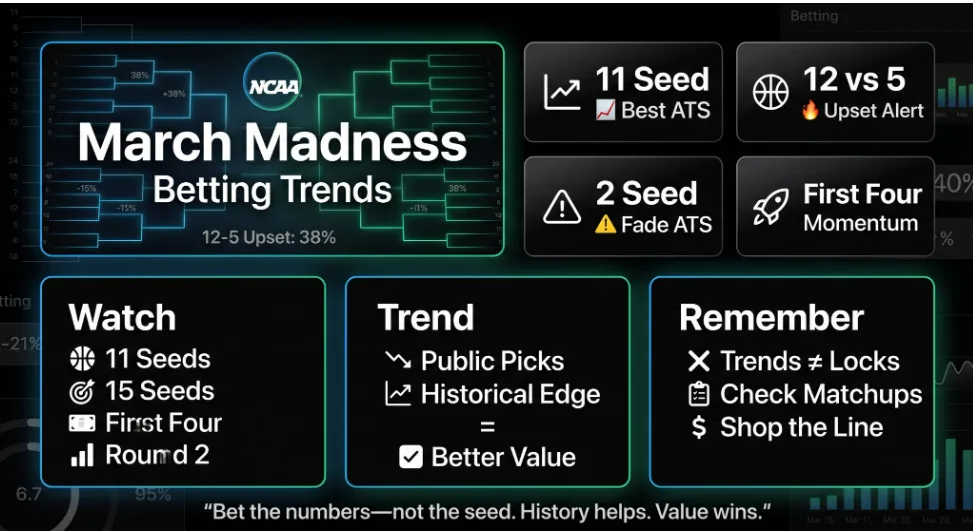
Eleven-seeds have covered nearly 60 percent of their spreads since 2005. Bet Labs data cited by BetMGM puts them at 74-52-2 against the spread across 17 tournaments, the strongest mark of any seed in the field.
High-major teams that stumbled in conference play land on the 11 line most years. They keep games close and sometimes win outright, and two of them reached the Final Four across a recent three-tournament stretch. The committee stamps them with a double-digit seed, and the betting public reads that number instead of the talent behind it.
The 12-Over-5 Upset Survives, but the Spread Edge Is Gone
Twelve-seeds beat five-seeds 35.37 percent of the time, a 58-106 first-round record since 1985 per NCAA.com. At least one 12-seed has won its opener in 34 of the last 40 tournaments.
The cover tells a different story than the upset. Twelve-seeds held a 65-52-2 ATS edge against the five dating to 1996, then the market closed the gap. They have gone 19-17 ATS since 2017, a 53 percent rate that barely clears a coin flip. All four five-seeds won and covered in 2023, the kind of year that empties brackets built on the trend alone.
The 2-Seed Wins Early and Covers Worst
Two-seeds carry the lowest cover rate of the top four lines. The pattern can be traced back to inflated public spreads, the price you pay for backing a reputation.
The straight-up record sets the trap. Two-seeds beat 15-seeds about 93 percent of the time, so money floods the favorite and the line balloons past 20 points. A 15-seed built to stay within the number turns that spread into a coin flip, and the two-seed clears it less often than any peer near the top of the bracket.
The 15-Seed Covers More Than the 13 or 14
Fifteen-seeds cover at 53.1 percent, beating both the 13 and the 14. Boyd’s Bets ties the edge to spread size. A team getting 20-plus points only has to stay close, not win.
The outright odds stay long, with 15-seeds toppling two-seeds just 11 times in tournament history. Cover rate runs on a separate engine. Books that price a team to lose by three touchdowns hand the bettor a low bar, and a 15-seed clears a respectable loss often enough to cash the ticket while losing the game.
First Four Teams Carry Their Momentum Into the Next Round
First Four outright winners have gone 35-3 against the spread in the following round since 2013, a 92 percent cover rate documented by VSiN. A team rolling out of the play-in game has buried better-rested opponents almost every time.
The round feeds underdogs too. First Four dogs covered at 55.8 percent over an 11-tournament span, a 24-19 ATS edge built on small fields and soft lines. Books set these numbers fast on teams they have barely had time to study, and the dogs cash the gap.
Round Two Buries the First-Round Cinderella
Fourteen-seeds that pulled a first-round upset have gone 0-10 straight up and against the spread in the second round since 1998. VSiN clocks their average margin of defeat at 14.8 points per game.
The collapse extends past one seed. Better-seeded teams playing as second-round underdogs to a worse seed have gone 10-16 ATS since 2001. The Round of 32 rewards survivors with real depth and exposes the ones who rode a single hot shooting night into the weekend.
Reading Trends Without Getting Burned by Them
A seed trend marks a starting point, not a system. Splitting results by seed and round shrinks the sample fast, and a 0-10 streak can break the year you finally bet it. The trends that last share a cause beyond the number, roster quality the seed hides or public money the line swallows, while the rest rest on coincidence and snap the moment the market notices.
Smart Bet Insider tracks seed-and-round ATS records, line movement, and the matchups where history still holds an edge through every round of the bracket. Check the analysis before you lock a bracket on a trend the books already corrected.
Frequently Asked Questions
What is the most profitable seed to bet on in March Madness?
The 11-seed holds the best against-the-spread record of any seed in the modern era, covering close to 60 percent over 17 tournaments since 2005 per Bet Labs. These teams are often talented high-majors that slipped in conference play, good enough to keep games tight while the line treats them as longshots. Two 11-seeds have reached the Final Four in recent years.
How often does a 12-seed beat a 5-seed?
A 12-seed beats a 5-seed about 35.6 percent of the time, a 57-103 first-round record since 1985. At least one 12-seed has advanced past the opening round in 34 of the last 40 tournaments. The spread edge has faded though, with 12-seeds covering just 53 percent against the five since 2017.
Why are 2-seeds a bad bet against the spread?
Two-seeds carry the lowest cover rate among the top four seeds because the public inflates their spreads. They win early most of the time, beating 15-seeds about 93 percent straight up, but laying a large number against a team built to stay respectable loses money over time. The value sits on fading the two-seed, not backing it.
Do First Four teams perform well in the next round?
First Four outright winners have gone 35-3 against the spread in their next game since 2013, a 92 percent cover rate. Underdogs inside the First Four itself also cover at 55.8 percent over the last 11 tournaments. A soft line paired with a team riding momentum produces one of the bracket’s most consistent edges.
Which March Madness seeds should you fade?
Two-seeds and first-round Cinderella teams head the fade list. Two-seeds cover worst among top seeds because the public overprices them, and 14-seeds that win their opener have gone 0-10 ATS the following round since 1998. Both patterns reward betting against the crowd’s instinct rather than with it.