

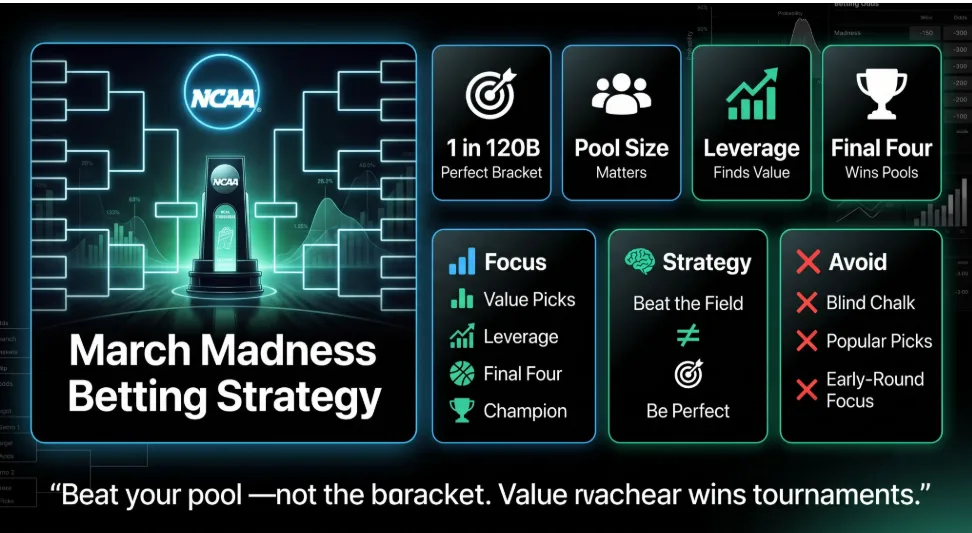
March madness betting strategy starts with a number that should reframe how you fill out a bracket: the odds of a perfect one are 1 in 9.2 quintillion by coin flip, and roughly 1 in 120 billion even for an informed picker. Perfection is off the table. Winning your pool is not, but it runs on math most entries ignore.
A bracket pool is a game-theory contest, not a prediction contest. The goal is expected value relative to the other entries, not raw accuracy. Smart Bet Insider breaks down where the field overpays and where the value hides. The math below shows how to build an edge instead of a guess.
Accuracy Is Not the Goal
Most entries try to predict the tournament correctly. The winners try to beat the field, and those are different problems. Finishing 40th out of 100 pays the same as finishing last, so a pick that matches half the pool does almost nothing to move you up the standings.
The points that win pools are the ones where you are right and the field is wrong. A correct champion shared by 30 percent of entries creates no separation, because everyone holding that team banks the same points. The edge lives in the picks that few others made and that still hit. Building a bracket means hunting for those spots, not maximizing the number of games you expect to call correctly.
The Leverage Ratio Tells You Where Value Sits
The single most useful number in pool strategy is the gap between a team’s real chance and how often the public picks it. Expressed as a ratio, leverage equals win probability divided by ownership percentage. A ratio above 1.5 flags a team underowned relative to its chances. Below 0.8 means overowned, poor value even if the team is strong.
A worked example shows the idea. A 1-seed with a 10 percent title chance picked by only 5 percent of the pool scores a 2.0 and a clear value play. Another favorite with the same 10 percent chance drawing 30 percent of brackets scores a 0.33 and a trap. The team is equally good in both cases. Only the underowned one pays you for being right, and sportsbook implied odds sharpen the read by flagging teams the market rates higher than the bracket field does.
Pool Size Decides How Contrarian to Go
The right amount of risk scales directly with how many entries you face. In small pools of 10 to 20, chalk is usually optimal, because the field is small enough that raw win probability matters more than standing out. A 1-seed champion gives the best straight expected value when few rivals can leapfrog you.
Large pools flip the logic. With 100 or more entries, a popular champion shared across the field leaves no room to climb, so a 2, 3, or 4 seed with lower ownership carries higher expected value through sheer uniqueness. The deeper the field, the more a Cinderella run into the Elite Eight outscores a correct chalk pick. Match the contrarian dial to the pool, not to your gut.
Scoring Format Changes the Whole Calculation
Before picking a single team, read how the pool awards points. Exponential scoring that doubles each round makes the champion the dominant lever, since late-round points dwarf early ones. Sequential scoring that rises gently, something like one through six points per round, rewards getting more picks right across the board instead of nailing one title call.
Upset multipliers change it again. When a pool awards bonus points for lower seeds winning, a 12-seed first-round upset can outscore a chalk 5-seed advance. A bracket built for an exponential pool and dropped into an upset-multiplier pool is built wrong. The format dictates whether champion differentiation or early-round upset hunting earns you the most points.
The Late Rounds Are Where Pools Are Won
The math of separation concentrates at the end of the bracket. Bracket Challenge Game winners since 2015 correctly picked 38 of 40 Final Four teams, and several missed seven or more first-round games and still won. Early-round upsets feel decisive and rarely are.
The pattern is clear about where to spend your attention. Winners can botch a handful of 8-versus-9 games and survive, but they need to be near perfect from the Sweet 16 on. Getting the title-game teams right separates a winner from the pack more than any cluster of correct first-round calls. Build the bracket backward from the champion and the Final Four, and treat the early rounds as the low-leverage noise they are.
Smart Bet Insider tracks implied title odds, public ownership gaps, and the matchups where the line disagrees with the bracket field all tournament long. Check the analysis before you lock a champion the whole pool already has.
Frequently Asked Questions
What are the odds of a perfect March Madness bracket?
The odds of a perfect bracket are 1 in 9.2 quintillion if every game is a coin flip. Using seeding knowledge and historical win rates, informed estimates fall between 1 in 2 billion and 1 in 128 billion depending on the model. No verifiably perfect bracket has ever been recorded in the modern tournament era.
Should I pick chalk or contrarian picks in my bracket pool?
The choice depends on pool size. In small pools of 10 to 20 entries, chalk picks like a 1-seed champion maximize expected value because differentiation matters less. In large pools of 100 or more, contrarian picks on a 2 through 4 seed gain value because fewer rivals share them, giving you more unique upside if they hit.
What is the leverage ratio in bracket strategy?
The leverage ratio is a team’s championship probability divided by the percentage of the pool that picks it. A ratio above 1.5 signals a team is underowned relative to its real chances, making it a value pick, while a ratio below 0.8 signals it is overowned. The number identifies where you can be right while most of the field is wrong.
Does my pool’s scoring system affect strategy?
Scoring format changes which picks matter most. Exponential scoring that doubles each round makes the champion pick dominant, while sequential scoring rewards getting more games right across all rounds. Upset-multiplier pools raise the value of early-round underdog picks, sometimes making a 12-seed upset worth more than a chalk advance.
How often does a 1-seed win March Madness?
A 1-seed has won the championship roughly 64 percent of the time since 1985, a rate that climbs to about 71 percent since the field expanded in 2011. That dominance makes a top seed the safest champion pick in small pools. In large pools, the high ownership that comes with a 1-seed can erase its value despite the strong odds.