

The Edge Is in the Early Market
Most bettors wait until Super Bowl week to place their prop bets. Sharp bettors have already moved. The 2027 Super Bowl futures and early prop markets are open right now — and the lines available today are meaningfully softer than anything you’ll find after the conference championships, when public money floods in and sportsbooks tighten every number across the board. If you want the best prices on the best props, the window to act is earlier than most people think.
Smart Bet Insider tracks Super Bowl futures and early prop markets from the moment they open, identifying value before the crowd catches up. With team futures analysis, early player prop trends, and patch-by-patch line movement tracking across every major sportsbook, Smart Bet Insider gives you the framework to build a 2027 Super Bowl card that starts sharp and stays sharp. This guide covers what to watch, where to bet, and how to read early markets before the field narrows.
What Are Super Bowl Futures and How Do They Work?
Super Bowl futures are long-range bets placed well before the event — sometimes months in advance — on outcomes like which team wins the championship, which conference produces the winner, or which player wins Super Bowl MVP. Unlike standard game bets placed close to kickoff, futures carry added variance because so many variables can change between now and game day. In exchange for that uncertainty, the odds available on futures are frequently far more generous than anything the market will offer later in the season.
The key mechanic that makes futures valuable is line movement over time. A team priced at +800 to win the Super Bowl in the preseason may shorten to +350 by playoff time if they perform well — meaning an early bet captures value that simply won’t exist later. Sportsbooks like Betway, DraftKings, and FanDuel all publish Super Bowl futures year-round, while Pinnacle remains the sharpest benchmark for assessing whether a futures price represents genuine value or inflated public expectation.
The Super Bowl Prop Market Lifecycle: A Multi-Phase Pricing System
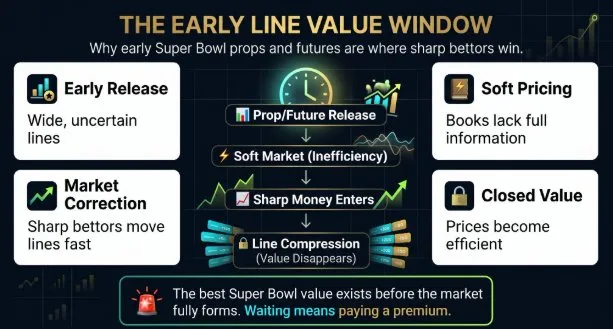
Research on sports betting market efficiency shows that accuracy depends on the quality, timing, and completeness of incoming information, meaning pricing shifts as new data is absorbed. Most betting content wrongly frames Super Bowl props as “early vs late” pricing, but they actually follow a lifecycle of uncertainty, information absorption, and compression — and the edge comes from identifying which phase the market is in.
The lifecycle has three phases. Phase 1 (soft release) opens with wide, uncertain lines due to missing matchup and injury context, with books prioritizing coverage over precision. Phase 2 (information injection) follows as sharp money and new information rapidly reprice markets; studies show odds continuously update as data is absorbed. Phase 3 (compression) occurs when public betting peaks and arbitrage closes gaps, driving lines toward equilibrium as informational edges are largely priced in.
How Early Prop Markets Differ From Super Bowl Week Props
Early prop markets — released weeks or months before the Super Bowl — operate squarely in Phase 1 of the lifecycle framework above: maximum uncertainty, wide margins, and models stretched across hundreds of low-confidence variables simultaneously. When books release early props, they are working without a confirmed matchup, with incomplete injury data, and without the sharp positioning that begins correcting prices in Phase 2. This uncertainty forces books to set wider lines with softer margins, creating genuine pricing inefficiencies that close rapidly as the game approaches and information sharpens.
The practical implication is significant. An early passing yard total set without knowledge of the opposing defense may be half a yard or more off where the line lands in Super Bowl week once the matchup is confirmed. Bettors who understand team tendencies, defensive schemes, and game script probabilities well enough to project these numbers ahead of the market have a structural advantage that shrinks rapidly as kickoff approaches. Tracking early prop movement on aggregators like Oddschecker allows you to monitor how lines shift as information enters the market — and to identify which direction the sharp money is already moving.
The Early Line Value Window: Acting Before the Market Matures
Every Super Bowl prop market goes through the same lifecycle: a soft open, a sharpening phase as serious bettors and models engage, and a closing phase where public money compresses the remaining value out of the line. What sharp bettors call the “Early Line Value Window” is that first phase — the period between a prop’s initial release and the moment it has been sufficiently bet into efficiency. For Super Bowl markets, this window typically lasts between 24 and 72 hours after a prop is first published, before sharp action and algorithmic engagement tighten the spread.
Acting inside the Early Line Value Window requires preparation. You need to know what a fair line looks like before the book publishes one — which means doing the underlying research on player usage rates, defensive matchup data, and game script probabilities in advance. Pro Football Reference and Next Gen Stats provide the raw data needed to form independent probability estimates. Smart Bet Insider monitors prop releases across all major books the moment they go live, alerting members when a newly published line sits outside fair value — before the market has had time to correct it.
Reading Super Bowl MVP Futures: Where the Value Hides
Super Bowl MVP futures are among the most consistently mispriced markets in all of sports betting. Quarterbacks win the award the vast majority of the time, which means QB futures are heavily bet, heavily shaded, and almost always poor value by the time the game rolls around. The real opportunity lies in non-QB MVP futures — skill position players, defensive standouts, and game script beneficiaries whose odds remain inflated simply because the public defaults to backing the starting quarterback.
Historically, wide receivers and running backs who are central to their team’s offensive identity in high-scoring Super Bowls have won MVP at odds that would have represented enormous value compared to the implied probability of a non-QB victory. The formula for identifying these plays starts with projected game script: high-total games favor offensive skill players, while low-total defensive contests open the door for defensive MVP longshots at massive prices. Checking MVP futures across platforms using Oddschecker lets you compare pricing gaps and identify which books are slowest to adjust their non-QB odds — which is consistently where the softest prices live.
Smart Bet Insider: First to the Market, First to the Value
Timing is everything in Super Bowl futures and early prop betting, and Smart Bet Insider is built around being first. The moment futures lines open or early props are published, Smart Bet Insider’s analysis is already running — cross-referencing current prices against independent probability models, flagging Early Line Value Window opportunities, and identifying the MVP longshots and team futures where the market is most vulnerable to mispricing.
Members receive early prop alerts, futures value picks, and line movement summaries covering every major sportsbook from the season’s opening week through Super Bowl kickoff. Every recommendation is confidence-tiered and backed by clear reasoning — not just a pick, but a framework for understanding why the value exists and when to act on it. Follow Smart Bet Insider today and make sure you’re inside the Early Line Value Window, not reading about it after it closes.
The Best Prices Are Available Right Now
Super Bowl 2027 prop and futures markets are already open, and the lines available today will not exist by the time casual bettors start paying attention. The Early Line Value Window closes fast, MVP futures compress as the season progresses, and team prices shorten the moment a roster starts performing above expectations. Every week you wait is a week of value the market has already priced away.
Smart Bet Insider is the resource that keeps you ahead of that curve — with real-time line alerts, futures tracking, and early prop analysis built for bettors who understand that timing is as important as picking the right side. Follow Smart Bet Insider now and start building your 2027 Super Bowl card while the market is still giving value away.
FAQs
1. When do Super Bowl futures markets open?
Super Bowl futures are available year-round at most major sportsbooks, with initial lines published before the NFL season begins in September. Lines are updated continuously as the season progresses, with the most significant movements occurring after playoff seeding is confirmed and after each conference championship game.
2. Is it better to bet Super Bowl props early or during Super Bowl week?
For most props, earlier is better — early lines carry softer margins and fewer sharp bets have engaged with the market. The exception is props heavily dependent on the specific matchup, such as defensive player props or game total-linked bets, where waiting until the matchup is confirmed provides necessary context that outweighs the price advantage of going early.
3. Which sportsbooks offer the best early Super Bowl prop markets?
DraftKings and FanDuel publish early props with the widest market variety. Pinnacle offers the sharpest pricing and is the best benchmark for evaluating value at recreational books. Use Oddschecker to compare lines across platforms and identify where each book is slowest to update.
4. What is Super Bowl MVP betting and how should I approach it?
Super Bowl MVP futures allow you to bet on which player wins the game’s most valuable player award. Quarterbacks win the award most often, making QB futures poor value due to heavy public action. The strongest approach is identifying non-QB players — receivers, running backs, and defensive standouts — whose implied odds significantly understate their actual probability of winning in the right game script.
5. How do I track Super Bowl futures line movement?
Oddschecker and OddsPortal both provide line movement history across multiple sportsbooks. For futures specifically, noting the opening line and tracking how it moves over weeks gives you a clear picture of where sharp money is landing and which teams are being bet into shorter prices by informed bettors.
6. What research tools should I use for early prop analysis?
Pro Football Reference provides historical performance and matchup data. Next Gen Stats covers advanced tracking metrics including target separation, route participation, and rushing efficiency. Cross-referencing both against early prop lines lets you form an independent view of where sportsbook numbers are set too high or too low relative to performance data.
7. How much should I allocate to Super Bowl futures bets?
Futures carry more variance than single-game bets due to the extended timeline and number of variables involved. A conservative allocation of 1–2% of total bankroll per futures position is recommended, with a maximum of three to five futures bets across the season to avoid overexposure. The value in futures comes from price, not volume — one well-timed early bet at the right number is worth more than ten late bets at compressed odds.