

Georgia’s Most Realistic Shot at Legal Sports Betting — and Why It Failed
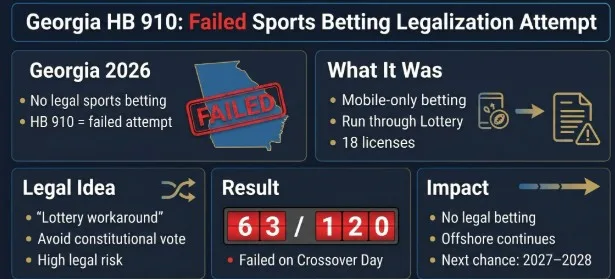
Georgia is the largest state by population without legal sports betting in the United States — and in 2026, it came closer than it ever has to changing that. House Bill 910, introduced by Representative Matt Hatchett, carried over from the 2025 session into 2026 with a novel legal strategy: bypass the need for a constitutional amendment entirely by treating sports betting as a form of lottery gaming under the Georgia Lottery Corporation’s existing authority. It was widely considered the Peach State’s most realistic legalization path. It still failed.
Smart Bet Insider tracks sports betting legislation across every US state — covering not just the legislative outcome but what it means for Georgia bettors who continue wagering through offshore platforms while neighboring states collect hundreds of millions in tax revenue. This guide covers exactly what HB 910 proposed, why its legal strategy was significant, how it failed, and what comes next for legal sports betting in Georgia.
What HB 910 Actually Proposed
HB 910 authorized online-only mobile sports betting with no physical sportsbooks, casinos, or racetracks attached. All regulatory authority would sit with the Georgia Lottery Corporation — the same body that has overseen Georgia lottery operations, HOPE Scholarship funding, and pre-K program revenues since 1993. Up to 18 Type 1 sports betting licenses would be available to eligible entities including the state’s five professional sports teams, the PGA Tour, Augusta National Golf Club, Atlanta Motor Speedway, and the Georgia Lottery itself.
The financial structure was designed for political viability, directing a 20–25% tax on wagering revenue to HOPE Scholarships and pre-K programs. HB 910 was projected to generate $300–$450 million annually, with high license costs including a $100,000 application fee and $1.5 million annual renewal fee.
The Lottery Doctrine Test: The Legal Framework Most Coverage Missed
Most competitor coverage of HB 910 stops at a surface-level description: that sports betting is being “reclassified” as lottery gaming under the Georgia Lottery Amendment, and therefore avoids a constitutional amendment requirement. What is missing is the actual legal framework courts would use to evaluate whether that classification is valid — what can be described as the “Lottery Doctrine Test.”
The Threshold Constitutional Question
At the center of this analysis is a threshold question: is sports betting merely an incidental expansion of lottery powers, or does it constitute a fundamentally distinct gambling category that falls outside the 1992 Lottery Amendment entirely? Under the Georgia Constitution, gambling is broadly prohibited except where explicitly carved out — meaning the legal system does not treat “lottery” as an open-ended category but as a narrowly defined exception.
Courts would likely begin with original intent analysis of the 1992 amendment, which was designed around traditional lottery mechanics — fixed-odds, draw-based, and non-interactive participation structures. The Georgia Constitution establishes this baseline framework for interpreting enumerated exceptions to gambling restrictions, and courts evaluating HB 910 would be applying those interpretive standards to a digital wagering product the 1992 drafters never contemplated.
Where Constitutional Category Theory Enters
The doctrinal conflict emerges at the next layer: whether continuous, real-time wagering markets like mobile sports betting can be legally analogized to lottery systems, or whether they introduce a structurally distinct form of gambling that violates the “scope boundary” of the amendment. This is where courts would move beyond statutory interpretation into constitutional category theory — distinguishing not just what the legislature intended, but what type of regulated activity the constitution actually permits.
Judicial reasoning at the Georgia Supreme Court when evaluating enumerated powers and exceptions would inform this analysis directly. In this framing, HB 910 is not simply a regulatory shortcut — it is a legal category shift attempt, testing whether sports wagering can be absorbed into “lottery” authority or whether it triggers a constitutional boundary that requires voter-level approval regardless of how the legislature labels it.
The Constitutional Strategy: Sports Betting as a Lottery Product
The most legally significant feature of HB 910 was not its market structure — it was its constitutional theory. Georgia’s 1992 Lottery Amendment authorizes the General Assembly to regulate lottery games but does not explicitly mention sports wagering. Previous Georgia sports betting proposals required a constitutional amendment, which mandates passage in two consecutive legislative sessions before reaching voters in a statewide referendum — a multi-year timeline that has killed every prior attempt.
HB 910’s sponsors argue sports betting fits under the Lottery Amendment’s broad language, following the same approach as 2024’s SB 386. However, as the Lottery Doctrine Test framework notes, labeling is only the first step—courts must still decide whether that classification is constitutionally valid, regardless of the legislative vote.
The Statutory Shortcut Problem: HB 910’s Central Legal Risk
The single most consequential analytical question surrounding HB 910 was whether its constitutional theory would survive legal challenge — and opponents argued forcefully that it would not. What legal observers called the “Statutory Shortcut Problem” was the risk that Georgia courts would reject the argument that the 1992 Lottery Amendment implicitly authorizes real-time mobile wagering on sports outcomes without explicit voter approval.
Georgia’s constitution broadly bans gambling, with only a lottery exception. Classifying mobile sports betting under that exception requires an expansive legal interpretation that opponents dispute. As a result, HB 910’s durability remains uncertain, with potential litigation risk even if passed, which could deter major operators like DraftKings, FanDuel, and BetMGM from fully committing to the market.
How HB 910 Failed: The Crossover Day Vote
The bill’s fate was determined on March 6, 2026 — Georgia’s Crossover Day, the legislative deadline after which bills must have cleared their originating chamber to remain alive in the session. HB 910 needed a two-thirds supermajority of 120 affirmative votes to clear the Georgia House. It received 63. The 63-to-98 tally was not close. The bill had failed to secure even a simple majority, let alone the supermajority its constitutional structure required.
The defeat reflected conservative opposition to gambling expansion, constitutional doubts about treating sports betting as a lottery product, and weakened momentum after a key legislative supporter left earlier in the session. Despite support from a Senate study committee citing education funding benefits, the proposal was ultimately unable to overcome long-standing institutional resistance to sports betting in Georgia.
Smart Bet Insider: What Georgia Bettors Should Do Right Now
HB 910’s failure means Georgia bettors have no legal regulated domestic option for mobile sports betting in 2026. The next realistic legislative window is either a special session — which Governor Brian Kemp has not indicated he will call — or the 2027 regular session, where a reintroduced bill would need to rebuild legislative support from scratch. A constitutional amendment route would push any voter referendum to November 2028 at the earliest, given the two-session passage requirement.
In the meantime, Georgia bettors continue to have access to the same offshore platforms available before HB 910 was introduced. Bovada, BetOnline, and Pinnacle remain the most reliable offshore options for Georgia residents — with the same legal framework that applies in other unregulated states: no state prohibition on individual bettor activity, with offshore platforms operating outside Georgia’s licensing jurisdiction. Smart Bet Insider tracks Georgia’s legislative status and offshore betting options, highlighting where the best lines and most reliable payouts are available while the state market remains closed.
Conclusion: The Largest Unregulated State in the US Stays That Way — For Now
Georgia’s HB 910 failure is the latest chapter in a legislative pattern that has now stretched across four consecutive sessions without producing a legal betting market. The constitutional theory was innovative. The education funding hook was politically smart. The operator interest from major brands was genuine. None of it produced the votes needed to clear the House supermajority threshold.
The Statutory Shortcut Problem — whether the lottery amendment can constitutionally support sports betting without voter approval — remains unresolved and will be the central legal question in any future Georgia legalization attempt. Until that question is settled either by courts or by a constitutional amendment process, Georgia’s status as the largest unregulated betting state in the US is unlikely to change. Follow Smart Bet Insider now and stay ahead of every Georgia legislative development as the 2027 session approaches.
FAQs
What was Georgia HB 910?
House Bill 910 was a Georgia legislative proposal introduced by Representative Matt Hatchett that would have authorized up to 18 online sportsbook licenses under the Georgia Lottery Corporation — without a constitutional amendment. The bill treated sports betting as a form of lottery-regulated gaming, directing tax revenue to education programs including HOPE Scholarships and pre-K initiatives.
Did HB 910 pass in Georgia?
No. HB 910 failed on March 6, 2026 — Georgia’s Crossover Day — receiving only 63 affirmative votes against the 120-vote supermajority threshold required. The 63-to-98 tally was not competitive, ending Georgia’s 2026 legalization push decisively.
Why did HB 910 need a supermajority?
Georgia’s constitution requires a two-thirds supermajority for legislation touching lottery operations under the 1992 Lottery Amendment. Because HB 910 classified sports betting as a lottery product to avoid a constitutional amendment referendum, it inherited the supermajority requirement — a significantly higher bar than a simple majority vote.
What is the Statutory Shortcut Problem?
The Statutory Shortcut Problem is the legal risk that Georgia courts would reject the argument that the 1992 Lottery Amendment implicitly covers mobile sports betting without explicit voter approval. Georgia’s constitution otherwise bans gambling, with the lottery as a specific exception. Using that exception to cover real-time sports wagering requires an expansive legal interpretation that opponents — and potential future courts — contest.
When could Georgia legalize sports betting?
The next realistic legislative window is the 2027 regular session for a statutory approach, or November 2028 for a voter referendum via constitutional amendment — which requires passage in two consecutive sessions before reaching the ballot. A special session in 2026 is possible but unlikely without a specific gubernatorial push from Governor Kemp.
Where can Georgia bettors place legal bets now?
Georgia has no legal domestic mobile sportsbook. Georgia bettors currently access offshore platforms including Bovada, BetOnline, and Pinnacle. There is no Georgia state law explicitly targeting individual offshore bettors — federal statutes target operators and payment processors rather than individual users. Always consult a legal professional for advice specific to your circumstances.
How does Georgia compare to neighboring states on sports betting revenue?
Tennessee, North Carolina, and Virginia all have legal, regulated mobile sports betting markets that are collecting significant tax revenue. Georgia — the largest state by population without legal betting — is estimated to be losing hundreds of millions in annual tax revenue to offshore platforms and neighboring states. The education funding argument in HB 910 was specifically framed around recapturing that lost revenue for HOPE Scholarships and pre-K programs.