
Introduction: Two Regulated Options, One Decision
For the first time since 2022, US bettors have two fully regulated prediction market platforms to choose from. Kalshi has been CFTC-licensed since 2021 and has operated as the dominant US-regulated option for three years. Polymarket returned to the American market in December 2025 after receiving CFTC regulatory approval through its QCEX subsidiary — completely changing the landscape for US-based traders who previously had no regulated alternative to Kalshi.
Smart Bet Insider covers both platforms in depth, tracking fees, market depth, liquidity, and pricing efficiency across the full prediction market landscape. The Polymarket vs Kalshi question is now genuinely interesting in a way it hasn’t been since Polymarket was blocked for US users — and the answer is more nuanced than “one is better.” This guide covers every dimension that matters for US bettors in 2026.
Why Identical Prices Don’t Encode Identical Information
A common analytical mistake in comparing Polymarket and Kalshi is assuming that identical prices encode identical information. In most comparisons, a contract trading at $0.70 on both platforms is treated as a uniform 70% probability. In reality, this equivalence breaks down once you account for differences in trader composition, regulatory constraints, and information flow dynamics.
Segmented Information Ecosystems
Cross-market research suggests that prediction market prices are not purely objective probability readings — they are reflections of segmented information ecosystems. Kalshi’s trading is dominated by US-regulated participation under CFTC oversight, including more institutional and macro-oriented flows. This tends to produce slower-moving but more structurally anchored pricing. Polymarket’s crypto-native environment historically attracts more global, retail-heavy, and narrative-sensitive traders — leading to faster repricing around news shocks and sentiment-driven updates.
This divergence creates a deeper issue than simple liquidity differences: the same price can represent different informational states across platforms. Empirical work on prediction markets shows that price discrepancies across venues often persist due to segmented trader bases and asymmetric information diffusion, rather than pure inefficiency alone.
Information Velocity vs Price Equivalence
A 60% contract on Kalshi is not necessarily equivalent to a 60% contract on Polymarket. The former may reflect a more institutionally stabilized probability anchored in slower information assimilation, while the latter may embed faster but noisier narrative-driven updates. The numerical price may be identical, but the information velocity and trader psychology behind it are structurally different.
Recognizing this gap transforms cross-platform comparison from a price-matching exercise into an analysis of competing probability formation systems. When Kalshi and Polymarket prices diverge, the question is not simply “which platform is right” — it is whether the divergence reflects a genuine information asymmetry, a difference in narrative sensitivity between trader bases, or a temporary liquidity lag that will correct as more participants engage with both markets.
Regulation and Legal Status: Both Are CFTC-Regulated
Both Kalshi and Polymarket US operate under CFTC oversight as Designated Contract Markets — the same federal regulatory framework that governs traditional financial derivatives exchanges. This means both platforms are fully legal for US users, can operate nationally across all 50 states (with specific state-level restrictions applying to sports event contracts in some jurisdictions), and are subject to the same consumer protection and market integrity standards.
The key regulatory distinction is operational history. Kalshi has operated under CFTC regulation since 2020, with a long track record of compliance and settlement procedures. Polymarket US via QCEX is newer to the regulated market following its 2025 approval pathway. Both are legitimate, but Kalshi’s longer history offers a deeper infrastructure advantage, especially in settlement transparency and support.
Fees: Polymarket Is Cheaper, With Caveats
The fee comparison is one of the most practically significant differences between the two platforms — and Polymarket holds the clear cost advantage for most trade types. Kalshi’s taker fee formula is 0.07 × price × (1 – price), peaking at $0.0175 per contract at $0.50 pricing. Polymarket US uses a coefficient of 0.05 for takers and offers a 0.0125 maker rebate — meaning Polymarket charges less on taker orders and actually pays makers rather than charging them.
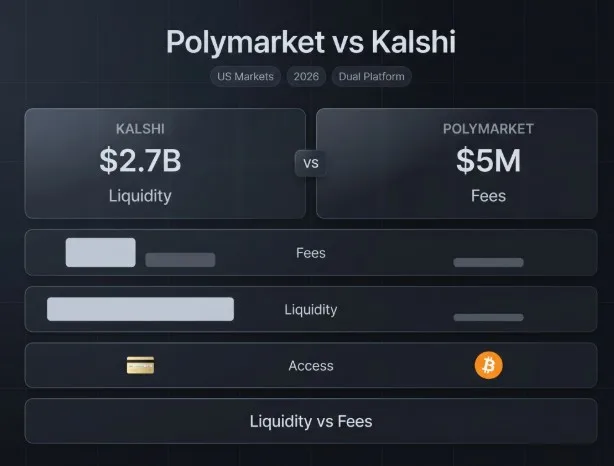
At the $0.50 midpoint on a 100-contract taker trade, Kalshi charges approximately $1.75 versus Polymarket US’s approximately $1.25 — a 40% cost advantage for Polymarket on the most common price point. The fee gap narrows at extreme price points where both formulas reduce fees as contracts approach certainty, but across the contested mid-probability range where most trading occurs, Polymarket US is the cheaper execution venue. The caveat is volume: Polymarket US is early-stage with around $5 million in weekly volume compared to Kalshi’s $2.7 billion — which affects the other critical variable in prediction market trading: liquidity.
Liquidity: Kalshi Dominates for US Traders
Liquidity is the dimension where the comparison is least ambiguous for US-based traders in 2026. Kalshi is running over $2.7 billion in weekly trades, while Polymarket US is a distant third at around $5 million in weekly volume with approximately 440 active markets. Together, Kalshi and Polymarket’s global platform produced $1.63 billion across Super Bowl 60 markets alone — but that Polymarket volume was almost entirely on the global decentralized platform, not the US-regulated venue.
What this means practically: on most markets, Kalshi’s order book is deep enough for meaningful position sizes without significant slippage. Polymarket US’s thin order book on many markets means the Displayed vs Executable Price Gap — the difference between the headline price and actual execution price — can be substantial. For small trades under $100, this matters less. For traders placing meaningful positions, executing on a $5 million weekly volume platform against a $2.7 billion one creates real execution cost differences that partially or fully offset Polymarket US’s fee advantage on any given trade.
Smart Bet Insider: The Right Platform for Your Trading Style
The Polymarket vs Kalshi decision in 2026 is not a binary choice but a routing decision. Kalshi wins on US domestic market depth, regulatory history, fiat funding simplicity, and liquidity for any trade that needs real execution depth. Polymarket US wins on fee efficiency and international/cultural market breadth for traders willing to manage crypto infrastructure. For most US bettors making the transition from traditional sportsbooks, Kalshi is the cleaner starting point — deeper sports markets, no crypto friction, and a support infrastructure built for the US market.
Smart Bet Insider tracks pricing, market availability, fee-adjusted value, and platform-specific recommendations across both Kalshi and Polymarket, identifying which venue offers better execution on each specific market type. The dual-account approach is the professional standard, and Smart Bet Insider’s coverage is built for traders running both. Follow Smart Bet Insider today and trade every prediction market on the platform that actually delivers better value for that specific contract.
Complement Each Other, Don’t Choose Between Them
Polymarket and Kalshi are not competing products for most serious US traders — they are complementary platforms with different structural strengths that together cover the prediction market landscape more completely than either does alone. Kalshi dominates on US domestic depth, funding simplicity, and liquidity. Polymarket US leads on fee efficiency and international breadth. The Funding Infrastructure Premium is real, the liquidity gap is significant, and the fee advantage matters — all three factors point in different directions for different trading profiles.
Smart Bet Insider covers both platforms with the same analytical depth — fee-adjusted value identification, cross-platform price comparisons, and platform-specific recommendations built for traders running the dual-account configuration. Follow Smart Bet Insider now and trade every prediction market on the platform that actually delivers the best price, the deepest execution, and the lowest total cost for each specific contract.
FAQs
Which is better for US bettors — Polymarket or Kalshi?
It depends on your trading style and priorities. Kalshi is better for US-domestic sports and political markets, fiat-first funding, and depth of liquidity. Polymarket US is better on fees and international/cultural market breadth. Most serious traders use both. Smart Bet Insider’s coverage identifies which platform offers better value for each specific market category.
Are both Polymarket and Kalshi legal in the US?
Yes — both operate as CFTC-regulated Designated Contract Markets. Polymarket re-entered the US market in December 2025 through its QCEX acquisition. Both are legal across most US states, with specific sports event contract restrictions applying in certain jurisdictions. Check each platform’s current state availability before trading.
How do Polymarket and Kalshi fees compare?
Kalshi’s taker fee peaks at $0.0175 per contract at $0.50 pricing. Polymarket US charges approximately $0.0125 per contract at the same price point — a 40% cost advantage. Polymarket US also pays maker rebates rather than charging maker fees. The fee advantage narrows at extreme price points but is consistent across the contested mid-probability range where most trading occurs.
What is the Funding Infrastructure Premium?
The Funding Infrastructure Premium is the practical advantage Kalshi holds for US bettors from a fiat banking background — Kalshi accepts bank transfers, debit card, and Apple Pay with no crypto experience required. Polymarket US requires USDC crypto funding and blockchain-based withdrawals. For crypto-native users, Polymarket’s four-hour median withdrawal is actually faster than Kalshi’s 18-hour median — but the setup friction for non-crypto users is a real operational cost.
Which platform has more sports markets?
Kalshi currently offers sports contracts across 17 different sports with more player props and futures markets. Polymarket US covers 14 sports with stronger international coverage. For US sports bettors transitioning from traditional sportsbooks, Kalshi’s broader domestic sports catalog and deeper US-market liquidity make it the more practical starting point.
What is the weekly trading volume comparison?
As of May 2026, Kalshi runs approximately $2.7 billion in weekly trades. Polymarket US processes approximately $5 million in weekly volume. The global Polymarket decentralized platform processes approximately $2.1 billion weekly — but that volume is not accessible to US regulated users. For liquidity purposes, US bettors are comparing $2.7 billion against $5 million.
Should I use both platforms simultaneously?
Yes — the dual-account approach is the standard professional configuration. Use Kalshi for US-domestic sports and political markets where its liquidity depth and market breadth provide clear advantages. Use Polymarket US for fee efficiency on shared markets and international/cultural event coverage. Smart Bet Insider’s picks identify the optimal execution venue for each specific contract type across both platforms.