

The Forecasting Platform That Isn’t a Prediction Market
Metaculus is one of the most accurate forecasting platforms in the world — and it is almost nothing like Kalshi. That distinction matters more than most prediction market commentary acknowledges. While Kalshi and Polymarket operate as financial exchanges where users trade contracts for real money, Metaculus is a structured forecasting community where users submit probability estimates, build calibration track records, and collectively generate research-grade predictions on questions ranging from AI development timelines to geopolitical scenarios to public health outcomes.
Smart Bet Insider covers the full spectrum of forecasting and prediction market tools, helping members understand not just where to trade but which platforms generate the most informative probability signals for different types of questions. Metaculus is not a betting platform. It is a research and forecasting infrastructure that produces some of the most rigorously calibrated probability estimates available anywhere — and understanding what it does differently from Kalshi explains a great deal about how prediction markets work at a fundamental level.
What Metaculus Is and How It Actually Works
Metaculus describes its offerings as “questions” rather than “markets” — a naming convention that reflects its forecasting rather than trading orientation. Users submit probability estimates on yes/no binary questions and on numeric range questions, and those individual forecasts are aggregated by the platform into a community prediction using a weighted ensemble that accounts for each forecaster’s track record and calibration history. No money changes hands in the standard platform experience. Accuracy is measured, tracked, and displayed publicly over time.
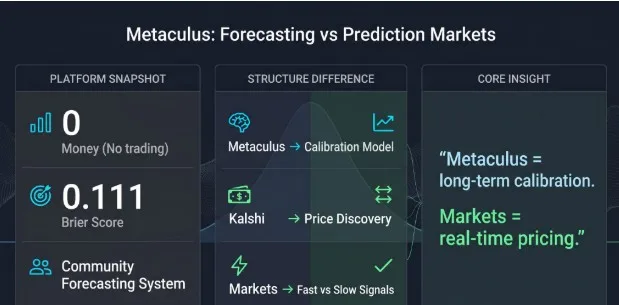
The scoring system uses the Brier score, which rewards calibration over confidence (0 = perfect accuracy, 1 = worst, 0.25 = random chance on binary questions). Metaculus’s community achieves a Brier score of about 0.111, outperforming many expert forecasters and comparable market estimates. This results from over a decade of refinement, clear resolution criteria, and a self-selecting community of serious forecasters.
Metaculus as a Calibration Prior: The Bayesian Framework Most Reviews Miss
Most competitor narratives flatten the distinction between Metaculus, Kalshi, and Polymarket into a category-level comparison: Metaculus is a forecasting site, while Kalshi and Polymarket are prediction markets. This framing misses the deeper statistical structure in how these systems actually generate information — and understanding that structure is what makes Metaculus genuinely useful rather than merely interesting.
The Bayesian Distinction: Prior vs Likelihood Estimator
In Bayesian terms, Metaculus behaves more like a stable prior distribution constructed from long-run calibration history, while prediction markets function as rapidly updating likelihood estimators driven by real-time liquidity and order flow. Metaculus forecasts are produced through aggregated human judgments continuously evaluated using proper scoring rules such as the Brier score, which rewards long-run calibration rather than short-term correctness. This produces probability estimates that are relatively inertial — slower to move than financial markets — but historically grounded in measured forecasting performance.
By contrast, regulated prediction markets like Kalshi operate as financial price discovery systems, where probabilities are inferred from contract prices formed under continuous trading conditions. These markets react quickly to new information, but they are also more sensitive to liquidity shifts, positioning effects, and short-term informational shocks that may not reflect durable probability updates.
Metaculus as a Conditioning Layer, Not a Substitute
The key analytical insight is that Metaculus is not a substitute for prediction markets — it is a conditioning layer for interpreting them. When Kalshi or Polymarket prices diverge significantly from Metaculus community probabilities, the disagreement should not be treated as noise or error. It reflects a structural difference between fast-updating market likelihoods and slower-moving calibrated priors. The most robust forecasting process emerges when Metaculus is used as a baseline distribution, and prediction markets are interpreted as real-time updates layered on top of that prior — not as independent competing estimates of the same probability.
The Core Structural Difference: Calibration vs Price Discovery
The fundamental difference between Metaculus and Kalshi is not surface-level — it is architectural. Kalshi is a price discovery mechanism: traders with real financial stakes buy and sell contracts, and the market price aggregates their collective assessments into an implied probability. The financial incentive structure creates alignment between trader conviction and capital commitment. Metaculus is a calibration mechanism: forecasters submit explicit probability estimates, and the aggregation algorithm weights those estimates by their historical accuracy. The incentive structure rewards being right over time, not winning any individual trade.
This structural difference produces different strengths. Kalshi is most informative on short-term, high-liquidity events with strong financial incentives, while Metaculus excels on long-term, low-liquidity forecasts like AI timelines and geopolitical outcomes. Neither is universally superior—they are optimized for different types of prediction problems.
The Superforecaster Advantage: Why Metaculus’s Track Record Matters
What sharp forecasters call the “Superforecaster Calibration Edge” is the advantage top Metaculus users have over public markets and expert panels, driven by disciplined probability estimation, Brier score feedback, and long-term track records. Tetlock’s research shows that a small group of well-calibrated forecasters can outperform both crowds and institutional experts on many long-horizon questions.
Metaculus operationalizes this advantage by publishing individual forecaster track records publicly and weighting community aggregations toward historically accurate contributors. In February 2026, Metaculus launched FutureEval — a continuously updated benchmark measuring how accurately AI systems predict real-world events compared to human forecasters. The benchmark found that humans currently outperform AI models on Metaculus-style forecasting questions, though Metaculus noted that gap could close. FutureEval is the clearest illustration of Metaculus’s institutional role: it is a research infrastructure, not a trading venue.
Smart Bet Insider: Using Metaculus as a Calibration Layer
Metaculus is free, requires no financial commitment, and produces some of the most rigorously calibrated probability estimates publicly available anywhere. For bettors and prediction market traders who want to stress-test their probability assessments against an independent, accuracy-focused community before committing capital on Kalshi or Polymarket, Metaculus is the most useful free reference tool in the ecosystem. The platform’s question archive also provides historical calibration data on how different types of forecasting questions tend to resolve — invaluable context for anyone developing a systematic prediction market strategy.
Smart Bet Insider’s prediction market analysis draws on signals from across the full forecasting ecosystem — Metaculus calibration data, Kalshi financial pricing, Polymarket liquidity, and traditional polling and expert consensus — to build probability assessments that are more robust than any single source. Follow Smart Bet Insider today and approach every prediction market trade with the multi-source analytical framework that serious forecasters use.
The Best Forecasting Platform for Being Right, Not Rich
Metaculus is not for bettors looking to make money — it is for forecasters who want to become genuinely more accurate over time. Its Brier scoring system, calibration tracking, editorial question curation, and long-horizon question depth make it the most intellectually rigorous free forecasting tool available in 2026. The Superforecaster Calibration Edge is real, documented, and accessible to anyone willing to engage with the platform seriously.
For prediction market traders, Metaculus is most valuable as a calibration reference — a second opinion from a non-financial, accuracy-focused community that has no stake in any particular outcome. Used alongside Kalshi and Polymarket, it adds a layer of analytical depth that purely financial market signals cannot replicate. Follow Smart Bet Insider now and build your prediction market strategy on the full range of forecasting intelligence available in 2026.
FAQs
Is Metaculus free to use?
Yes — Metaculus’s standard platform is entirely free. Users submit probability forecasts, build calibration track records, and access community predictions at no cost. The platform runs separate forecasting tournaments with cash prizes, which have their own entry and eligibility rules, but the core forecasting experience requires no financial commitment.
How does Metaculus score forecasters?
Metaculus uses Brier-style calibration scoring — a strictly proper scoring rule that rewards accuracy and penalizes overconfidence. A Brier score of 0 represents perfect accuracy, 0.25 represents random chance on binary questions, and 1 represents perfectly wrong predictions. The platform currently achieves a community Brier score of approximately 0.111, reflecting sustained calibration that outperforms most expert panels on comparable questions.
What is the difference between Metaculus and Kalshi?
Kalshi is a CFTC-regulated financial exchange where users trade real-money contracts and prices reflect supply-demand aggregation. Metaculus is a free forecasting platform where users submit explicit probability estimates scored by calibration accuracy. Kalshi is optimized for short-horizon, liquid financial markets. Metaculus is optimized for long-horizon, research-grade forecasting questions.
How accurate is Metaculus compared to other platforms?
Metaculus’s 0.111 community Brier score represents documented outperformance over individual expert forecasters and many financial prediction market estimates on comparable question types. The Superforecaster Calibration Edge — the informational advantage of a self-selecting, accuracy-tracked forecasting community — is the structural source of that performance difference. Polymarket and Kalshi tend to be more accurate on short-horizon, high-liquidity events; Metaculus tends to be more accurate on long-horizon questions.
Does Metaculus have a mobile app?
No — Metaculus currently lacks a dedicated mobile app. The web experience is optimized for desktop, which reflects the platform’s orientation toward detailed probability distribution inputs, long-form question descriptions, and calibration charts that work best on larger screens. The learning curve for effective Metaculus forecasting is steeper than for standard prediction market trading.
What is Metaculus FutureEval?
FutureEval is a benchmark launched by Metaculus in February 2026 that continuously measures how accurately AI systems predict real-world events compared to human forecasters on Metaculus questions. It uses a standardized prompt to run major AI models on forecasting questions, tracks performance over time, and compares AI accuracy against the Metaculus community and Pro Forecasters. Humans currently outperform AI models, but Metaculus notes that gap may close.
Can I use Metaculus alongside Kalshi and Polymarket?
Yes — and for serious prediction market traders, using all three is the most analytically robust approach. Metaculus provides calibration context and long-horizon probability estimates. Kalshi provides regulated, fee-transparent financial trading with winner account protection. Polymarket provides the deepest global liquidity across the widest range of markets. Smart Bet Insider integrates signals from all three into its prediction market coverage.