
One of the Most Watched Senate Markets of 2026
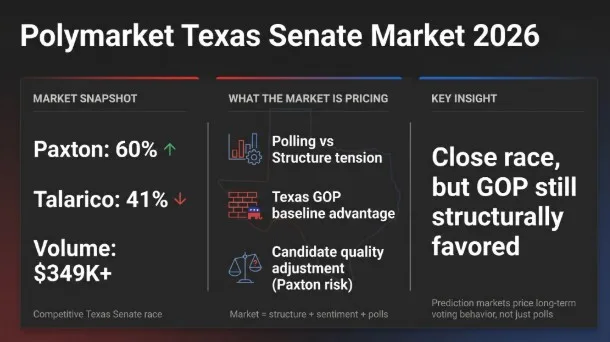
The Texas Senate race is shaping up as one of the most consequential and closely watched contests of the 2026 midterm cycle — and Polymarket’s Texas Senate Election Winner market is reflecting that intensity with over $349,000 in trading volume and a race that has shifted meaningfully across the past several months. The current market has Republican Ken Paxton priced at approximately 60% and Democrat James Talarico at around 41% — a competitive margin for a state that no Democrat has won statewide since 1994.
Smart Bet Insider covers prediction market political data alongside broader market intelligence — helping members understand what these prices actually mean, where they may be mispriced, and how the market’s current consensus compares to the available polling and structural evidence. The Texas Senate market is one of the most liquid and actively traded state-level markets on Polymarket in 2026. This guide breaks down the current odds, the race background, and what informed traders are actually pricing in.
The Race: How the Texas Senate Matchup Developed
The 2026 Texas Senate race for John Cornyn’s seat has produced one of the most unusual Republican primary battles in recent Texas history. Cornyn and Attorney General Ken Paxton, neither of whom secured a majority in the March 3 primary, advanced to a May 26 runoff — a result that itself reflected a fractured GOP primary field including Representative Wesley Hunt. Paxton, backed heavily by the MAGA base, defeated Cornyn in the runoff and will now face Democratic nominee James Talarico, a state representative from Austin, in the November 3, 2026 general election.
Talarico’s path through the Democratic primary was similarly notable. He defeated US Representative Jasmine Crockett, who had entered the race as a late candidate with strong initial support among Black voters, by consolidating leads among Latino and white Democratic primary voters. Talarico enters the general election as a candidate who has already demonstrated organizational strength and donor enthusiasm — and, unusually for a Texas Democrat, polling leads over both potential Republican opponents in surveys conducted before the primary concluded.
What the Polymarket Odds Are Currently Saying
The current Polymarket Texas Senate market prices Ken Paxton at approximately 60% and James Talarico at approximately 41%. That 19-point gap reflects the market’s collective assessment that Paxton is a meaningful favorite — but not a lock — in a state that has voted Republican at the statewide level in every election since 1994. The market’s pricing assigns Talarico a genuine, non-trivial shot at victory rather than treating the race as a structural Republican walkover.
The market’s current pricing sits in notable tension with recent polling. April 2026 surveys from the Texas Politics Project at the University of Texas found Talarico leading Paxton by 8 percentage points among registered voters (42% to 34%), while Texas Public Opinion Research polling found Talarico ahead by 5 points (46% to 41%). In both surveys Talarico led among independent voters by more than 20 percentage points. The Polymarket market is pricing a Paxton win despite polling that currently favors Talarico — a divergence worth examining carefully.
The Candidate vs System Pricing Split: Why Polling Doesn’t Directly Translate to Market Probability
A major interpretive error in most election-market commentary is treating the Texas Senate race as a simple head-to-head contest between Ken Paxton and James Talarico. In reality, Polymarket is not pricing a pure “candidate vs candidate” matchup — it is pricing a candidate outcome inside a structurally constrained electoral system. That distinction explains the core paradox in the market: Talarico can lead in polling averages while still trading below 50%.
The Three-Component Probability Model
From a prediction-market perspective, the correct decomposition of win probability is not a binary Paxton vs Talarico contest — it is: P(candidate win) = Texas partisan baseline × candidate adjustment × turnout elasticity. The “baseline” represents the structural Republican vote floor embedded in Texas electoral behavior, documented consistently through metrics like the Cook Partisan Voting Index. The “candidate adjustment” captures deviations driven by individual factors such as Paxton’s impeachment history or Talarico’s crossover appeal. The “turnout elasticity” reflects how midterm participation shifts amplify or compress partisan advantages depending on national environment and voter drop-off dynamics.
Why Polling Is an Input, Not a Direct Win Probability
Most surface-level analyses treat polling as a direct proxy for win probability rather than one input constrained by a persistent state-level partisan baseline. Polymarket pricing, by contrast, reflects this layered model implicitly — weighting individual candidate signals against the underlying structural probability distribution of Texas electoral outcomes. A registered voter poll showing Talarico up 8 points does not translate to a 58% win probability in a state where Republicans have won every statewide race for three decades and where turnout patterns in midterm years consistently advantage the Republican coalition.
What the Market Is Actually Saying
This decomposition is critical for interpreting the current 60/41 pricing. The market is not discounting or ignoring Talarico’s polling leads — it is embedding those polls inside a structural expectation that Texas statewide elections revert toward a Republican-leaning equilibrium under typical turnout conditions.
The 41% Talarico price reflects a genuine candidate adjustment for Paxton’s impeachment baggage and the unusually strong independent voter alignment — but it is compressed by the baseline and turnout elasticity components that have historically reasserted Republican advantages when registered-voter preferences meet actual November turnout. Research on prediction market accuracy in political contexts consistently shows that prediction markets outperform single polls precisely because they incorporate this kind of multi-layered structural information rather than treating any one input as definitive.
The Paxton Candidacy Risk Factor the Market Is Absorbing
Paxton is not a conventional Republican Senate nominee. He was impeached by the Republican-controlled Texas House in 2023 on allegations including abuse of office and corruption — charges he has denied and of which the Texas Senate acquitted him. His general election candidacy introduces genuine candidate quality risk that a standard Republican nominee would not carry. Talarico has already made Paxton’s impeachment a centerpiece of his campaign messaging, calling him “the most corrupt politician in America” to enthusiastic reception, and the April polling showing Talarico’s widest leads against Paxton specifically — rather than Cornyn — suggests the corruption narrative is resonating with moderate and independent voters.
The market’s 60% Paxton pricing therefore reflects a complex trade-off: Texas’s deep structural Republican advantage working in one direction, and Paxton’s unusual candidate baggage, independents breaking heavily toward Talarico, and polling leads working in the other. Kalshi similarly prices Talarico at approximately 43%, consistent with the broader prediction market consensus that the race is competitive but Paxton retains a structural edge. BetOnline has Paxton at -125 and Talarico at -105, making it the tightest odds of any platform — reflecting the bookmaker’s view that the race is closer to a coin flip than the prediction market’s 60/41 split suggests.
Smart Bet Insider: Reading the Texas Market for Genuine Value
The Texas Senate market reflects a split between strong polling for Talarico and the long-standing Texas Structural Discount. The key question is whether 2026 marks a real shift in Texas politics or a repeat of past polling overstatements. Smart Bet Insider tracks this market across Polymarket, polling, and structural indicators, identifying pricing gaps where trading value may emerge as Election Day approaches.
A Market That Deserves Serious Attention
The Polymarket Texas Senate market is pricing a genuinely competitive race with meaningful uncertainty — not a foregone Republican conclusion. The tension between Talarico’s consistent polling leads, Paxton’s candidate quality risk, and the 30-year Texas Structural Discount creates exactly the kind of complex analytical environment where prediction market pricing can be meaningfully right or meaningfully wrong. The current 60/41 split is a defensible consensus position — but it is not a settled one.
Smart Bet Insider will track every significant development in this market through November 3 — new polling, fundraising reports, endorsements, and the structural indicators that predict whether 2026 represents a genuine Texas political shift or another cycle where the structural Republican advantage reasserts itself. Follow Smart Bet Insider now and stay ahead of every move in one of 2026’s most consequential Senate races.
FAQs
What are the current Polymarket odds on the Texas Senate race?
As of late May 2026, Polymarket has Ken Paxton (R) at approximately 60% and James Talarico (D) at approximately 41%. The market has over $349,000 in total trading volume. Kalshi prices Talarico at approximately 43%, consistent with the broader prediction market consensus that the race is competitive but Paxton holds a structural advantage.
Who are the candidates in the 2026 Texas Senate race?
The Republican nominee is Ken Paxton, Texas Attorney General, who defeated incumbent Senator John Cornyn in the May 26 Republican primary runoff. The Democratic nominee is James Talarico, a state representative from Austin, who won the Democratic primary over US Representative Jasmine Crockett. The general election is scheduled for November 3, 2026.
Why is Polymarket pricing Paxton as the favorite despite polling showing Talarico ahead?
Polymarket’s market incorporates both current polling and the historical structural advantage Republicans hold in Texas statewide elections. No Democrat has won a Texas statewide race since 1994, and polling has consistently overstated Democratic performance in Texas in recent cycles. The prediction market’s Paxton-favored pricing reflects the Texas Structural Discount — the market weighting of historical patterns alongside individual survey data.
What is the Texas Structural Discount?
The Texas Structural Discount is the systematic adjustment political traders apply to Texas Democratic polling leads, reflecting the historical pattern that Texas surveys have consistently overstated Democratic final margins. It accounts for differential turnout between registered and likely voters, structural Republican advantages in low-propensity voter universes, and the 30-year track record of Republican statewide dominance. It is the primary reason Paxton is priced as a favorite despite current polling showing Talarico ahead.
How does Ken Paxton’s impeachment affect the market pricing?
Paxton’s 2023 impeachment by the Republican-controlled Texas House — on allegations including abuse of office and corruption, of which the Texas Senate acquitted him — introduces genuine candidate quality risk that a standard GOP nominee would not carry. April polling shows Talarico’s largest leads specifically against Paxton rather than Cornyn, suggesting the corruption narrative resonates with moderates and independents. The market’s 60% Paxton price reflects an absorption of this risk alongside Texas’s structural Republican advantage.
How can I track live Texas Senate odds on Polymarket?
The live market is available at Polymarket’s Texas Senate Election Winner page, where prices update continuously as traders react to new polling, campaign developments, and political news. The Polymarket Texas Senate hub also hosts related markets including margin-of-victory contracts and matchup resolution markets that together provide a more complete picture of trader sentiment.
How does the Texas Senate market compare across prediction market platforms?
Polymarket (60/41 Paxton/Talarico), Kalshi (approximately 57/43), and BetOnline (-125 Paxton / -105 Talarico) all reflect a competitive race with Paxton as a moderate favorite. BetOnline’s tightest odds suggest bookmaker pricing sees the race closer to a coin flip than the prediction market consensus. These cross-platform pricing differences are worth monitoring as the campaign progresses — significant divergences between platforms often signal information asymmetries worth examining.