
Introduction: The Number Everyone Is Watching
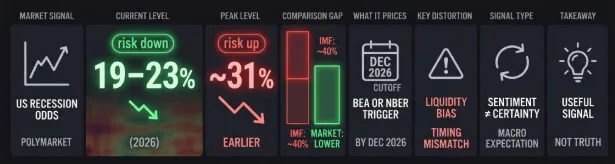
The Polymarket recession contract has become one of the most widely referenced economic signals in 2026 — cited by analysts, financial journalists, and macro traders as a real-time gauge of market sentiment on US economic risk. The current implied probability on Polymarket’s “US recession by end of 2026?” contract sits around 19–23% as of late May 2026, down from a peak of approximately 31% earlier in the year and significantly lower than the IMF’s own 40% recession probability assessment.
Smart Bet Insider covers prediction market data across economics, politics, and sports — helping members understand not just what the numbers say but what they actually mean and where the market may be mispriced. The Polymarket recession contract is one of the most liquid macro markets on the platform with over $5.7 million in trading volume. This guide breaks down exactly what the market is pricing, how to read it correctly, and what the current odds actually tell you — and don’t.
What the Polymarket Recession Contract Actually Measures
Before drawing any conclusions from Polymarket’s recession odds, understanding the exact resolution criteria is essential. The contract resolves “Yes” under two specific conditions: either the Bureau of Economic Analysis reports two consecutive quarters of negative US real GDP (seasonally adjusted annualized change from the prior quarter), or the National Bureau of Economic Research publicly declares a recession before the contract’s end date of December 31, 2026.
These resolution paths matter more than often acknowledged. The BEA’s two-negative-quarters definition can be affected by later data revisions, while the NBER typically declares recessions months after they begin, on a delayed and non-calendar timeline. As a result, Polymarket isn’t pricing general economic weakness, but whether one of these specific criteria will be met by December 31, 2026.
How Polymarket Recession Odds Have Moved in 2026
The trajectory of the recession contract through 2026 tells its own story. Odds peaked at approximately 31% in early 2026 as tariff escalation fears, labor market softening signals, and global growth downgrades from the IMF pushed trader sentiment toward recession risk. By late May 2026, the contract had retreated to approximately 19–23% as equity markets recovered, Bitcoin rallied, and incoming economic data showed resilience in consumer spending.
The gap between Polymarket’s 19–23% recession odds and the IMF’s ~40% estimate reflects several factors: different definitions of “recession,” a trader base influenced by equity sentiment, and genuine disagreement between institutional forecasts and market pricing.
The Liquidity Distortion Problem: Reading Recession Odds Correctly
The single most important interpretive error bettors and analysts make with the Polymarket recession contract is treating the displayed price as a clean, reliable probability estimate. As Smart Bet Insider has covered in its broader Polymarket analysis, prediction market prices are not uniformly efficient — they are liquidity-weighted consensus estimates shaped by who is trading, how much capital is present, and how actively the order book is being updated.
What sharp macro traders call the “Liquidity Distortion Problem” is the gap between headline recession probabilities and a clean market-implied estimate, driven by three factors: thin order books that let single trades move prices, trader bias tied to equity sentiment that distorts macro signals, and bid-ask spreads that mean the displayed price may not be executable. Checking the live order book i\s essential before treating Polymarket prices as reliable signals.
The Contract Window vs Real Recession Timing: The Mispricing Gap
A major interpretive mistake in reading Polymarket recession odds is assuming the contract is pricing economic recession risk itself. In reality, it is pricing something more specific and narrower: the probability that a recession becomes officially detectable within a fixed resolution window — defined by BEA and NBER criteria — before December 31, 2026.
Why GDP-Based Rules Are Not an Official Recession Definition
This distinction matters because US recession dating is not a real-time economic measurement. The Bureau of Economic Analysis explicitly notes that GDP-based rules like “two consecutive quarters of negative growth” are not an official recession definition — recession determination is ultimately made by the NBER using a broader set of indicators including employment, income, and industrial production, often with significant delay.
Similarly, the NBER’s Business Cycle Dating Committee emphasizes that recession dates are assigned retrospectively, based on “significant decline in economic activity spread across the economy,” and not a fixed numerical trigger or real-time signal. The Committee has historically taken six months to over a year to make official declarations after a recession has already begun.
The Structural Gap Between Economic Reality and Contract Observability
This creates a structural gap between economic reality and contract observability. A recession that begins in late 2025 may only be officially confirmed well after the contract’s resolution window, depending on data revisions and NBER lag. Conversely, an economic slowdown occurring in 2027 would be entirely excluded from pricing, even if market participants view it as highly likely.
As a result, Polymarket is not pricing “recession risk” in a pure macro sense — it is pricing whether recession conditions will be both realized and officially recognized within a compressed calendar window. This creates a systematic distortion: late-cycle recession risk is consistently underweighted, while early-period shocks are disproportionately influential, because only outcomes that fit the resolution timeline matter for payoff. Understanding this gap is essential for anyone using Polymarket recession odds as an economic signal rather than a trading instrument.
What the Current 19–23% Implies — and What It Doesn’t
A 19–23% implied probability on the recession contract means the current market consensus assigns roughly a one-in-five chance of a BEA or NBER recession determination by December 31, 2026. That is a meaningful risk signal — not a dismissal of recession risk, and not a prediction of recession. The contract is pricing a specific, time-bounded, definitionally constrained outcome — not a general assessment of whether the US economy is weakening.
Academic work on prediction market accuracy by Wolfers and Zitzewitz consistently shows that prediction markets are most informative when contracts are liquid, resolution criteria are unambiguous, and trader composition includes genuinely informed participants. The Polymarket recession contract scores well on liquidity and passably on resolution clarity — but the calendar-year deadline creates a timing distortion that compresses what is genuinely a multi-year economic risk into a binary year-end outcome. A trader who believes recession risk is elevated but likely to materialize in 2027 rather than 2026 would rationally trade No on this contract while holding a bearish economic view — which means the market price underrepresents total recession risk even when it is functioning efficiently.
Smart Bet Insider: Using Polymarket Macro Data Intelligently
Polymarket recession odds are most valuable as a directional sentiment indicator and a cross-reference against traditional economic forecasts — not as a standalone probability estimate to be taken at face value. Smart Bet Insider tracks the full ecosystem of macro prediction markets on Polymarket, covering not just the headline recession contract but correlated markets including inflation, Fed rate decisions, Treasury yield movements, and GDP print outcomes that together provide a more complete picture of economic sentiment than any single number.
The Liquidity Distortion Problem, the resolution criteria timing issue, and the equity-correlated trader composition are all factors Smart Bet Insider’s macro market analysis accounts for when interpreting prediction market economic data. Follow Smart Bet Insider today and approach every Polymarket macro contract with the analytical framework that separates genuine market intelligence from noise.
A Useful Signal With Real Interpretive Limits
Polymarket’s recession odds are one of the most useful real-time economic sentiment indicators available in 2026 — but only for users who understand what they are actually measuring. The contract prices a specific, time-bounded, definitionally constrained outcome, not a general assessment of economic health. The Liquidity Distortion Problem is real. The gap between Polymarket’s 19–23% and the IMF’s 40% reflects genuine interpretive differences that deserve scrutiny rather than dismissal.
Smart Bet Insider tracks Polymarket’s full economics market suite alongside traditional forecaster data, delivering macro market intelligence that accounts for the structural distortions that surface-level number-reading misses entirely. Follow Smart Bet Insider now and read every Polymarket economic signal with the interpretive framework it demands.
FAQs
How is the Polymarket recession probability calculated?
The recession probability on Polymarket is the current market price of the “Yes” contract — reflecting where real traders are buying and selling based on their assessment of the likelihood the contract resolves positively. With over $5.7 million in total trading volume, the price aggregates collective knowledge from thousands of participants trading real money rather than a polling or survey methodology.
What triggers a “Yes” resolution on the Polymarket recession contract?
The contract resolves “Yes” if either the BEA reports two consecutive quarters of negative US real GDP (seasonally adjusted annualized change from the prior quarter) by December 31, 2026, or the NBER’s Business Cycle Dating Committee publicly declares a recession before that date. Both conditions require official institutional confirmation — market estimates or media declarations do not trigger resolution.
Why is Polymarket’s recession probability lower than the IMF’s estimate?
The IMF’s 40% recession probability reflects a broad economic assessment of downside risk. Polymarket’s 19–23% prices a specific, time-bounded outcome tied to precise resolution criteria within calendar year 2026. The gap also reflects trader composition — Polymarket’s macro base skews equity-correlated — and the fact that some traders who believe recession risk is real may nonetheless bet “No” if they believe it will materialize in 2027 rather than within the contract’s window.
How reliable are prediction market recession odds historically?
Prediction markets are directionally informative but not definitively accurate on recession calls. Wolfers and Zitzewitz’s research shows prediction markets systematically outperform polls and individual forecasters on average — but exhibit deviations from true probabilities in lower-liquidity or retail-dominated environments. The recession contract’s liquidity is high relative to most Polymarket economics markets, which improves reliability, but the calendar-year deadline and NBER timing issues create structural distortions any serious user should account for.
What is the Liquidity Distortion Problem on macro Polymarket contracts?
The Liquidity Distortion Problem is the gap between a displayed headline probability and a statistically clean probability estimate, created by thin order book moves from single large trades, equity-correlated trader composition, and bid-ask spread effects. Always check the live order book spread before treating any Polymarket macro price as a reliable probability signal — the headline number and the tradeable number are not always the same.
Can I trade the Polymarket recession contract in the US?
Yes — Polymarket re-entered the US market following its acquisition of CFTC-regulated exchange QCEX in late 2025. The US-regulated platform operates under CFTC oversight with a distinct fee structure. Macro and economics markets are broadly available to US users, though availability can vary and users should verify current access at account registration.
How does the Polymarket recession contract compare to prediction markets on Kalshi?
Kalshi also offers macro economic contracts including recession-related markets. Key differences include fee structure — Polymarket’s US platform charges a flat 0.30% taker fee while Kalshi uses a probability-weighted formula peaking near 1.75 cents per contract at $0.50 — and market depth, which varies by contract. Smart Bet Insider compares pricing across both platforms to identify where the same economic outcome is more efficiently traded.