
The Broker That Brought Prediction Markets to the Mainstream
Robinhood didn’t invent prediction markets — but it may have done more than any other platform to bring them to a mainstream US audience. By embedding event contracts directly into its existing brokerage app alongside stocks, crypto, and options, Robinhood gave tens of millions of existing users immediate access to prediction market trading without a new account, a new app, or a new learning curve. In November 2025 alone, Robinhood processed over 3 billion contracts — a figure that illustrates the scale of retail adoption the platform has driven.
Smart Bet Insider tracks the full prediction market landscape, covering how platforms work, how they compare, and where bettors and traders find genuine value. The Robinhood prediction market product sits at an interesting intersection of brokerage familiarity and prediction market mechanics — and understanding exactly how it works, who it’s for, and how it stacks up against Kalshi is essential for anyone navigating this space in 2026.
How Robinhood Prediction Markets Work
Robinhood’s prediction market product — branded as Event Contracts — operates on the same binary yes/no framework as every major regulated prediction market. Each contract asks a clearly defined question about a future event: will a specific team win, will inflation exceed a threshold, will a political outcome occur? Contracts are priced between $0.01 and $0.99, reflecting the market’s collective probability estimate. If you hold the correct outcome at resolution, the contract pays $1. If you’re wrong, it pays $0.
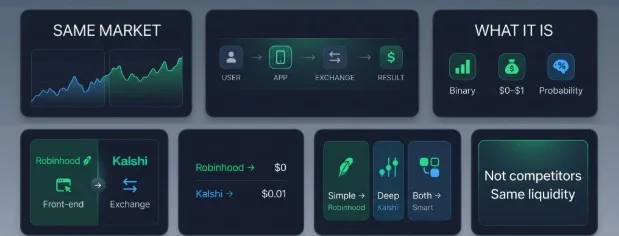
The critical infrastructure detail that most coverage glosses over: Robinhood’s Event Contracts are powered by Kalshi’s CFTC-regulated exchange backend. When you trade on Robinhood, you are trading Kalshi contracts — the markets, liquidity pools, and contract settlement all run through Kalshi’s regulated infrastructure. What differs is the front-end interface, the account integration, and the fee structure. Robinhood functions as a distribution channel and user experience layer built on top of Kalshi’s exchange, not an independent prediction market in its own right.
The “Not Actually a Separate Exchange” Misconception
A common simplification in most comparisons of Robinhood and Kalshi is to treat them as two competing prediction market platforms offering similar products under different brands. In reality, that framing misses the core market structure entirely — and understanding the distinction changes how you should evaluate everything from pricing efficiency to liquidity depth.
Kalshi Is the Exchange Layer
Kalshi operates as a CFTC-regulated Designated Contract Market — meaning it is the actual venue where event contracts are listed, matched, and cleared. It is the exchange layer where price discovery occurs and where liquidity is formed through its native order book. Kalshi controls market design, contract specifications, and the infrastructure through which trades settle.
Robinhood Is the Distribution Layer
Robinhood, by contrast, functions primarily as a distribution layer and brokerage interface. When users trade event contracts inside the Robinhood app, they are not interacting with an independent exchange — they are accessing prediction markets routed through regulated exchange infrastructure, most notably Kalshi’s backend systems for shared markets. Robinhood’s role is to embed access to those contracts inside a broader retail investing ecosystem that already includes stocks, options, and crypto.
Why This Distinction Matters
This structural separation has important implications. It determines who ultimately controls market design (Kalshi and regulated exchanges), where liquidity is actually formed (exchange order books rather than the brokerage front end), and what “competition” really means in practice. The platforms are not two parallel exchanges competing for order flow — they are a single exchange layer paired with a high-distribution retail access layer. Understanding this separation changes how performance, liquidity, and pricing efficiency should be evaluated — and explains why surface-level “Robinhood vs Kalshi” comparisons often misrepresent how prediction markets actually function in 2026.
The Infrastructure Relationship: Robinhood Is Built on Kalshi
As the exchange vs distribution layer distinction above makes clear, both platforms are regulated by the Commodity Futures Trading Commission (CFTC) as Designated Contract Markets — but they occupy different positions in the market stack. Kalshi is the exchange; Robinhood is the access point. In early 2026, Robinhood further strengthened its own infrastructure by acquiring MIAXdx, a CFTC-licensed exchange, giving it the ability to list, clear, and manage risk for prediction market contracts independently of Kalshi on some markets.
The practical implication for traders is that Robinhood’s market depth, pricing, and liquidity on shared markets are functionally identical to Kalshi’s — because they draw from the same order book. Where the platforms diverge is in market breadth, fee structure, and user experience. Kalshi operates as a standalone prediction market platform with its own web interface, mobile app, and public API. Robinhood embeds prediction market access into a broader financial services app already used for stocks, ETFs, and crypto — creating a fundamentally different entry point and usage context.
The Distribution Advantage: Robinhood’s Structural Edge
The most significant competitive advantage Robinhood holds over dedicated prediction market platforms is what sharp traders call the “Embedded Access Advantage” — the benefit of reaching prediction market users where they already are, rather than requiring them to seek out a new platform. A retail investor who already uses Robinhood for stock trading can access event contracts with zero additional friction: no new account, no new deposit, no new identity verification. That frictionless entry point is responsible for Robinhood processing 3 billion contracts in a single month.
This distribution advantage matters beyond user acquisition — it shapes the composition of who is trading on the platform. Robinhood’s prediction market user base skews heavily toward retail participants who are already comfortable with its brokerage interface but may have limited prior experience with prediction market mechanics. That creates a market structure where informed traders with genuine predictive edge are competing against a larger proportion of casual participants than on Kalshi, where the user base has self-selected toward prediction market engagement specifically. Research consistently shows that market efficiency improves with more informed participants — meaning Kalshi’s more specialized user base produces tighter, more accurately priced markets on average.
Fee Comparison: Where the Platforms Diverge Most
The fee structure is where Robinhood and Kalshi diverge most sharply — and where the choice between them becomes practically significant for active traders. Kalshi charges no commissions on trades but applies a $0.01 per contract settlement fee when a market resolves. Robinhood Event Contracts charge zero commissions and zero settlement fees — making it the lower-cost platform for high-volume traders who hold contracts to resolution.
The catch is market breadth. Kalshi offers a significantly wider range of prediction markets than Robinhood — more sports events, more granular political contracts, more economic data markets, and deeper liquidity on less prominent events where Robinhood’s order book may be thin or nonexistent. For traders focused on the highest-volume, highest-profile markets — major sports outcomes, election contracts, top-tier economic data — Robinhood’s zero-fee structure at identical Kalshi-powered pricing is a clear value advantage. For traders seeking market breadth and the ability to find edge in less mainstream contracts, Kalshi’s standalone platform offers access that Robinhood’s curated selection does not.
Smart Bet Insider: Using Both Platforms Strategically
The Robinhood-Kalshi comparison is not a binary choice — it is a complementary deployment question. Robinhood’s zero-settlement-fee structure makes it the optimal execution venue for high-confidence contracts you intend to hold to resolution on markets where both platforms offer identical access. Kalshi’s broader market depth makes it the better platform for finding edge in less prominent events and for active trading strategies that benefit from deeper order book liquidity.
Smart Bet Insider tracks pricing, market availability, and fee-adjusted value across both Robinhood and Kalshi, identifying where the same contract is more efficiently traded on one platform versus the other. Combined with sharp sports and event analysis, that comparison layer is what turns prediction market access into prediction market edge. Follow Smart Bet Insider today and make sure every event contract trade you place — on Robinhood, Kalshi, or anywhere else — is backed by the clearest available intelligence.
Two Platforms, One Infrastructure, Different Use Cases
Robinhood and Kalshi are not competitors in the traditional sense — they share the same underlying exchange infrastructure and draw from the same liquidity pools on shared markets. What they represent is two different access models for the same prediction market ecosystem: Robinhood’s Embedded Access Advantage reaches retail users at massive scale through frictionless brokerage integration, while Kalshi’s standalone platform serves more engaged prediction market participants with broader market depth and a specialized trading environment.
For serious bettors and traders in 2026, the right answer is not one platform or the other — it is understanding when each delivers better value and building a strategy that uses both accordingly. Smart Bet Insider delivers exactly that intelligence, alongside sharp sports and event analysis across every major market both platforms offer. Follow Smart Bet Insider now and trade every prediction market with the structural understanding that separates informed execution from guesswork.
FAQs
1. Is Robinhood’s prediction market the same as Kalshi?
The underlying markets, liquidity, and contract settlement are the same — Robinhood’s Event Contracts are powered by Kalshi’s CFTC-regulated exchange infrastructure. What differs is the user interface, account integration, market selection, and fee structure. Trading on Robinhood is effectively trading on Kalshi through a different front end with different fees.
2. What are the fees on Robinhood Event Contracts?
Robinhood Event Contracts charge zero commissions and zero settlement fees — making it the lowest-cost option for contracts held to resolution. Kalshi charges no commission but applies a $0.01 per contract settlement fee at resolution. For active traders holding contracts to expiry, Robinhood’s zero-fee structure represents a meaningful cost advantage on high-volume trades.
3. Is Robinhood’s prediction market legal in all US states?
Yes — Robinhood Event Contracts operate under CFTC regulation as a Designated Contract Market, which provides federal jurisdiction over event contracts and makes them available across all 50 US states. This is the same regulatory framework that allows Kalshi to operate nationally, including in states where traditional sportsbooks cannot.
4. What is the Embedded Access Advantage?
The Embedded Access Advantage is Robinhood’s structural edge in reaching prediction market users through its existing brokerage platform. Existing Robinhood users can access event contracts with no new account, deposit, or verification — creating frictionless entry that drove over 3 billion contracts processed in November 2025 alone. This distribution advantage shapes the platform’s retail-heavy user composition.
5. Which platform has more markets — Robinhood or Kalshi?
Kalshi offers significantly broader market depth than Robinhood — more sports events, more political contracts, more economic data markets, and deeper liquidity on less prominent events. Robinhood’s event contract selection is curated toward high-profile outcomes where retail interest is highest. For market breadth and edge-finding in niche contracts, Kalshi’s standalone platform is the stronger choice.
6. How does Robinhood’s prediction market differ from a sportsbook?
Unlike sportsbooks, where the house sets odds and profits from bettor losses, Robinhood Event Contracts are exchange-traded instruments where prices reflect peer-to-peer market consensus. No house takes the other side — you buy or sell contracts at market prices set by collective trader activity. This means neither Robinhood nor Kalshi has a financial incentive to limit winning traders in the way sportsbooks do.
7. Can I use both Robinhood and Kalshi simultaneously?
Yes — and for active prediction market traders, using both is the optimal strategy. Robinhood’s zero-settlement-fee structure is better for contracts held to resolution on shared high-volume markets. Kalshi’s broader market depth is better for less mainstream contracts and active trading strategies requiring deeper order books. Smart Bet Insider identifies the best execution venue for each specific contract type across both platforms.