
A New Kind of Betting Market Is Growing Fast
Social sports betting is one of the fastest-growing segments of the US wagering market in 2026 — and most mainstream betting coverage hasn’t caught up with what it actually is. These platforms don’t look like traditional sportsbooks and they don’t operate under traditional gambling law. They are a distinct category of product built on sweepstakes frameworks, peer-to-peer wagering mechanics, and community-driven engagement that is reshaping how millions of Americans interact with sports.
Smart Bet Insider tracks every segment of the US sports wagering landscape — from regulated sportsbooks and offshore platforms to sweepstakes books and the emerging social betting category. Whether you’re curious about what these platforms offer, whether they’re legal in your state, or how they compare to traditional betting options, this guide covers the social sports betting landscape in full.
What Social Sports Betting Actually Is
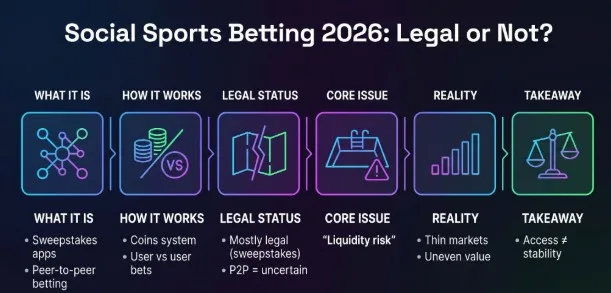
Social sports betting encompasses two distinct platform types that are often conflated but operate under meaningfully different models. The first is sweepstakes-based social sportsbooks — platforms like Fliff, Thrillzz, and Rebet that use a dual virtual currency system (Gold Coins for entertainment, Sweeps Coins redeemable for real prizes) to offer sports prediction markets under promotional sweepstakes law rather than gambling regulation.
The second is true peer-to-peer betting platforms — apps like BettorEdge, BetOpenly, and ProphetX where users set their own odds and bet directly against each other rather than against a house. These platforms charge a small fee on matched wagers instead of building margin into odds, and their legal status varies significantly by state depending on whether peer-to-peer wagering is treated as gambling under local law. Understanding which category a platform belongs to is the essential first step before signing up.
The Legal Framework: Why Most Social Platforms Can Operate Broadly
Sweepstakes-based social sportsbooks operate under the same legal framework as sweepstakes casinos — US promotional sweepstakes law rather than state gambling licensing. Because no purchase is required to receive Sweeps Coins, these platforms do not meet the legal definition of gambling in most states. This is why platforms like Fliff and Thrillzz can serve users in states like Texas, California, and Georgia where licensed sportsbooks cannot operate.
As the Regulatory Category Misclassification Problem section notes, this legal position is not stable. States like Idaho, Washington, Michigan, and Nevada restrict or exclude sweepstakes models, and ongoing reclassification risk means today’s access is not guaranteed. True peer-to-peer platforms like BetOpenly also face complex, state-by-state legal uncertainty over whether matching wagers constitutes unlicensed gambling activity.
The Liquidity Illusion: Peer-to-Peer Betting’s Core Challenge
The Structural Tradeoff in Peer-to-Peer Betting
The most appealing feature of true peer-to-peer betting platforms — user-set odds and no house margin — is also the source of their most significant structural limitation. What sharp bettors call the “Liquidity Illusion” is the gap between a platform’s promise of peer-to-peer market depth and the reality that bet matching depends entirely on finding a counterparty willing to take the other side of your specific wager at your specific price.
The Reality of Thin Markets
On a thin platform, a user setting odds on a mid-tier college basketball game at a reasonable price may wait hours for a match — or never find one at all. Unmatched bets are capital sitting idle rather than generating returns. The major regulated exchanges like Betfair in the UK solved this through scale — enormous user bases create liquid order books across thousands of markets simultaneously.
Why Liquidity Determines Market Quality
US peer-to-peer betting platforms are still building toward that scale, meaning the Liquidity Illusion is a genuine and underreported limitation for bettors who approach these platforms expecting the same depth as a traditional sportsbook. Research on betting exchange market efficiency consistently shows that liquidity depth is the primary driver of price accuracy and market utility on exchange-style platforms.
The Regulatory Category Misclassification Problem
One of the biggest misunderstandings in the social betting landscape is the assumption that regulators treat all “social sportsbooks,” “sweepstakes betting apps,” and “peer-to-peer wagering platforms” as a single category. In practice, they don’t. The legal status of these platforms depends less on branding and more on how a specific state interprets the underlying mechanics of the product.
The Sweepstakes Exemption Model
The first regulatory interpretation is the sweepstakes exemption model, where platforms operate under promotional law rather than gambling law. Regulators focus on whether participation is truly free, whether alternative entry methods exist, and whether prize redemption is structured in a non-deceptive way. Oversight falls under state Attorneys General and the FTC rather than gaming commissions — which is why platforms like Fliff and Thrillzz can operate broadly without sportsbook licenses.
The Skill-Based or Exchange Interpretation
The second interpretation applies more often to peer-to-peer platforms like BetOpenly and ProphetX. Regulators evaluate whether outcomes are driven by user skill and market interaction rather than house-backed wagering. Enforcement under this model is inconsistent — some states view matching users at odds as a functional form of gambling regardless of skill arguments, creating unpredictable legal exposure for platforms operating under this framework.
The Illegal Gambling Reclassification Risk
The third interpretation is the most consequential: the illegal gambling reclassification risk. This emerges when “free entry” mechanisms are judged to be artificially constructed or when platform economics closely resemble traditional wagering. In these cases, regulators may argue that promotional framing does not change the underlying gambling nature of the activity — which is precisely the argument being used in states that have moved to restrict sweepstakes platforms operating at scale.
This classification split explains a core inconsistency in the market: why platforms with nearly identical mechanics can be considered compliant in one state and restricted in another. It is not the product type that determines legality, but the regulatory lens applied to it — and that lens is becoming more scrutinizing across more states in 2026.
How Social Betting Compares to Regulated Sportsbooks
For bettors in states without legal sportsbooks, social and peer-to-peer platforms offer a genuinely useful alternative — sports prediction markets, player props, spreads, and totals are all available on leading sweepstakes platforms with real prize redemption potential. The experience closely mirrors a licensed sportsbook for casual bettors, and the community features — social feeds, group competitions, and leaderboards — add an engagement dimension that traditional sportsbooks don’t replicate.
For serious bettors focused purely on value and market efficiency, the comparison is less favorable. Sweepstakes sportsbook lines are often priced with wider margins than regulated competitors, and the redemption rate variable — how much real value each Sweeps Coin delivers — adds a layer of opacity that doesn’t exist in direct cash wagering. Checking community experiences on Reddit’s r/beermoney and r/sportsbook before committing to any social platform gives you the most accurate real-bettor data on redemption reliability and line quality that platform marketing alone will never provide.
Smart Bet Insider: Navigating the Full Social Betting Landscape
The social sports betting category is evolving rapidly — new platforms are launching, existing platforms are updating their coin economies and redemption terms, and regulatory scrutiny is increasing in states that are beginning to examine whether sweepstakes betting platforms operating at scale require dedicated oversight frameworks. Smart Bet Insider monitors the social and peer-to-peer betting landscape continuously, tracking which platforms offer the best redemption value, which states have introduced new restrictions, and how line quality compares across the category.
Beyond platform guidance, Smart Bet Insider delivers the same sharp sports analysis across NFL, NBA, college football, NHL, and esports that members in regulated states rely on — calibrated to cover the specific platforms available to bettors in states without licensed sportsbooks. The social betting market offers real value for bettors who approach it with the right framework. Follow Smart Bet Insider today and make sure your social sports betting strategy is built on the clearest intelligence available in 2026.
Social Betting Is Legitimate — With Caveats
Social sports betting in 2026 is a genuine, legally distinct market offering real sports wagering access to millions of US bettors in states where licensed sportsbooks remain unavailable. The sweepstakes legal framework is robust, the leading platforms have established redemption track records, and the peer-to-peer segment offers pricing transparency that traditional sportsbooks don’t match — when there’s enough liquidity to make it work.
The caveats are real: the Liquidity Illusion limits peer-to-peer platforms in thin markets, redemption rates vary significantly across social books, and regulatory scrutiny is increasing. Knowing which platforms deliver genuine value and which are riding the category’s marketing momentum is what separates profitable social betting from wishful thinking. Follow Smart Bet Insider now and approach the social sports betting market with the platform intelligence and analytical edge it demands in 2026.
FAQs
1. Are social sportsbooks legal in my state?
Most social sportsbooks operate under sweepstakes law and are legal in the majority of US states. States that restrict or exclude sweepstakes betting models include Idaho, Washington, Michigan, Nevada, and a small number of others. Always check your preferred platform’s availability list before signing up — most publish a current list of restricted states on their website.
2. What is the difference between a social sportsbook and a peer-to-peer betting platform?
Social sportsbooks use a dual virtual currency model under sweepstakes law — Gold Coins for entertainment, Sweeps Coins redeemable for real prizes — and operate against a house. Peer-to-peer platforms like BetOpenly and ProphetX match users directly against each other at user-set odds, charging a small fee on matched wagers instead of building margin into lines.
3. Can you win real money on social sportsbooks?
Yes — Sweeps Coins earned on social sportsbooks can be redeemed for real cash prizes on reputable platforms. The key variable is the redemption rate: how much dollar value each Sweeps Coin converts to and what the minimum redemption threshold is. Always calculate actual cash value before committing to a platform, and verify redemption experiences through community reviews.
4. What is the Liquidity Illusion on peer-to-peer platforms?
The Liquidity Illusion is the gap between a peer-to-peer platform’s promise of user-set odds and the reality that bet matching depends on finding a willing counterparty at your specific price. On thin platforms, popular bets may go unmatched for hours or not at all. Liquidity depth — the volume of active users placing bets — is the primary indicator of whether a peer-to-peer platform delivers on its value proposition.
5. Which social sportsbooks are best in 2026?
Fliff leads the market on user experience, loyalty rewards, and sports market variety. Thrillzz and Rebet offer competitive daily coin grants and reliable redemption processes. For peer-to-peer betting, BettorEdge combines social features with real-money wagering, while BetOpenly offers the lowest fee structure at 1% on matched wagers.
6. How do social sportsbook lines compare to regulated books?
Social sportsbook lines are generally priced with wider margins than regulated competitors like DraftKings or FanDuel. For bettors focused on value extraction rather than entertainment, this pricing gap matters across a full season of wagering. Use social platforms for market access in unregulated states, but benchmark lines against regulated books when both are available.
7. Is regulatory scrutiny of social betting increasing in 2026?
Yes — a growing number of states have begun examining whether sweepstakes betting platforms operating at scale require dedicated oversight frameworks beyond standard promotional sweepstakes law. The same regulatory pressure that has targeted sweepstakes casino operators is beginning to extend to sports-focused platforms. Smart Bet Insider tracks these developments in real time so members always have current information on platform availability and legal status.