

The Industry’s Most Consequential Technology Shift
Responsible gambling has been a compliance checkbox for most of the online betting industry’s history — a terms-of-service section, a self-exclusion portal, and a helpline number buried in the app footer. In 2026, that is changing fundamentally. AI-powered behavioral monitoring has moved from experimental pilot programs to mandatory infrastructure at major regulated sportsbooks.
This shift is driven by regulatory pressure in the US, UK, and Europe that is making algorithmic player protection a license condition rather than an optional feature. Smart Bet Insider tracks the regulatory and technological environment shaping the sports betting market in 2026 — and understanding how AI monitoring systems work is increasingly relevant for every serious bettor operating in a regulated market.
What AI Responsible Gaming Monitoring Actually Does
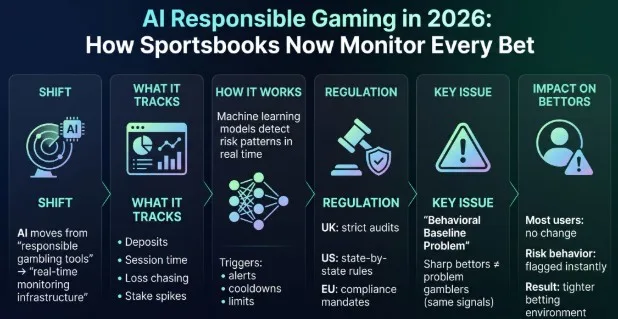
AI responsible gaming systems monitor player behavior in real time across every dimension of a betting session — deposit frequency, stake escalation, session duration, and loss-chasing patterns. Unlike traditional responsible gaming tools, which relied on self-reporting and static deposit limits, AI monitoring is proactive and continuous: the system flags at-risk behavioral signals without waiting for the player to recognize a problem themselves.
The core technology is machine learning models trained on large datasets of anonymized player behavior, calibrated to distinguish between normal variance and statistically significant signals associated with problem gambling episodes. By 2026, over 80% of major sportsbook operators are using AI in production environments rather than testing stages. When a system detects an at-risk pattern, responses range from automated in-app messaging and cooling-off prompts to account-level restrictions — depending on the severity of the signal and the regulatory requirements of the jurisdiction.
Actually Policed
One of the most overlooked aspects of AI-powered responsible gaming is not the technology itself, but how it is enforced. While most industry commentary states that AI monitoring is “mandatory” across regulated markets, enforcement operates through a layered compliance system rather than a single global standard.
UK Enforcement: Audit-Ready Evidence
In the UK, the Gambling Commission enforces compliance through licence conditions under the LCCP. Operators must demonstrate that systems are functioning effectively through audit-ready evidence — intervention logs, player risk flags, and documented model governance processes. Enforcement actions can be triggered by thematic reviews, whistleblower reports, or statistical anomalies in player protection outcomes, and are formally recorded as fines, regulatory settlements, or in severe cases, licence suspension or revocation.
Three Tiers of Compliance Maturity
In practice, regulators distinguish between three levels. “Required by regulation” means an operator must have AI monitoring in place. “Actively audited” means the system’s outputs are subject to review, documentation, and reproducibility checks. “Self-reported compliance” refers to operators providing internal assessments without continuous external verification — a model that still exists in lower-intensity regulatory environments like several US states.
The Fragmented Enforcement Reality
This distinction matters because enforcement is not uniform across jurisdictions. Pennsylvania requires quarterly reports on AI-driven intervention rates, while other states rely on reporting-based oversight with limited external verification. Penalties range from financial fines to mandatory independent audits or, in repeated breaches, licence restrictions — producing a fragmented enforcement landscape where AI monitoring is universal in principle but uneven in how rigorously it is policed in practice.
The Regulatory Pressure Driving Adoption
The deployment of AI responsible gaming tools in 2026 is not primarily market-driven — it is regulatory. The UK Gambling Commission’s affordability check framework began its phased rollout in early 2026, requiring licensed operators to conduct financial risk assessments on players who reach defined deposit thresholds.
The first tier uses shared credit reference data to flag financially vulnerable individuals, with early pilot results showing that approximately 95% of Stage 1 checks resolve without interrupting the player’s session. As the enforcement layer framework above makes clear, the UKGC now expects real-time behavioral monitoring as a continuous compliance requirement — not a periodic audit function, and not a self-reported checkbox.
In the US, adoption varies significantly by state. New Jersey and Michigan have issued guidance encouraging operators to deploy algorithmic player monitoring, while Pennsylvania has gone further by requiring quarterly reporting as part of its 2026 compliance framework refresh.
The National Council on Problem Gambling’s NGAGE 3.0 survey, published in early 2026, found that overall gambling risk is easing among the general population but remains elevated among 18-to-29-year-old sports bettors — intensifying calls for AI monitoring specifically targeted at younger bettor cohorts on mobile platforms.
The Behavioral Baseline Problem: AI Monitoring’s Core Limitation
The most important technical challenge in AI responsible gaming is what data scientists call the “Behavioral Baseline Problem”: the difficulty of establishing what “normal” looks like for any individual bettor before the system can meaningfully flag deviations. A model trained on population-level data assigns risk scores based on aggregate patterns — but individual bettors vary enormously in their normal behavior.
A high-volume sharp bettor making large, rapid deposits during live betting sessions may trigger the same algorithmic signals as a problem gambler in acute distress — not because their risk profiles are similar, but because their surface behaviors overlap. This creates two failure modes: false positives that interrupt legitimate betting activity, and false negatives where genuinely at-risk bettors go undetected until harm has already occurred.
Research on AI-driven behavioral health monitoring consistently identifies individual baseline calibration as the primary source of model error in real-world deployments. The most sophisticated operators in 2026 address this by building individual behavioral baselines over the first 30–90 days of account activity before applying population-level risk scoring — reducing false positive rates while improving detection accuracy for genuine at-risk patterns.
What AI Monitoring Means for Bettors in Practice
For the majority of recreational and disciplined bettors, AI monitoring systems will be invisible in normal operation — behavioral patterns that don’t deviate significantly from established baselines generate no friction in the betting experience. The UKGC’s pilot data showing 95% of Stage 1 checks resolving without session interruption reflects the design intent: protect vulnerable users without degrading the experience for everyone else.
Where bettors are more likely to encounter these systems is in specific behavioral contexts: rapid loss-chasing sequences during live betting, significant deposit escalation after losing sessions, or extended session durations combined with increasing stake sizes. If an AI system flags your account for a responsible gambling check-in, responding honestly is both the appropriate response and the fastest path to returning to normal account function.
Responsible Gambling resources from the National Council on Problem Gambling are worth familiarizing yourself with independently — not because Smart Bet Insider assumes any reader has a problem, but because understanding what these systems detect helps disciplined bettors manage their account behavior on regulated platforms more effectively.
Smart Bet Insider: Betting Smarter Within a More Monitored Environment
The expansion of AI monitoring across regulated sportsbooks in 2026 changes the platform-level context surrounding how bets are placed and accounts are managed. Disciplined bankroll management, session-based deposit planning, and avoiding emotionally driven loss-chasing behavior are not just good betting practice in 2026 — they are the behavioral profile that regulated AI systems are designed to leave undisturbed.
Smart Bet Insider’s approach has always been built around exactly this framework: structured analysis, pre-planned bet selection, and disciplined bankroll management rather than reactive, session-driven wagering. That framework aligns naturally with what AI monitoring systems consider low-risk behavior — meaning members who follow Smart Bet Insider’s process are simultaneously building a more profitable and more sustainable betting operation. Follow Smart Bet Insider today and approach every regulated sportsbook in 2026 with the strategy and discipline the modern betting environment rewards.
Responsible Gaming Technology Is No Longer Optional
AI-powered responsible gaming monitoring is now infrastructure, not aspiration. Regulatory mandates in the UK, growing requirements across US states, and the commercial reality that sustainable betting businesses require sustainable customers have driven adoption past the tipping point. For bettors, the practical implication is a regulated environment that is more protective for vulnerable users and more functional for disciplined bettors whose behavior naturally aligns with low-risk profiles.
Smart Bet Insider’s framework — structured analysis, pre-planned selections, and disciplined bankroll management — is built for exactly this environment. Follow Smart Bet Insider now and bet with the strategy that performs best in the monitored, regulated sportsbook landscape of 2026.
FAQs
1. What is AI responsible gaming monitoring?
AI responsible gaming monitoring uses machine learning systems to analyze player behavior in real time — tracking deposit patterns, session duration, stake escalation, and loss-chasing signals. Unlike traditional self-reporting tools, these systems are proactive and continuous, operating in the background of every betting session on regulated platforms.
2. Which sportsbooks use AI monitoring in 2026?
Over 80% of major regulated sportsbook operators are using AI behavioral monitoring in production in 2026. Pennsylvania requires quarterly reporting on intervention rates, while New Jersey and Michigan have issued guidance encouraging deployment. DraftKings, FanDuel, and BetMGM are among the major US operators with active AI responsible gaming infrastructure.
3. Can AI monitoring affect my betting account?
Yes — if an AI system detects behavioral patterns associated with problem gambling risk, responses can range from in-app messaging to cooling-off prompts and account-level restrictions. For the vast majority of bettors with stable behavioral patterns, these systems operate invisibly and generate no account friction.
4. What is the Behavioral Baseline Problem?
The Behavioral Baseline Problem is the challenge AI monitoring systems face in distinguishing between a high-volume disciplined bettor and a problem gambler when their surface behaviors overlap. The most sophisticated 2026 systems build individual behavioral baselines over 30–90 days before applying population-level risk scoring — reducing false positives for legitimate bettors while improving detection accuracy for at-risk patterns.
5. How does the UK’s affordability check system work?
The UK Gambling Commission’s affordability framework requires licensed operators to conduct financial risk assessments on players who reach defined deposit thresholds. The first tier uses shared credit reference data to flag financially vulnerable individuals. Early pilot results show approximately 95% of Stage 1 checks resolve without interrupting the player’s session.
6. Does AI monitoring apply to offshore sportsbooks?
Offshore sportsbooks operating outside state or national regulatory licensing frameworks are not subject to the same AI monitoring mandates as licensed operators. This is one of the structural distinctions between regulated and unregulated platforms — regulated books carry compliance costs including responsible gaming infrastructure that offshore books do not. The National Council on Problem Gambling provides resources regardless of which platform you use.
7. What should I do if my sportsbook sends a responsible gambling check-in?
Respond honestly and engage with the process. Responsible gambling check-ins are generated by behavioral monitoring systems, not manual account reviews, and responding appropriately is both the right thing to do and the fastest path to returning to normal account function. If you are experiencing gambling-related distress, the National Council on Problem Gambling helpline is available 24/7 at 1-800-522-4700.