

The Biggest Legal Fight in US Sports Betting
The most consequential legal battle in US sports wagering right now has nothing to do with which team wins the game — it’s about who gets to take the bet in the first place. Prediction markets, led by Kalshi and Polymarket, have exploded into the sports event contract space under a federal regulatory framework that bypasses state gambling licensing entirely. State gaming regulators, backed by the established sportsbook industry, are fighting back — and the outcome will reshape the entire US sports betting landscape for years to come.
Smart Bet Insider tracks the legal and regulatory environment across every US wagering market, covering not just where to bet today but how the market itself is changing. Whether you’re a bettor trying to understand what platforms you can legally use or an engaged observer of how this fight unfolds, this guide covers the 2026 legal battle over sports event contracts from both sides.
What Are Prediction Markets and Why Do They Matter?
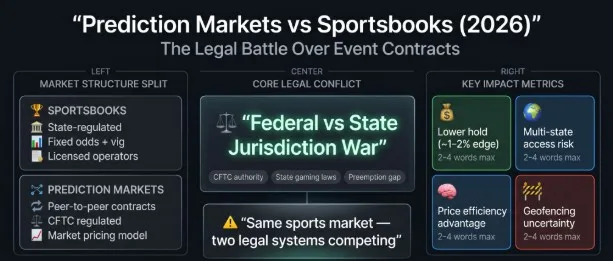
Prediction markets are platforms where users trade yes/no contracts on the outcome of future events — including sports contests. Instead of betting against a bookmaker at fixed odds, users buy and sell contracts at prices that reflect collective probability estimates, with each contract paying $1 if the outcome occurs and $0 if it doesn’t. Kalshi, the leading CFTC-regulated prediction market, is licensed as a Designated Contract Market — meaning it operates under federal commodities law rather than state gambling regulation.
This distinction is the source of everything: because Kalshi’s sports event contracts are classified as derivatives under the Commodity Exchange Act rather than wagers under state gambling law, Kalshi can legally offer sports markets in California, Texas, and other states where DraftKings and FanDuel cannot operate. The scale of this advantage is enormous — in January 2026 alone, Kalshi processed an estimated $9.1 billion in trading volume, with 91.1% tied directly to sports event contracts. That market reach, built on federal preemption rather than state-by-state licensing, is precisely what has state gaming regulators and established sportsbooks alarmed.
The State vs. Federal Jurisdictional War
In February 2026, the legal conflict reached a new intensity. The CFTC publicly declared it would defend its “exclusive jurisdiction” over event contracts, even as state regulators in Nevada, Massachusetts, and Tennessee pressed forward with enforcement actions against Kalshi — with divergent outcomes in federal and state courts. On February 19, 2026, a federal court in Tennessee sided with Kalshi, granting a preliminary injunction and finding that its sports event contracts are likely swaps subject to exclusive federal jurisdiction under the Commodity Exchange Act.
The contrasting outcomes across states highlight the core legal instability: different courts are reaching different conclusions on the same fundamental question. More than 30 states and Washington DC have filed amicus briefs supporting state authority, arguing that sports prediction markets should be treated as gambling subject to state regulation. Coinbase has filed lawsuits against Connecticut, Illinois, and Michigan challenging state actions that restrict sports-related event contracts. Traders on prediction markets themselves are pricing in a significant risk that Kalshi could be forced to geofence up to 15 states by year-end — which would reshape the platform’s volume and market position dramatically.
The Jurisdictional Preemption Gap: The Core of the Legal Fight
At the heart of this battle is what legal scholars call the “Jurisdictional Preemption Gap” — the space between what federal commodities law explicitly authorizes and what state gambling law has traditionally governed, and the question of which framework takes precedence when the two conflict. Stanford Law’s Joseph Grundfest articulated the structural distinction clearly in April 2026: “Prediction markets are functionally exchanges where buyers and sellers meet at a market-clearing price. They are not bookmakers because no one in the market is contractually obligated to take the other side. That distinction has legal and economic consequences.”
The Jurisdictional Preemption Gap matters for bettors because it determines which platform you can legally use in your state, and whether a platform you access today might be unavailable tomorrow.
States that lose their federal preemption arguments will be unable to enforce their gambling regulations against CFTC-licensed prediction markets — leaving established sportsbooks competing against a federally shielded rival that operates under lower tax burdens, different consumer protection rules, and a fundamentally different revenue model. The American Gaming Association has estimated that prediction markets captured over $600 million in tax revenue that would otherwise have flowed to state-regulated sportsbooks — a figure that gives state regulators powerful fiscal incentives to keep fighting.
What This Means for Bettors Using Both Platforms
For bettors navigating both regulated sportsbooks and prediction markets in 2026, the practical implications are significant. Prediction markets like Kalshi consistently offer tighter pricing than sportsbooks on liquid sports markets — typically a 1–2 percentage point edge on implied hold — because peer-to-peer contract pricing doesn’t require the same bookmaker margin that funds sportsbook operations. For high-volume bettors who have already developed a profitable edge, that pricing difference compounds meaningfully over a full season.
The risk is access stability. A platform you can use today under federal preemption arguments may be geofenced in your state if those legal arguments fail. Kalshi reported nearly $1.9 billion in college basketball wagers in February 2026 alone, demonstrating the scale of what’s at stake — but also the scale of the regulatory target on its back. Smart bettors in 2026 treat prediction market access as a complement to regulated sportsbook accounts, not a replacement — using platforms like Kalshi where pricing is sharper while maintaining accounts at DraftKings, FanDuel, and Pinnacle as stable, legally certain alternatives.
Smart Bet Insider: Covering Both Sides of the Market
The prediction market vs. sportsbook legal battle is moving fast — court rulings, state enforcement actions, and CFTC regulatory guidance are all shifting the access landscape in real time. Smart Bet Insider tracks every development, covering which platforms remain accessible in which states, how pricing compares across both market types, and what the legal trajectory means for bettors trying to build a stable, long-term wagering operation. The goal is not to pick a side in the legal argument — it is to make sure members always know where the value is and where they can legally access it.
From Kalshi’s federal preemption fight to DraftKings’ state-by-state market position, every piece of the landscape matters for bettors who bet seriously. Smart Bet Insider delivers that intelligence alongside the sharp weekly picks, line movement alerts, and platform analysis that members across every regulated and prediction market state rely on. Follow Smart Bet Insider today and stay fully informed on the most consequential legal battle in US sports betting.
The Outcome of This Fight Will Define US Sports Betting
The legal battle between prediction markets and state gaming regulators is not a niche regulatory dispute — it is a foundational question about who controls the future of US sports wagering and under what rules. If federal preemption arguments prevail, prediction markets will operate alongside regulated sportsbooks in every state with limited state-level oversight. If states succeed, the patchwork of restrictions will intensify and prediction market access will fragment state by state in the same way regulated sportsbooks have.
Smart Bet Insider tracks every ruling, regulatory development, and platform access change so members are never caught off guard by a shift in the legal landscape. Follow Smart Bet Insider now and make sure you always know where the value is, which platforms you can access, and how the 2026 legal battle over sports event contracts is reshaping the market you bet in.
FAQs
1. What is the difference between a prediction market and a sportsbook?
Sportsbooks let bettors wager against the house at bookmaker-set odds with built-in vig. Prediction markets are peer-to-peer exchanges where users trade yes/no contracts at prices reflecting collective probability estimates — no bookmaker takes the other side. This structural difference is the basis of Kalshi’s argument that its sports contracts are derivatives regulated by the CFTC, not gambling regulated by state gaming commissions.
2. Is Kalshi legal in my state?
Kalshi operates under CFTC regulation as a Designated Contract Market, arguing that federal law preempts state gambling restrictions. In practice, availability varies: federal courts in Tennessee have sided with Kalshi’s preemption argument, while states including Nevada and Massachusetts have pursued enforcement actions. Check Kalshi’s current availability map for your specific state, as the legal situation is evolving rapidly in 2026.
3. Can prediction markets offer better odds than sportsbooks?
Yes — on liquid markets, prediction market pricing typically carries 1–2 percentage points less implied hold than standard sportsbook lines. A disciplined bettor should compare prices at both venues before placing any bet. The pricing advantage is most pronounced in high-volume markets like NFL games and major tournaments where Kalshi’s order books are deepest.
4. Why are states fighting prediction markets so aggressively?
Fiscal incentives are the primary driver. State gaming regulators have estimated that prediction markets have captured over $600 million in tax revenue that would otherwise have flowed to licensed, tax-paying sportsbooks. States also argue that consumer protection rules, responsible gambling requirements, and integrity monitoring that apply to licensed sportsbooks should apply equally to platforms offering functionally equivalent sports wagering products.
5. What is the CFTC’s position on sports event contracts?
The CFTC has publicly declared it will defend its exclusive jurisdiction over event contracts, arguing that sports-related contracts structured as derivatives fall under the Commodity Exchange Act regardless of state gambling law. The CFTC’s regulatory framework gives federally licensed Designated Contract Markets like Kalshi a preemption argument that has succeeded in some federal courts in 2026.
6. Could the Supreme Court settle this dispute?
Potentially — the conflicting federal and state court rulings on Kalshi’s preemption arguments create exactly the kind of circuit split that can elevate a case to Supreme Court review. Legal observers at Holland & Knight have noted the deepening jurisdictional divide across courts as the most likely pathway to eventual Supreme Court consideration, though the timeline for that outcome remains uncertain.
7. Should I use prediction markets instead of sportsbooks for sports betting?
Use both where legally available. Prediction markets offer pricing advantages on liquid markets and access in states where sportsbooks are unavailable. Regulated sportsbooks offer promotional value, broader market variety, and legally stable access. The optimal approach is holding accounts on both types of platform and comparing prices before every bet — which is exactly the framework Smart Bet Insider’s picks are built around.