

Hockey Props Are the Market’s Best Kept Secret
NHL prop betting in 2026 remains one of the most underserved markets in all of sports wagering. While sportsbooks dedicate enormous modeling resources to NFL and NBA lines, hockey props — particularly player-level markets — are consistently priced with softer margins and less sharp engagement than comparable markets in other major sports. For bettors willing to learn the game’s structure, that gap represents genuine, repeatable value that most of the betting public never finds.
Smart Bet Insider was built for bettors who go where the market is weakest. With player prop analysis, game total frameworks, goaltender performance modeling, and line movement tracking across the full NHL season, Smart Bet Insider delivers the structured intelligence needed to profit from hockey’s most underpriced betting markets. Whether you’re new to NHL props or looking to sharpen a strategy that’s already working, this guide covers the 2026 season from the ice up.
Understanding NHL Prop Bet Types
NHL props fall into three main categories: player props, game props, and period props. Player props cover individual performance markets — shots on goal, points, goals, and assists for skaters, and saves or goals-allowed for goaltenders. Game props cover broader match-level outcomes such as total goals, whether the game goes to overtime, and which team scores first. Period props — bets on the outcome of a specific period rather than the full game — are a smaller but increasingly available market that carries unique value due to how line matching patterns shift across periods.
Understanding which category a bet belongs to matters because each requires a completely different research approach. Player props demand individual performance data, line combinations, and power play deployment tracking. Game props require team-level offensive and defensive metrics, goaltender form, and schedule context. Period props reward bettors who understand how teams manage game flow — some rosters are built to start fast, others to close strong, and those tendencies are rarely reflected accurately in period-level pricing at books like Betway, DraftKings, and FanDuel.
Why NHL Player Props Are Consistently Mispriced
Hockey’s scoring structure creates major challenges for sportsbook pricing models. Unlike basketball, NHL production is heavily driven by power-play usage, line deployment, and opponent defensive structure. A top-six forward on a weak power play has a very different offensive profile than a similar player on an elite man-advantage unit. Many sportsbooks still underprice these role-based differences, even though deployment and usage — not reputation alone — are what truly drive NHL prop value.
Shots on goal props remain one of the NHL’s most consistently mispriced markets. Shot volume is far more stable than goals or assists, yet sportsbooks still rely too heavily on season averages while underadjusting for matchup quality, shot suppression, line deployment, and venue effects. Natural Stat Trick and Hockey Reference provide the underlying Corsi, shot attempt, and expected goals data needed to identify when a shot total has been set materially above or below what the matchup context actually supports. Smart Bet Insider integrates both sources into every player prop breakdown it publishes.
Why Deployment Beats Talent in NHL Props
Talent vs Deployment: The Core Betting Mistake
One of the biggest mistakes recreational NHL bettors make is evaluating props based purely on player talent instead of player deployment. In hockey, opportunity drives production far more directly than reputation. A second-line winger temporarily promoted onto a team’s first power play unit can become a significantly better prop target than a star player stuck in a difficult matchup or losing offensive-zone usage. Sportsbooks often react slowly to these role changes, creating short windows where player props are still priced off season-long averages instead of current deployment reality.
Power Play Usage and Its Outsized Impact
Power play usage is especially important because PP1 players receive the highest-value offensive opportunities in hockey: more puck possession, higher-quality shot locations, and increased scoring chances. Tracking recent power play time-on-ice trends can reveal role increases before sportsbooks fully adjust their numbers, while monitoring live line combinations at Lineups.com helps identify players receiving top-line deployment due to injuries, coaching adjustments, or matchup-specific tactical decisions.
Why Sharp Bettors Focus on Deployment Signals
Sharp NHL prop bettors also pay close attention to offensive-zone start percentage and coaching deployment patterns, because coaches frequently shelter offensive players in favorable situations. Research into NHL pace and offensive structure further demonstrates how deployment and game context materially affect shot generation and scoring probability — meaning in NHL props, role changes create value faster than public perception, and often faster than sportsbook pricing models can react.
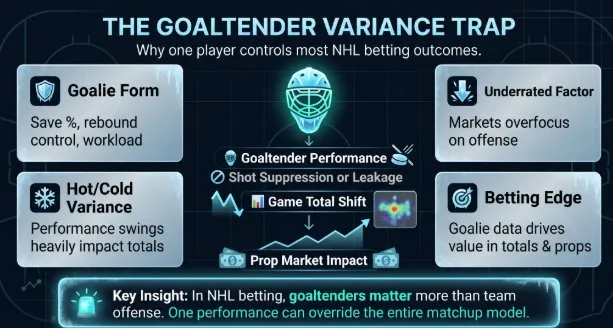
The Goaltender Variance Problem: Hockey’s Biggest Betting Trap
One of the most important structural realities of NHL betting — and one that most bettors underestimate — is how much goaltender variance affects game-level prop outcomes. A single elite goaltender performance can suppress a game total that was legitimately priced at six goals down to four, or a goaltender having a poor night can inflate a low-total matchup into a six-goal contest. What sharp bettors call the “Goaltender Variance Trap” is the tendency to research a game’s offensive matchup thoroughly while underweighting the single player most responsible for how many goals actually cross the line.
The practical implication is that game total props and first-goal markets should always be evaluated through a goaltender lens first. Current save percentage, high-danger save rate, recent workload, and back-to-back scheduling all materially affect how a goaltender is likely to perform — and these variables are frequently underweighted by sportsbook models that lean too heavily on team-level offensive and defensive averages. Tracking goaltender metrics on MoneyPuck gives you a real-time picture of who is genuinely performing above or below expectation, which is the most reliable leading indicator for game total and goaltender prop value across the 2026 season.
Reading NHL Game Props: Totals, Periods, and First Goal
NHL game totals are set within a narrow band — most games are priced at 5.5 or 6 goals — which means the margin for pricing error is small but the frequency of mispricing is higher than in sports with wider scoring distributions. The key variables that move a game total meaningfully are goaltender matchup quality, power play differential between the two teams, rest and travel schedule, and arena effects. Road teams playing the second game of a back-to-back against a rested home goaltender in a low-scoring arena represent a consistently lower-total profile that books are slow to fully price, particularly early in the weekly schedule when lines are first published.
First goal scorer props follow a similar logic to NFL touchdown props — the public gravitates toward the most famous offensive names, inflating their prices and leaving value on secondary scorers, power play specialists, and defensemen who take the ice on elite man-advantage units. Checking line combinations and power play deployment on Daily Faceoff before betting any first-goal or anytime-goal market is a one-step research habit that immediately separates your process from the public. Smart Bet Insider’s game prop breakdowns incorporate line combination data, power play efficiency, and goaltender form into every NHL total and first-goal recommendation.
Smart Bet Insider: Built for the NHL Market’s Blind Spots
The NHL prop market’s weakness is precisely where Smart Bet Insider is strongest. While recreational bettors focus on goals and points for the league’s biggest names, Smart Bet Insider’s analysis digs into shots on goal mismatches, goaltender variance signals, period-level team tendencies, and power play deployment patterns that the majority of sportsbook models underweight. This is not surface-level content — it is game-specific, matchup-driven intelligence built for bettors who want an edge that holds up across a full 82-game season.
Members receive pre-game NHL prop breakdowns covering player prop value picks, game total analysis, goaltender flags, and confidence-tiered recommendations across all major markets every game day. From October through the Stanley Cup Playoffs, Smart Bet Insider tracks the patterns the market misses and delivers them before the lines have moved. Follow Smart Bet Insider today and start approaching NHL props the way the sharpest hockey bettors in the market already do.
Conclusion: The NHL Prop Market Rewards the Prepared Bettor
NHL props in 2026 represent one of the clearest remaining edges in North American sports betting — a market where sportsbook models are thinner, public engagement is lower, and the research tools available to informed bettors are better than ever. Shots on goal mispricing, the Goaltender Variance Trap, period-level team tendencies, and power play deployment gaps all create consistent opportunities across a full season that the casual betting market never fully closes.
Smart Bet Insider delivers the analysis, alerts, and confidence-rated picks needed to act on those opportunities every game day — from opening night through Game 7 of the Stanley Cup Finals. The edge in NHL props is real, it is repeatable, and it belongs to the bettors who do the work. Follow Smart Bet Insider now and make every NHL prop bet count in 2026.
FAQs
1. What are the most popular NHL prop bet types?
The most widely available NHL player props are shots on goal, points, goals, and assists. Game props include total goals, overtime yes/no, and first goal scorer. Period props — betting on first, second, or third period outcomes individually — are growing in availability and represent some of the softest lines in the market due to lower public engagement.
2. Which sportsbooks offer the best NHL prop markets?
DraftKings and FanDuel offer the widest NHL prop variety for US-based bettors. Betway and Pinnacle are strong options for sharper lines and international markets. Use Oddschecker to compare props across books and identify where pricing gaps exist.
3. Why are shots on goal props considered good value in NHL betting?
Shot volume is significantly more stable game-to-game than goals or points, making it a more predictable betting surface. Because sportsbooks price shot totals primarily on season averages without fully adjusting for opponent shot suppression or line matchup context, the market regularly produces over/under lines that diverge from what the specific matchup data actually supports.
4. How does goaltender performance affect NHL prop betting?
Goaltender form is the single highest-impact variable in game total and first-goal markets. A goaltender running above expected save percentage can suppress totals significantly below their pre-game line, while a struggling goaltender inflates scoring outcomes. Always check current save rates and high-danger performance on MoneyPuck before betting any game total prop.
5. What research tools should I use for NHL prop analysis?
Natural Stat Trick for shot attempt and expected goals data, Hockey Reference for historical performance and matchup splits, Daily Faceoff for current line combinations and power play deployment, and MoneyPuck for goaltender performance metrics. These four sources cover the primary inputs needed to evaluate most NHL player and game props.
6. How does the NHL schedule affect prop betting?
Back-to-back games are one of the most reliable schedule-based edges in NHL betting. Teams playing the second night of a back-to-back, particularly on the road, show measurable declines in offensive output, shot volume, and goaltender performance. Books adjust for this but frequently underweight the compounding effect of travel distance and opponent rest advantage — especially in mid-season stretches with dense scheduling.
7. What bankroll strategy works best for NHL props?
A flat-stake model of 1–2% of total bankroll per bet is recommended for NHL props given the inherent variance of a low-scoring sport. Shots on goal props carry lower variance than goal or point markets and are better suited to slightly larger stakes within your model. Avoid over-betting game totals in goaltender-heavy matchups where a single performance outlier can swing the result regardless of how well the underlying research was done.