
Polymarket fees confuse new traders because the platform built its reputation on charging almost nothing, then added a fee structure as it grew. The headline still holds for most of what you do: Polymarket charges no deposit fee, no withdrawal fee, and nothing on your winnings. What it does charge is a small taker fee on certain trades, and the size depends on the market and how you place your order.
The real cost of trading on Polymarket is mostly not Polymarket. Third-party card processors, blockchain gas, and the order type you choose drive most of what you actually pay. Smart Bet Insider covers prediction markets and the mechanics that quietly eat into returns. The sections below break down every fee you might hit, which trades are free, and how to keep your costs near zero.
Maker vs Taker: The Fee That Actually Matters
Polymarket runs on a central limit order book, so your fee depends on whether you make liquidity or take it. Place a limit order that waits for someone to trade against it, and you are a maker. Click buy or sell at the current price, and you are a taker.
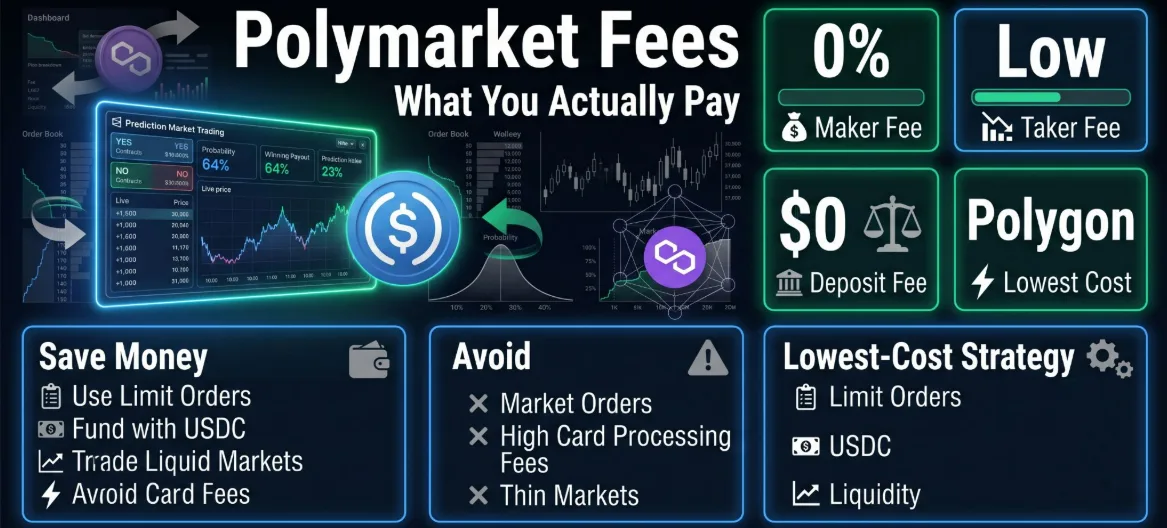
That distinction is the whole game. Per Polymarket’s documentation, maker orders pay zero trading fees. Taker orders pay a small fee that varies by market category, and sell orders are not charged a taker fee.
The fee is also dynamic. It peaks when a share trades near 50 cents, where uncertainty is highest, and shrinks toward zero as the price approaches 1 cent or 99 cents. A trade at the extremes can round down to no fee at all.
What Each Category Costs
Taker fees run by market category, and geopolitics markets carry no fee at all. The table below shows the approximate peak taker rates reported across categories in 2026, expressed per 100 shares traded.
| Category | Approx. peak taker fee (per 100 shares) |
| Geopolitics / world events | Free |
| Sports | $0.75 |
| Politics, finance, tech | $1.00 |
| Economics, culture, weather | $1.25 |
| Crypto | $1.80 |
Those are ceilings, not flat charges. Because the fee scales with how close the price sits to 50 cents, most real trades cost less than the peak. A position bought at 90 cents pays far less than the same trade at 50 cents.
For context, the fee is small compared to a traditional sportsbook. A sportsbook bakes a 5 to 10% vig into its odds, while a Polymarket taker fee on most categories stays well under that on a comparable position.
Deposits, Withdrawals, and Gas
Polymarket itself charges nothing to move money in or out. Per the Polymarket Help Center, there are no platform fees to deposit or withdraw, and winning shares always redeem at $1 with no cut taken.
The costs come from everywhere else. Funding with a debit or credit card through a provider like MoonPay carries a processing fee, often in the 3 to 4.5% range. Buying USDC on an exchange and sending it over the Polygon network instead avoids that markup almost entirely.
Gas is the other line item, and it is tiny. Polygon transactions typically cost under a cent, and Polymarket often subsidizes them through meta-transactions, so most traders pay nothing for on-chain activity. Bridging to Ethereum is the one exception, where gas can spike.
How to Keep Your Costs Near Zero
The cheapest way to trade Polymarket is mostly about discipline, not luck. Three habits do most of the work, and they stack.
Use limit orders. Maker orders pay zero trading fees, and on some categories you even collect a rebate funded by taker fees. The only tradeoff is patience, since a limit order may not fill right away.
Fund with USDC over Polygon and trade liquid markets. Depositing stablecoin directly skips the card-processor cut, and a deep, tight market keeps the spread, your real hidden cost, small. Smart Bet Insider tracks the prediction markets where trading stays cheap and the odds stay sharp. Check the analysis before you place a market order you did not need to.
Frequently Asked Questions
Does Polymarket charge trading fees?
Polymarket charges a taker fee on most market categories, while maker orders that add liquidity pay nothing. The taker fee varies by category, from free on geopolitics markets up to higher rates on crypto, and it scales with how close the price sits to 50 cents. Sell orders are not subject to the taker fee.
Are there deposit or withdrawal fees on Polymarket?
Polymarket does not charge any fee to deposit or withdraw funds, and it takes no cut of winning payouts. The costs you encounter come from third parties, such as card processors charging 3 to 4.5% or blockchain gas when moving funds. Depositing USDC over the Polygon network avoids almost all of these.
What is the difference between maker and taker fees on Polymarket?
A maker places a limit order that waits to be filled and pays zero trading fees, sometimes earning a rebate. A taker accepts an existing order at the current price and pays the category-based taker fee. Choosing limit orders over market orders is the single biggest way to cut your trading costs.
Why are some Polymarket markets free to trade?
Geopolitics and world events markets carry no taker fee at all, and Polymarket takes no profit from trading activity on them. Across other categories, the fee is dynamic and falls to nearly zero on trades priced near the 1 cent or 99 cent extremes. Maker orders remain free regardless of category.
How much does it cost to trade on Polymarket compared to a sportsbook?
Polymarket is generally cheaper than a traditional sportsbook for most trades. A sportsbook embeds a 5 to 10% vig into its odds, while Polymarket’s taker fees stay well below that on most categories and drop to zero for makers and geopolitics markets. The main hidden cost on Polymarket is the bid-ask spread in thin markets, not the fee itself.