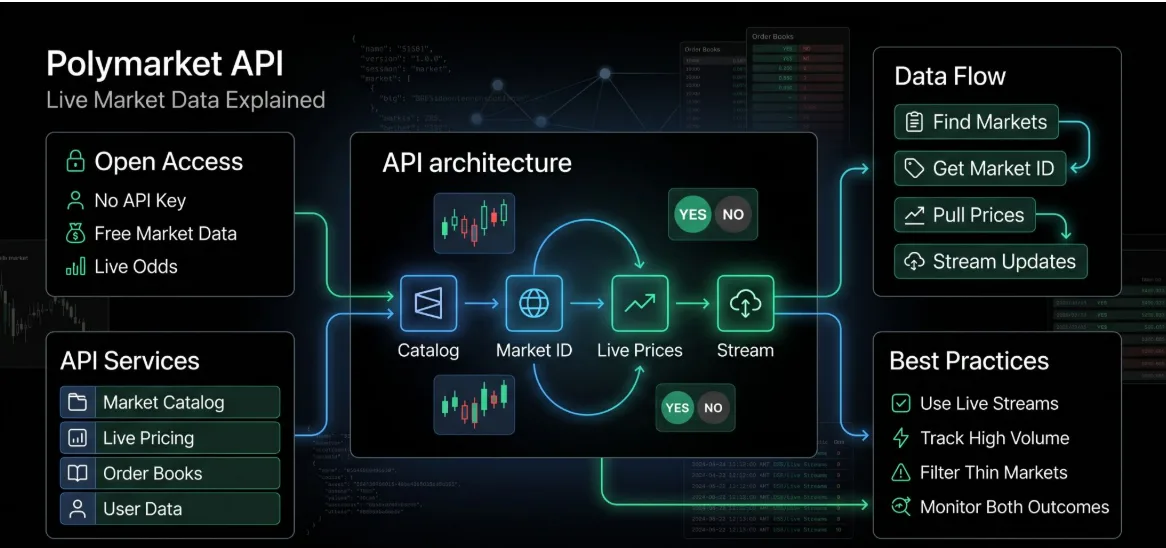
The Polymarket API spreads its data across several separate services, each answering a different question. Pulling live market data means knowing which one to ask. The part that surprises most people is how open it is, since reading prices, market lists, and order books takes no account, no wallet, and no key. The data is free to anyone who wants it.
That openness is why prediction-market odds show up in so many dashboards and news tickers. Smart Bet Insider works with this data daily and understands both what it offers and where it quietly misleads. The sections below explain how the data flows in plain terms, without assuming you write code.
What the Polymarket API Is
An API (Application Programming Interface) is a doorway that lets one program request data from another. Polymarket’s version hands out everything happening across its markets, the live odds, the trading volume, the outcomes on the move, in a format other software can read. Per Polymarket’s own documentation, the reading side stays fully public.
Picture the difference between watching a scoreboard and getting a live feed of every number behind it. A casual visitor sees the odds on the website. The API gives a developer those same odds as raw, structured data they can pour into an app, a chart, or an alert system. Reading any of it requires no permission, which is unusual for a platform handling real money.
The Different Services Behind the Data
Polymarket splits its data across separate services, each built for one job. One handles discovery, the catalog of which markets exist and what each one asks. Another handles live pricing, the current odds and the depth of buying and selling behind them. A third handles user history, tracking individual positions and past trades.
For pulling live market data, the first two do nearly all the work. The catalog tells you what is out there and what to call it, and the pricing service tells you what each outcome is worth right now. Keeping them apart is deliberate, since it lets the heavily used pricing data stay fast while the catalog absorbs broad browsing. A typical project taps the catalog to find a market, then the pricing service to follow it.
Finding a Market Comes First
Every data project starts with discovery, because you cannot track a price until you know how to point at the market. The catalog service returns the full list of active markets with their details: the question being asked, the closing date, the trading volume, and a set of identifiers the pricing service depends on. This is the entry point for any analytics tool.
The identifiers are the part that matters. Each market hands over a code the rest of the system uses to recognize it, and skipping that step is like looking up a stock price without knowing the ticker symbol. Once a project pulls that code from the catalog, every later request for that market’s odds keys off it. Discovery comes before pricing for exactly this reason.
Why Every Market Is Really Two Bets
The detail that confuses newcomers most is that a single yes-or-no market splits into two separate things under the hood. A market asking whether an event will happen carries one tradable side for yes and another for no, each with its own price and its own identifier. The two prices move in mirror image, since a rising chance of yes is a falling chance of no.
This matters the moment you try to show the odds. A tool that pulls only one side displays half the market and can leave a dashboard looking broken or lopsided. The data treats each outcome as its own line, with its own code and its own price. Once that clicks, the rest of the pricing flow falls into place.
A Snapshot Versus a Live Stream
Two ways exist to get prices, and the difference decides whether your data is fresh or stale. The simple way asks for the current price on demand and returns a snapshot frozen at the instant you asked. Ask again a minute later and a new snapshot comes back. This works for a quick check or a page that refreshes now and then.
Keeping prices genuinely live calls for the other method, a continuous connection that pushes every change the moment it lands. Instead of asking over and over, the project opens one steady link and the updates flow in on their own. Anything tracking a fast-moving market in real time, a live dashboard or a price alert, leans on that streaming connection, since repeated snapshots would bury the system in requests.
The Catch Most People Miss
Live data carries a quiet trap that has nothing to do with the technology. On thinly traded markets, the reported price may not reflect a real, active market at all. A market with little money moving through it can show a stale number, a leftover from a trade made hours ago rather than a live read on the odds. Building anything serious means filtering those quiet markets out.
The second trap is human. Prediction markets often move faster than the news, so by the time a headline breaks, the odds may have shifted hours earlier. A newcomer reads what looks like a slow reaction and jumps in, only to find the market already adjusted. The data is honest, but reading it well means checking whether a price is fresh and whether the move already happened.
What People Make Of It
The pieces add up to a simple flow: find a market in the catalog, follow its price through the pricing service, and stream the updates when speed matters. From that base, people build probability dashboards that sit beside other data, alert tools that fire when a market crosses a threshold, and trackers that follow positions and volume over a season. Journalists and researchers pull the odds as a real-time read on public expectation.
Smart Bet Insider tracks prediction-market data and what it signals about where the crowd expects events to land. Check the analysis when you want the meaning behind the numbers a feed like this pulls.
Frequently Asked Questions
Is the Polymarket API free to use?
Reading Polymarket market data is free and requires no account or wallet. The market catalog and live pricing are fully public, so anyone can pull current odds, volumes, and order books at no cost. Only placing actual trades requires sign-in and a funded wallet.
Do you need a Polymarket account to pull market data?
No account is needed to read market data. Pricing, market listings, and order books stay open to anyone, which is why prediction-market odds appear in so many third-party dashboards and news tickers. An account and wallet come into play only when you place or manage trades.
Why does a single Polymarket market have two prices?
A yes-or-no market splits into two separate tradable outcomes, one for yes and one for no, each with its own price. The two move in mirror image, since a higher chance of one means a lower chance of the other. Tools that track only one side end up showing half the market.
How do you get live updating odds instead of a fixed number?
Live updating odds come from a continuous streaming connection rather than repeated one-off requests. The connection pushes each price change as it happens, which keeps a dashboard or alert current without constantly re-asking. A single on-demand request returns only a snapshot frozen at that moment.
Can the Polymarket API show inaccurate prices?
The data can mislead on thinly traded markets, where a reported price may be a stale leftover from the last trade rather than a live read. Low-volume markets are the main culprit, so any serious tool filters them out. Prices on active, high-volume markets reflect the real odds far more reliably.