
MLB underdog betting strategy rests on a quirk baseball has that most sports don’t: the moneyline asks the dog to win the game, nothing more. There is no point spread to clear, no margin to cover. A +140 underdog that wins by one run pays exactly the same as one that wins by ten.
That simplicity hides where the real money is made and lost. Backing dogs blindly drains a bankroll, but specific spots have turned a profit across decades of baseball. Smart Bet Insider breaks down which underdog situations hold up over a full season and which ones only look good on a hot week. The patterns below separate the structural edges from the noise.
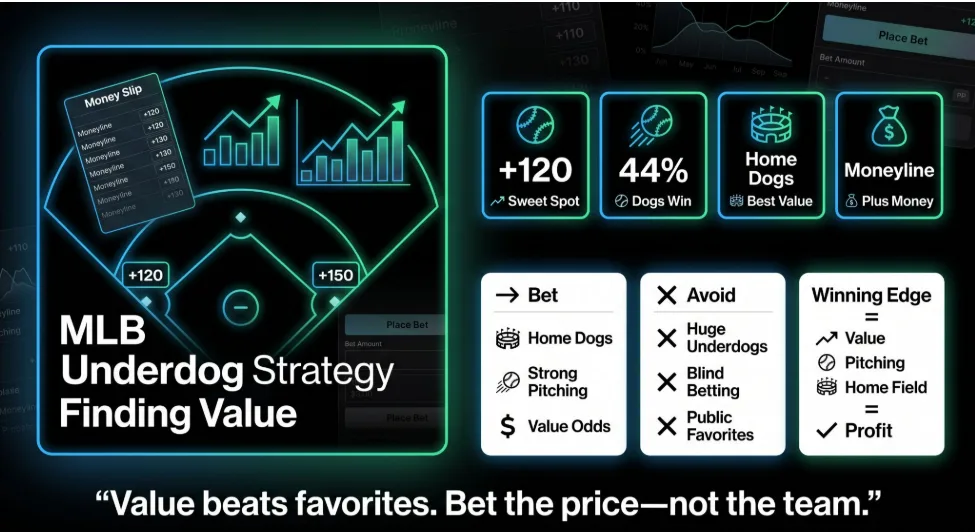
The Public Overbets Favorites, and the Line Pays for It
Underdog value starts with where the public puts its money. Casual bettors back the team that should win, which forces books to shade favorite prices past their true probability. A team installed at -180 might carry a real win chance closer to 60 percent than the 64 percent the line implies, and the public hammers it anyway.
That shading leaves the dog overpriced in the bettor’s favor. The other side of an inflated favorite is an underdog getting more plus-money than its chances deserve. Backing the dog is not contrarian for its own sake, it is collecting the value the public hands over every time it piles onto the obvious side.
You Can Lose Most of Your Bets and Still Profit
The math of plus-money is the whole reason dog betting works. MLB underdogs win roughly four of every nine games, about 44 percent, a number that would bankrupt a spread bettor. On the moneyline it does the opposite, because each win pays more than each loss costs.
A simple example shows it. Nine underdogs at an average of +130, betting $100 each, risks $900 total. Winning just four of those nine grosses $520 against $500 in losses, a profit on a sub-.500 record. The plus price means the break-even win rate sits near 45 percent, not 50, which is why a losing record can still close the season in the black.
Home Dogs Are Where the Edge Concentrates
Not all underdogs are equal, and the venue splits them sharply. Home underdogs of +120 or longer have produced positive ROI in 14 of the past 20 seasons, the cleanest standing edge in baseball betting. Road dogs over the same span land closer to break-even.
The reason is concrete advantage, not luck. A home underdog bats last, which matters in any tied late-inning game, and it knows its own park, from the wall heights to the bullpen entrances. Baseball is also the rare sport where home field is undervalued by the public, since the last at-bat is a tangible edge the crowd noise narrative tends to ignore. The home dog stacks a real advantage on top of an inflated price.
The Starting Pitcher Decides More Than the Record
Pitching drives an MLB line further than any team’s win-loss record. An ace at home in a park that suppresses offense can flip a team from underdog to favorite, and the public often assumes the line already accounts for every starter’s recent form. It usually does not.
The edge lives in the lag. A starter whose strikeout rate, walk rate, or velocity has shifted recently may be priced on last month’s numbers, leaving a dog with a quality arm undervalued against an average opponent. Home underdogs whose starter carries an ERA under 4.00 against a weaker road starter have shown ROI in the 3 to 5 percent range. The matchup matters more than the name on the front of the jersey.
Where the Dog Stops Holding Up
The strategy breaks the moment it turns into betting every dog on the board. Blanket underdog betting is a losing approach, and the biggest moneyline dogs are the worst offenders, since small underdogs have historically been more profitable than huge ones. A +250 dog wins rarely enough that the long price still does not cover the losses.
Road dogs are the other soft spot. Without the last at-bat or park familiarity, a road underdog has to overcome travel and unfamiliarity, which drags its long-term return toward zero. The edge that holds up is narrow and specific: home dogs in a reasonable plus-money range with a real pitching case, not a scattershot fade of every favorite.
Building the Underdog Edge Into a System
A sound underdog strategy filters hard and bets flat. Start with home dogs at +120 or longer, layer in a starting-pitcher matchup the line has not fully priced, and skip the giant moneyline numbers that look tempting and pay nothing over time. Flat unit sizing keeps the variance survivable, since even a profitable approach loses 35 to 40 percent of its bets and a long cold streak is a certainty across 162 games.
Smart Bet Insider tracks home-dog spots, pitching mismatches, and the games where the public has shaded a favorite past fair value all season long. Check the analysis before you back a dog the price has already turned against.
Frequently Asked Questions
Are MLB underdogs profitable to bet?
MLB underdogs are profitable only in specific spots, not as a blanket strategy. Home underdogs of +120 or longer have produced positive ROI in 14 of the past 20 seasons, while road dogs and giant moneyline underdogs run closer to break-even or worse. The edge comes from selective home-dog betting with a pitching case, not from fading every favorite.
Why can you bet underdogs and still profit with a losing record?
Plus-money odds let you win less than half your bets and still turn a profit. MLB underdogs win about 44 percent of games, but each win at a price like +130 pays more than each loss costs, dropping the break-even win rate to roughly 45 percent. A sub-.500 record on dogs can finish a season in the black.
Are home or road underdogs the better bet in MLB?
Home underdogs are the stronger bet by a clear margin. They bat last, know their own park, and benefit from home-field advantage the public tends to undervalue, which is why home dogs of +120 or longer have been profitable in 14 of the past 20 seasons. Road dogs lack those advantages and have historically been close to break-even.
How important is the starting pitcher when betting MLB underdogs?
The starting pitcher is the single biggest factor in an MLB line and the key to most underdog value. A dog with a quality starter, an ERA under 4.00, facing an average road starter has shown ROI in the 3 to 5 percent range. Lines often lag recent changes in a pitcher’s strikeout rate, walk rate, or velocity, leaving those dogs underpriced.
Should you bet big moneyline underdogs in MLB?
Big moneyline underdogs are generally a poor bet despite their tempting payouts. Small underdogs have historically been more profitable than large ones, because a +250 dog wins too rarely for even the long price to cover the losses. The most reliable underdog value sits in the +120 to +150 range rather than the longshots.